Seller Financing on MLS: How to Find and Structure Deals
Discover how to find and structure seller financing deals on MLS, allowing you to bypass traditional lenders for smoother property purchases.
Seller Financing on MLS: How to Find and Structure Deals

Seller financing on MLS means the listing signals that the property owner will act as the bank, collecting your down payment and monthly note instead of sending you to a mortgage lender. It’s rare, but the payoff can be real: a seller who owns free and clear can carry paper without triggering a due-on-sale clause, while a seller who still has a mortgage cannot legally do that without lender consent. Before you draft an offer, verify title status and check for loan-originator exposure.
A few signals tell you it’s worth a closer look:
- Public remarks or agent notes mention “owner will carry,” “seller financing available,” or “contract for deed.”
- The property has sat on the market well past average days-on-market for the area.
- The listing agent confirms, when asked directly, that the seller owns the home outright.
The RESO Data Dictionary actually lists “Seller Financing” as a standard value inside its Buyer Financing field, with an example population rate of a measurable share, proof that this isn’t some fringe workaround. It’s a recognized transaction type your MLS already has a place for, even if most agents never check that box.
Key Takeaways
Seller financing on MLS works when the seller owns the property free and clear, the paperwork matches term-for-term, and both sides verify title before signing anything.
| Point | Details |
|---|---|
| Rare but real | The RESO Data Dictionary recognizes seller financing as a standard MLS field, even though few agents use it. |
| Verify title first | Confirm the seller owns free and clear before assuming they can legally carry a note without triggering due-on-sale. |
| Watch loan-originator rules | Financing more than a few deals a year can trigger federal Regulation Z licensing requirements. |
| Match your documents | The promissory note and security instrument must align on every term to hold up in enforcement. |
| Search by keyword, not filter | Use terms like “owner will carry” and “contract for deed” since most MLS systems lack a dedicated checkbox. |
| Automate the outreach | SendMLS helps investors send state-approved offers fast and track when listing agents open them. |
Table of Contents
- What Does Seller Financing Mean on an MLS Listing?
- What Types of Seller Financing Show Up on MLS Listings?
- Is Seller Financing a Good Idea for Buyers and Sellers?
- What Legal Rules Apply to Seller Financing in the U.S.?
- How Do You Find Seller-Financed Listings on MLS?
- How Do You Structure the Terms of a Seller-Financed Deal?
- What Documents Do You Need to Close a Seller-Financed Deal?
- What Red Flags Should You Watch for Before Signing?
- How Experienced Investors Actually Work These Deals
- Speed Up Your Seller-Financing Offers Without Cutting Corners
- Where to Verify Seller-Financing Rules and Terms
- Frequently Asked Questions About Seller Financing on MLS
- Sources
What Does Seller Financing Mean on an MLS Listing?
Owner financing, sometimes called seller financing or “owner will carry,” is a deal where the seller extends credit to the buyer instead of a bank doing it. You sign a promissory note and a security instrument, then send payments directly to the seller (or a servicer) rather than to a mortgage company. It shows up on the MLS in a handful of predictable spots: agent remarks, public remarks, or occasionally a financing-terms field if your regional MLS supports one.
Most standard, mortgage-ready listings won’t mention it because there’s no reason to. You’ll see it surface most often in three situations:
- Investors buying rental houses from landlords who want ongoing income instead of a lump sum.
- Retiring owners of paid-off homes who prefer installment income over a single sale price hit.
- Buyers who don’t qualify for a conventional mortgage but can make a solid case for consistent payments.
What Types of Seller Financing Show Up on MLS Listings?
Sellers structure owner financing several different ways, and each carries its own legal mechanics.
- Purchase-money mortgage or deed of trust: the seller holds a standard lien; default triggers foreclosure, judicial or non-judicial depending on the state.
- Contract for deed (land contract): the seller keeps legal title until the loan is paid off, which speeds up eviction-style remedies for the seller but leaves buyers with weaker protections.
- Lease-option: buyer rents with a right to purchase later; less binding than a sale, more flexible for sellers testing the waters.
- Wraparound mortgage: the seller’s existing loan stays in place and the buyer’s payment wraps around it, a structure that leans directly into due-on-sale risk.
In MLS data, expect these terms buried in agent remarks rather than a dedicated dropdown.
Is Seller Financing a Good Idea for Buyers and Sellers?
For buyers, owner financing means faster closings, underwriting that isn’t tied to a FICO score, and sometimes better terms if the seller wants speed over price. For sellers, it means steady monthly income, a broader buyer pool, and often a higher effective sale price than a cash buyer would offer.
The trade-offs cut both ways. Buyers usually pay a higher interest rate than a bank would charge, and many deals carry a balloon payment that forces a refinance in five to ten years. Sellers take on collection risk and, if they still owe a mortgage, expose themselves to due-on-sale enforcement. A deal makes sense when the numbers pencil out for both sides after pricing in that risk. It doesn’t make sense when a seller is stretching to make a shaky property look financeable.
What Legal Rules Apply to Seller Financing in the U.S.?
Federal rules can treat a seller who finances properties regularly as a loan originator, which pulls in Regulation Z and Truth in Lending obligations unless a narrow exemption applies. That single fact kills more DIY seller-financing plans than any pricing disagreement ever does.
The CFPB’s loan-originator compensation rules define when someone crosses from “seller who financed one house” into “unlicensed lender.” If you plan to carry paper on more than a handful of deals a year, Dodd-Frank and Regulation Z exemptions narrow fast, and you should treat the activity like a lending business, not a side favor to a buyer.
Then there’s due-on-sale. Under 12 USC 1701j-3, a lender can demand full repayment the moment title transfers if the seller still owes money on the property. Confirm free-and-clear ownership before you assume a seller can legally carry the note.
State guidance adds another layer. Texas, for example, requires the TREC seller-financing addendum, which mandates buyer credit documentation and tax/insurance escrow options, while explicitly reminding brokers they cannot give legal advice on structuring the deal.
- Confirm the seller owns the property free and clear, or has written lender consent to finance a sale.
- Ask a local real estate attorney whether your deal structure triggers loan-originator licensing.
- Use a title or escrow company for closing regardless of how informal the deal feels.
Pro Tip: Ask your MLS support desk whether agents in your region are permitted to reference seller-financing terms in public remarks. Some MLS boards restrict this language to agent-only fields, and missing that distinction wastes searches.
How Do You Find Seller-Financed Listings on MLS?
Since most MLS systems lack a dedicated seller-financing checkbox, you find these deals with keyword searches and direct outreach, not filters.
Start with saved searches using strings like “owner will carry,” “seller financing,” “owner financing,” “land contract,” and “contract for deed” across both public and agent remarks. Run them weekly since these listings get scooped up fast once word gets out.
When you reach a listing agent, ask direct questions: Does the seller still carry a mortgage? Would they consider a first lien or only a second position behind existing debt? What structure do they have in mind, amortized, interest-only, or balloon? Their answers tell you in under two minutes whether the deal is even viable.
Off-MLS, pull county deed and mortgage records to confirm what the seller actually owes before you waste time negotiating terms they can’t legally offer. Pair that with traditional outreach, driving for dollars, direct mail to absentee owners, and a short buyer resume that shows proof of funds and payment history builds trust fast with a seller who’s never done this before.
Pro Tip: If your MLS has no seller-financing field, build the workflow around automated saved searches for your keyword list, then route hits straight into your outreach queue so you’re not the fifth investor to call.
How Do You Structure the Terms of a Seller-Financed Deal?
Most owner-financed deals start with a down payment between 10% and 20%, an interest rate benchmarked against current mortgage rates or the IRS Applicable Federal Rate, and amortization spread over 20 to 30 years with a balloon due in five to ten years, patterns confirmed by Zillow’s overview of seller financing.
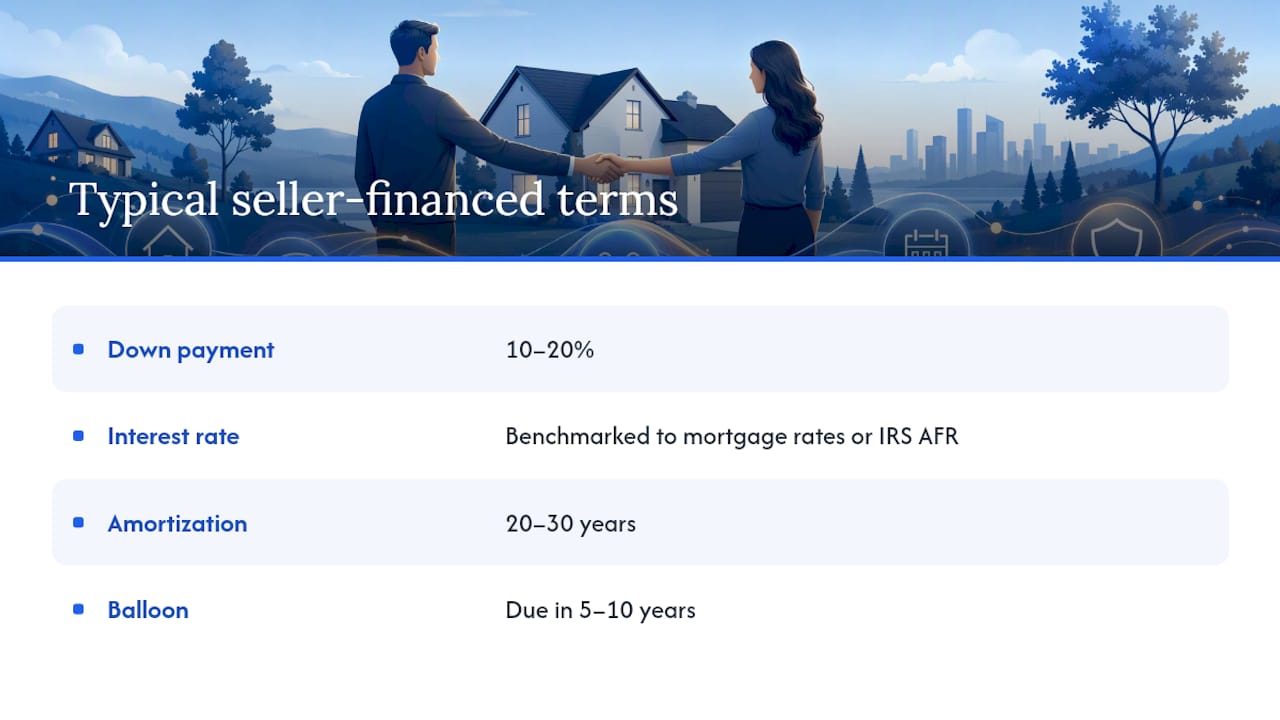
Which variables you push depends on what the seller actually needs. A seller who wants monthly income will accept a lower rate for a longer term. A seller who wants to cash out soon will push for a shorter balloon, even if that means a lower purchase price.
Common trade points: sellers often accept a smaller down payment in exchange for a higher rate, or agree to escrow taxes and insurance in exchange for a shorter balloon that gets them to their exit faster.
What Documents Do You Need to Close a Seller-Financed Deal?
Two documents form the backbone of any owner-financed sale: the promissory note and the security instrument, either a mortgage or deed of trust. Every number between them has to match exactly, since mismatched terms are a leading cause of enforcement failures down the road.
Beyond those two, expect a seller-financing addendum attached to the purchase agreement, a title search with title insurance, and escrow instructions covering the down payment and, often, ongoing tax and insurance payments. Standard templates from eForms and other form providers cover the same core structures.
At closing, the deed and lien get notarized and recorded with the county, the down payment changes hands, and someone, the seller or a third-party servicer, takes over collecting monthly payments going forward.
What Red Flags Should You Watch for Before Signing?
Verify the title is clear (or that the existing lender has consented to the sale), pull a current title report, and confirm property taxes and insurance are current before you sign anything.

Red flags that should stop you cold: a seller who’s still heavily mortgaged and can’t explain how they’ll avoid due-on-sale enforcement, gaps in the title chain, recent liens or tax delinquencies, or a seller who refuses to use a title or escrow company. On the document side, watch for numbers that don’t match between the note and the security instrument, a missing acceleration clause, or vague language around who pays taxes and insurance.
How Experienced Investors Actually Work These Deals
Teams that do this regularly verify title and mortgage status before they ever discuss terms, because a seller who’s underwater can’t legally carry paper no matter how good the conversation sounds.
The workflow: run MLS keyword searches, confirm free-and-clear status through county records, prep a buyer resume and sample note, submit the offer, then hand off to title and escrow for closing. Before signing anything, decide who handles servicing and bookkeeping if you end up holding the paper long term.
Speed Up Your Seller-Financing Offers Without Cutting Corners
Finding a seller-financed listing is only half the battle. Getting your offer in front of the listing agent fast, formatted correctly, matters just as much when these deals move quickly once word gets out. SendMLS is built for investors who need volume without the manual grind of typing contracts one at a time.
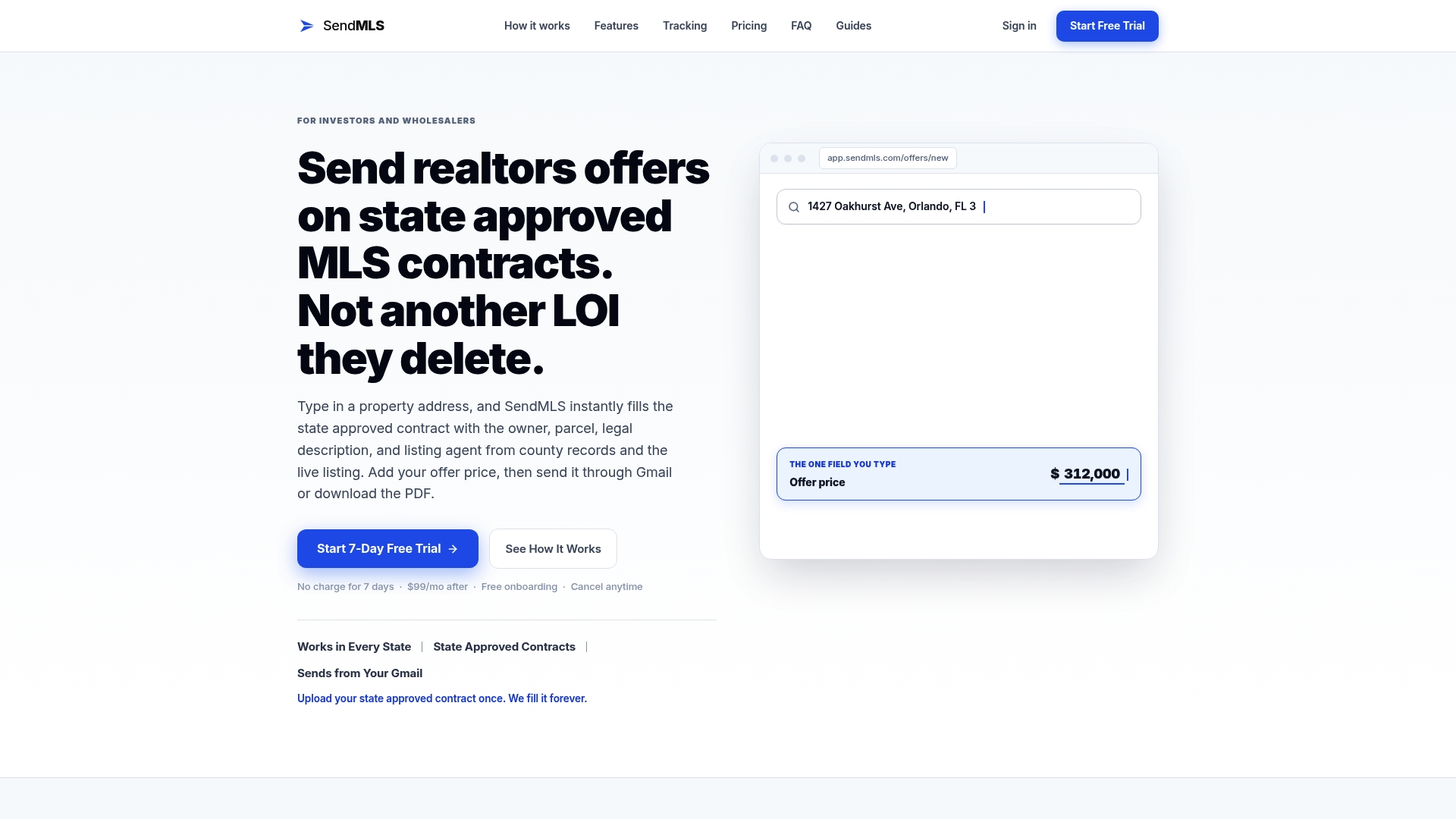
SendMLS auto-populates state-approved contracts with property details pulled from county and MLS data, so you’re not retyping addresses and legal descriptions into a template at midnight. Offers send straight from your Gmail, landing as real paperwork rather than a text an agent scrolls past, and open tracking tells you the moment an agent views your offer so you know exactly when to follow up. None of this replaces a real estate attorney reviewing your note and security instrument, or a title company running the search, it’s a tool for getting more qualified offers out the door faster, not a substitute for legal work. Start a 7 day free trial and see how many seller-financed listings you can reach before your next open house.
Where to Verify Seller-Financing Rules and Terms
Before you sign anything, run your deal past a few authoritative sources, in this order: an attorney first, then title and escrow, then your broker for MLS-specific practice questions.
- Federal rules: the CFPB’s Regulation Z guidance on loan-originator status, and IRS Form 6252 for installment-sale tax reporting.
- Due-on-sale statute: 12 USC 1701j-3 governs when a lender can call a loan due after a title transfer.
- State model forms: the TREC seller-financing addendum shows the credit-documentation and escrow language conservative title companies expect.
- Template sources: eForms and similar providers publish standard addendum structures you can bring to your attorney for review.
Frequently Asked Questions About Seller Financing on MLS
How do you find seller financing options on MLS listings? Run saved keyword searches across public and agent remarks using terms like “owner will carry,” “seller financing,” and “contract for deed,” since most MLS systems don’t offer a dedicated filter for it.
What is an owner-financing addendum? It’s a document attached to the purchase agreement that spells out the loan terms, down payment, interest rate, and amortization schedule the seller and buyer agreed to, distinct from the promissory note and security instrument that actually create the debt.
Are MLS listings with seller finance legal in every state? Seller financing itself is legal nationwide, but state rules on required disclosures and broker involvement vary, and federal loan-originator rules can apply depending on how many deals a seller finances per year.
How do I know if a seller can legally offer financing? Check county deed and mortgage records to confirm the seller owns the property free and clear, or get written proof their existing lender consents to the sale, since an outstanding mortgage usually means due-on-sale risk.
What are the biggest advantages of seller financing for investors? Faster closings, underwriting that doesn’t depend on a bank’s credit box, and access to deals that never reach conventional buyers because the property doesn’t qualify for standard mortgage financing.
Sources
- Buyer Financing - Property - RESO Data Dictionary
- How to owner finance a house: rules, docs and taxes | LegalClarity
- Loan originator compensation requirements under Truth in Lending Act (Regulation Z) | CFPB
- What Is Seller Financing and How Does It Work? | Zillow
- TREC seller-financing addendum (TREC No. 26-8)