PropStream Alternatives for Wholesalers: Send, Track, Scale
Discover top PropStream alternatives for wholesalers. Scale your MLS workflows with tools like SendMLS and SkySlope Offers today!
PropStream Alternatives for Wholesalers: Send, Track, Scale

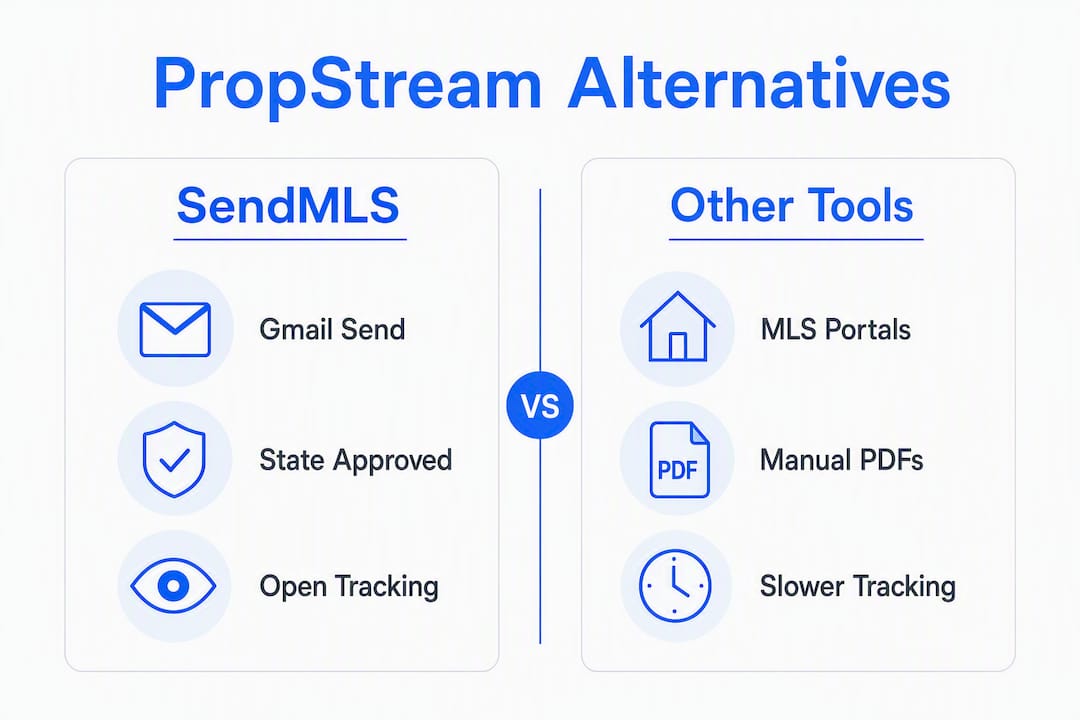
For high-volume MLS offer workflows, the tools that actually move the needle are SendMLS (Gmail-send with state-approved auto-fill and open-tracking), SkySlope Offers (MLS-native agent workflows), ShowingTime Offer Manager (portal-based with instant agent notifications), Dotloop (transaction management with forms), zipForm (state forms library), TransactionDesk (broker-integrated forms), and DocuSign with templates (signing infrastructure with custom contract templates).
Quick profile matches: solo wholesalers and land investors running volume plays get the most from SendMLS; agent-facing teams working inside MLS ecosystems fit SkySlope Offers or ShowingTime; compliance-heavy brokerages lean on TransactionDesk or zipForm; and investors who already have a signing workflow but need template speed can bolt DocuSign onto their existing stack.
Start with a 7-day pilot on one live MLS listing before committing to any platform.
Table of Contents
- Which PropStream alternatives actually compare on the features that matter?
- How to choose the right PropStream alternative: decision criteria and vendor questions
- Exactly how each alternative sends offers, and why the method matters
- How to keep automated offers “clean” — preflight checklist and follow-up timing
- Typical setup timeline and pricing to move from VA workflows to automated sends
- Which alternative should you pick by buyer profile?
- Key Takeaways
- What most wholesalers get wrong about MLS offer software
- SendMLS gives volume-offer investors a faster path to “yes”
Which PropStream alternatives actually compare on the features that matter?
| Platform | Best for | How offers are sent | State-approved forms | Open-tracking | Bulk sends | Team seats | MLS integration | Trial available |
|---|---|---|---|---|---|---|---|---|
| SendMLS | Solo wholesalers, land investors, small teams | Gmail direct | Yes, auto-filled | Yes, real-time | Yes | Yes, multi-seat | MLS-friendly | 7-day free trial |
| SkySlope Offers | Agent-facing teams, brokerages | MLS portal | Via SkySlope Forms | Yes, within ecosystem | Limited | Yes | Deep MLS integration | Contact vendor |
| ShowingTime Offer Manager | Listing agents, buyer agents | MLS portal | MLS-standard forms | Yes, instant alerts | Limited | Yes | Native MLS | MLS-dependent |
| Dotloop | Small teams, agents | Portal/PDF | State forms via library | Limited | No | Yes | Partial | Free tier available |
| zipForm | Brokerages, licensed agents | PDF/portal | Comprehensive state library | No | No | Yes | Partial | Via association |
| TransactionDesk | Broker-integrated teams | PDF/portal | State forms | No | No | Yes | Broker-level | Via broker |
| DocuSign + templates | Any investor with existing workflow | Email/portal | Custom templates only | Limited | No | Yes | Via API | 30-day trial |
Pros and cons at a glance:
- SendMLS: Contracts auto-fill from MLS/county data, send from your Gmail, open-tracking fires the moment an agent views the offer. No agent license required. The gap: it’s built for investors, not for agents managing listing-side workflows.
- SkySlope Offers: Automatically creates an offer file when a listing posts and notifies users when offers come in. Strong for brokerages. Weak for investors who want Gmail-style personal delivery.
- ShowingTime Offer Manager: Agents see offers the instant they arrive. Transparent for the listing side. Investors submitting through it have no control over the send experience.
- Dotloop: Clean transaction management, decent forms library, but no bulk-send capability and open-tracking is minimal.
- zipForm / TransactionDesk: Deep state forms coverage. Both are built for licensed agents inside broker systems, not for investors sending 50 offers a week independently.
- DocuSign + templates: Flexible and widely trusted. Requires manual template setup per state, no auto-fill from MLS data, and open-tracking depends on envelope settings.
Pro Tip: Run a sample bulk send of 10 offers during any free trial. Check per-send timestamps and open receipts. If the platform can’t show you an audit log at that volume, it won’t hold up at 100 offers a week.
How to choose the right PropStream alternative: decision criteria and vendor questions
Volume throughput is the first filter. If you’re sending 20+ offers a month, any platform that requires manual PDF export per offer will become your bottleneck within two weeks.
Eight questions to ask before you commit:
- Can the platform auto-fill my state’s approved purchase contract from MLS or county data?
- How is open-tracking logged — what metadata is captured (timestamp, IP, device)?
- Does the offer send from my personal Gmail or from a platform domain?
- What’s the maximum number of offers I can send in a single batch?
- Can each team member send from their own email with centralized admin visibility?
- How does the platform handle non-standard inputs like multi-parcel addresses or HOA addenda?
- What happens if a state form is updated — how quickly does the library refresh?
- Is there a dedicated onboarding contact, or is support ticket-only?
Red flags during demos: no native forms library (meaning you’re uploading custom PDFs every time), open-tracking that only logs “delivered” not “viewed,” no admin dashboard showing all team sends in one place, and per-offer pricing that makes bulk sends prohibitively expensive. Agents are required to present offers, but they filter aggressively for professionalism first — a platform that produces sloppy contracts removes you from consideration before the agent even reads the price.
Exactly how each alternative sends offers, and why the method matters
There are three send styles in practice, and they produce very different outcomes.
Gmail direct (SendMLS model): The offer lands in the agent’s inbox as a real email from a real person, with a state-approved contract attached. Open-tracking fires the moment the agent clicks. You know within seconds whether your offer has been seen. This is the fastest path from “I found a listing” to “the agent has my paperwork.”

MLS portal / offer manager (SkySlope, ShowingTime): Offers submit through the MLS interface and the listing agent gets a portal notification. Agents are notified the moment an offer is viewed, which is useful for the listing side. For investors, the trade-off is loss of personal delivery — your offer sits in a queue with every other submission, and you have no control over the email experience.
Portal/PDF attachment (Dotloop, zipForm, DocuSign): You generate a PDF, upload it to a portal or attach it to an email manually. Compliance is solid when forms are correct. Speed is not. Bulk sending at volume means your VA is uploading files one at a time, which is exactly the workflow you’re trying to replace.
Workflow sequence for Gmail-send:
- Pull aged MLS listing (90+ days on market)
- Platform auto-fills state contract with property address, county, and offer terms
- Send directly from Gmail with one click
- Open-tracking notifies you the moment the agent views it
- Call or text within 15 minutes of the open notification
Workflow sequence for MLS portal:
- Submit offer through portal interface
- Agent receives portal notification
- Follow up by phone 24 hours later if no response
Pro Tip: Gmail-send works best on aged inventory where the listing agent is already frustrated. A personal email with a real contract attached reads differently than a portal ping. Use MLS-native tools when the agent specifically requests portal submission or when your broker requires it.
How to keep automated offers “clean” — preflight checklist and follow-up timing
Software scales your volume. It also scales your mistakes. One bad template sent 80 times is 80 rejections.
Preflight checklist before any bulk send:
- County name matches the property address (wrong county is an immediate disqualifier)
- Legal description pulled from the correct parcel record
- Earnest money deposit reflects local norms (typically 1% of offer price for on-market deals)
- 7-day inspection contingency included — agents expect it on investor offers
- Proof of funds attached or ready to send on request
- Assignment language reviewed: standard “and/or assigns” language triggers immediate skepticism from experienced agents; novation or double-close language is cleaner
- Closing date is realistic (30–45 days, not 7)
The discovery call is not optional. A scripted 5–7 question framework that uncovers seller motivation and signals that you’re a principal buyer materially increases the chance your automated offer gets presented. Call before you send, or at minimum the same day.
Open-tracking is only useful when you act on it fast. The moment-of-open is your best window. A one-line follow-up text — “Hey [agent name], just wanted to make sure my offer on [address] came through clearly — happy to answer any questions” — sent within 15 minutes of the open notification outperforms any follow-up sent cold the next day.
Pro Tip: Position yourself as a cash principal buyer on the discovery call before the offer arrives. Agents who already know you’re a real buyer treat the automated contract as confirmation, not as spam.
Typical setup timeline and pricing to move from VA workflows to automated sends
Day 0–7 (pilot week):
- Sign up for a trial, connect Gmail, run 5–10 test sends on real listings
- Verify state form accuracy against your state’s current approved contract
- Check open-tracking receipts and audit log
Week 2–3:
- Map edge cases: multi-parcel addresses, HOA addenda, unique county forms
- Provision team seats if applicable; set admin permissions
- Run first bulk batch (20–30 offers) and review timestamps
Month 1:
- Ramp to full volume; confirm broker/MLS compliance with your agent or attorney
- Retire VA contract-typing tasks; redirect VA to follow-up calls
Pricing shapes to compare: per-user monthly subscriptions (most common), per-send fees (watch for these at volume — they compound fast), forms-library access fees (some platforms charge separately), and enterprise throughput tiers for teams sending 200+ offers a month.
A straightforward ROI comparison: a VA handling contract typing at $900/month produces roughly 60–80 offers monthly with a meaningful error rate on county data and closing dates. A subscription platform at a fraction of that cost can handle the same volume with consistent form accuracy, and the time you recover goes back into sourcing and follow-up.
For the 180+ days on market strategy, the math gets even cleaner — aged listings require high offer volume and fast follow-up, both of which favor automation over manual VA work.
Which alternative should you pick by buyer profile?
Solo wholesaler: SendMLS. Gmail-send, state-approved auto-fill, open-tracking, and a price point that replaces VA contract costs. Start sending offers without an agent on day one of the trial.
Land investor: SendMLS. Blasting low offers on stale county land listings is the entire model. Volume tooling with bulk sends and a 2–5% acceptance rate expectation makes this a natural fit.
Small acquisitions team (2–10 people): SendMLS for multi-seat Gmail-send with centralized open-tracking, or SkySlope Offers if your team works inside an MLS-integrated brokerage environment.
High-volume flipper: SendMLS for throughput and open-tracking speed. If your broker requires MLS portal submissions, pair it with ShowingTime Offer Manager for the agent-facing side.
Run a live pilot on one real listing before you pay for anything. The trial window is the only honest benchmark.
Key Takeaways
For high-volume MLS offer workflows, the send method and open-tracking speed matter more than any other feature — choose a platform that auto-fills state-approved contracts and notifies you the moment an agent views your offer.
| Point | Details |
|---|---|
| Send method determines reception | Gmail-direct sends land as personal paperwork; portal submissions queue with every other offer. |
| Open-tracking requires a fast SOP | A view notification is only useful if you call or text within 15 minutes of the open. |
| Clean offers prevent bulk rejection | Wrong county data, aggressive assignment language, or missing proof of funds gets filtered before the price is read. |
| VA replacement math favors automation | A subscription platform handles the same monthly volume as a VA at a fraction of the cost with fewer errors. |
| SendMLS fits volume-offer investors | Auto-filled state contracts, Gmail-send, real-time open-tracking, and a 7-day free trial with no setup required. |
What most wholesalers get wrong about MLS offer software
The common assumption is that any tool that generates a PDF contract solves the problem. It doesn’t. The bottleneck isn’t producing a document — it’s getting that document in front of an agent in a way that reads as legitimate, tracking whether they’ve seen it, and following up at exactly the right moment.
Most platforms in this category were built for licensed agents managing transactions, not for investors sending 60 offers a month on aged inventory. That’s a real distinction. An agent-facing tool optimizes for the listing side: portal notifications, compliance logging, broker oversight. An investor-facing tool optimizes for throughput, personal delivery, and follow-up speed.
The investors who convert at the highest rates aren’t the ones with the most sophisticated software. They’re the ones who run a clean discovery call, send a professional contract the same day, and pick up the phone within minutes of an open notification. Software makes that motion repeatable at scale. It doesn’t replace the motion.
SendMLS gives volume-offer investors a faster path to “yes”
If you’re currently burning 10–15 minutes per offer or paying a VA to type contracts into DocuSign, SendMLS is the direct replacement. State-approved contracts auto-fill from MLS and county data. Offers send from your Gmail, so they land as real paperwork from a real person, not a portal ping. Open-tracking tells you the exact moment an agent views your offer.
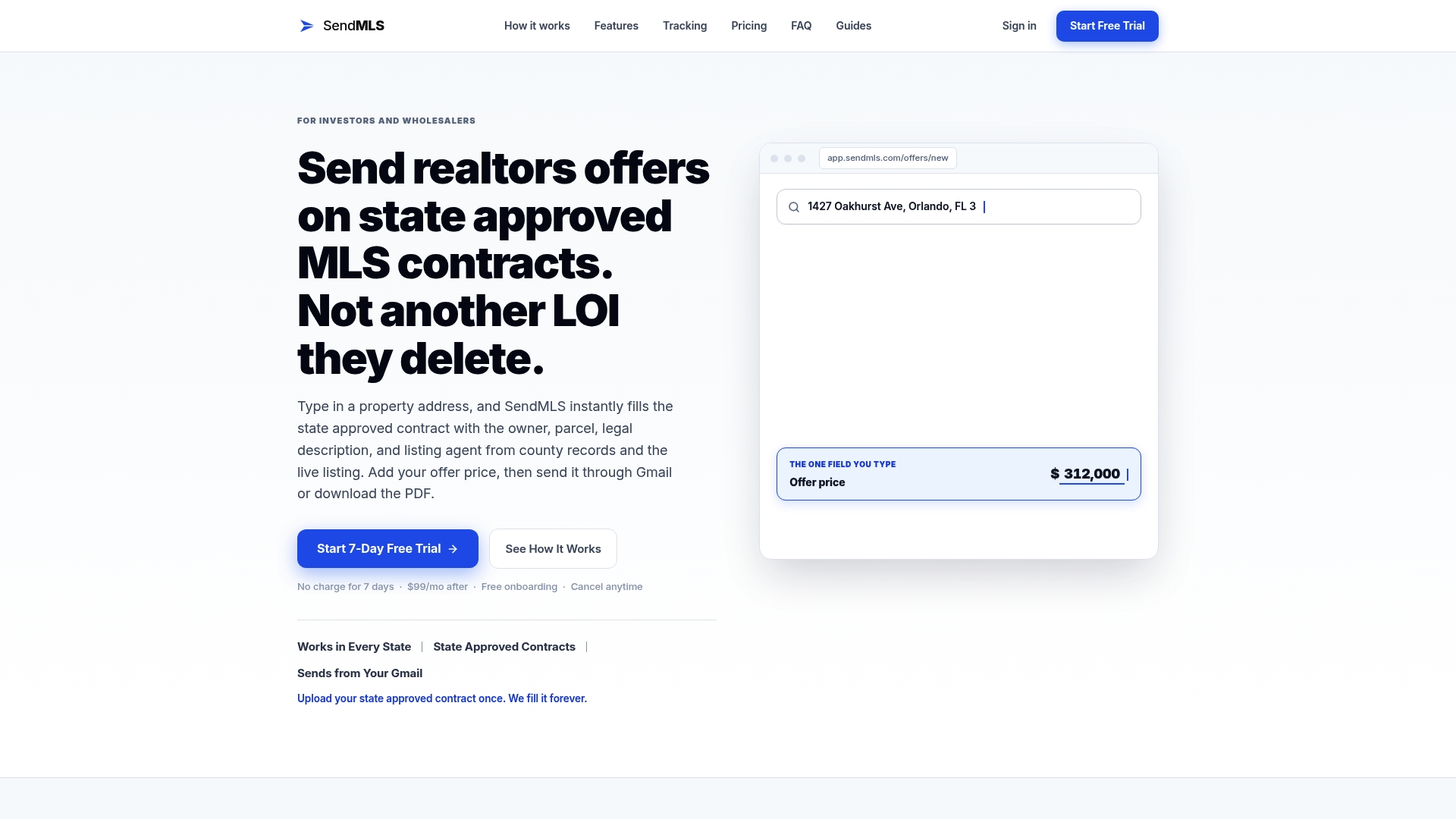
For solo wholesalers, the math is simple: more offers, fewer errors, no VA overhead. For land investors, 100 offers on stale county listings before lunch is a realistic daily target. For small acquisitions teams, every rep sends from their own Gmail while you watch every open in one dashboard. For high-volume flippers who need one deal from 60 offers, throughput and follow-up timing are everything.
The 7-day free trial requires no setup and no credit card commitment. Run it on one live MLS listing today and see how many offers you can get out the door before the week ends.