Privy Alternatives for Developers: Best Embedded Wallets 2026
Explore the top Privy alternatives for developers in 2026. Discover embedded wallets like Crossmint and Dynamic tailored for your needs.
Privy Alternatives for Developers: Best Embedded Wallets 2026

For developer-first embedded wallets, Crossmint, Dynamic, and Openfort are the strongest Privy alternatives heading into 2026, with Turnkey and Coinbase Smart Wallet close behind for teams that prioritize MPC custody and native EVM support respectively.
Here is the short version for engineers who need to shortlist fast:
- Crossmint — best for NFT-native apps and cross-chain minting with built-in on/off-ramp; smart accounts, custodial or non-custodial
- Dynamic — best for consumer onboarding flows with multi-wallet support and a polished auth layer; EOA and smart account options
- Openfort — best for gaming and high-throughput apps needing sponsored gas and account abstraction out of the box
- Turnkey — best for teams that want raw MPC key infrastructure without opinionated UX; non-custodial, TEE-backed
- Thirdweb — best for rapid prototyping across EVM chains; strong SDK breadth, free tier available
- Web3Auth — best for social-login onboarding with a proven MPC key-share model; wide chain support
- Sequence — best for gaming studios needing a full wallet-plus-marketplace stack; smart accounts on EVM
- Coinbase Smart Wallet — best for consumer fintech apps targeting Base and Ethereum mainnet; ERC-4337 smart accounts, zero gas friction
For a technical POC, Thirdweb, Dynamic, and Openfort let you reach a working integration in under a day. For enterprise procurement with compliance requirements, Turnkey and Crossmint have published security audits and SOC2 posture that security teams will ask for.
The term “Privy alternatives” covers two distinct product categories that rarely overlap. The first is the embedded wallet infrastructure space, where Privy competes with the platforms above. The second is the ecommerce email-capture and popup space, where Privy has strong adoption among small and mid-sized Shopify merchants but faces scaling limits. This article focuses on the wallet infrastructure category. If you landed here looking for email/SMS alternatives, the all-in-one platforms that bundle popups, email, and SMS are a separate evaluation track.
Table of Contents
- Key Takeaways for Developers and Fintech Teams
- EOA vs. Smart-Account Wallets: What Should You Build On?
- How Privy Works and What Changed in 2025–2026
- Privy Alternatives in 2026: Annotated Vendor Roundup
- Head-to-Head Comparison of the Key Technical Dimensions
- How We Evaluated These Platforms
- Which Wallet Infrastructure Should You Choose?
- Strategies for Mixing Providers and Practical Deployment Patterns
- Final Key Takeaways: Quick Checklist to Act On
- What Actually Works for Fintech Teams Building Embedded Wallets
- SendMLS: Volume Offer Software for Real Estate Investors
- Sources
Key Takeaways for Developers and Fintech Teams
The single most important selection signal is your account model. Smart accounts unlock sponsored gas and account recovery but add contract deployment overhead; EOAs are simpler but shift UX complexity to the user.
- Account model first: Decide EOA vs. smart account before evaluating vendors. Most 2026 platforms support both, but their defaults differ.
- Sponsored gas is table stakes for consumer apps: Any platform without a paymaster or relay API will require users to hold native tokens, which kills conversion.
- MPC custody vs. non-custodial: Turnkey and Web3Auth use MPC key shares; Crossmint and Sequence offer custodial options. Know your regulatory exposure before picking.
- Time to launch: Thirdweb and Dynamic can reach a working demo in hours; Turnkey and Fireblocks-grade infrastructure takes days to weeks for full integration.
- Migration complexity from Privy: Exporting key material is the hard part. Platforms that support key export (Turnkey, Openfort) reduce lock-in risk significantly.
Low-risk to prototype: Thirdweb, Dynamic, Openfort. Requires security/legal review before production: Turnkey, Crossmint (enterprise tier), Sequence (for regulated fintech).
EOA vs. Smart-Account Wallets: What Should You Build On?
An EOA (externally owned account) is a standard keypair wallet. The private key controls the account directly, there is no contract logic, and every action requires the key holder to sign. A smart account (also called a smart contract wallet or ERC-4337 account) is a contract deployed on-chain that holds assets and executes logic. The signing key authorizes the contract, not the assets directly.
For embedded wallet UX, the difference matters at every layer.
EOA pros and cons:
- Simple to implement; no contract deployment cost
- Native compatibility with every EVM tool and wallet standard
- No built-in account recovery without a custodian holding the key
- Gas must be paid by the user in native tokens unless you add a relay layer
Smart account pros and cons:
- Account recovery and social recovery built into contract logic
- Sponsored gas via ERC-4337 paymasters; users never need to hold ETH
- Batched transactions reduce round trips and improve UX
- Contract deployment adds latency and a one-time gas cost on first use
- Upgradeability is powerful but introduces a new attack surface
For consumer-facing apps where you want zero-friction onboarding, smart accounts with a paymaster are the right default in 2026. For B2B or developer tooling where users are already crypto-native, EOAs are often simpler and cheaper to operate.
Pro Tip: A hybrid pattern that works well in production: use an EOA as the signing key (generated via MPC or TEE), then wrap it in a smart account for gas sponsorship and batching. You get the key-management simplicity of an EOA with the UX benefits of account abstraction. Openfort and Thirdweb both support this pattern explicitly.
How Privy Works and What Changed in 2025–2026
Privy’s wallet infrastructure product gives developers a headless embedded wallet experience. It handles key generation, secure storage (using MPC key shares split between the user’s device and Privy’s servers), and a React SDK for onboarding flows. The developer experience is opinionated: you get a pre-built auth and wallet creation flow that works in a few hours, with support for social login, email, and SMS authentication.
The architecture is primarily EOA-based with MPC key management, meaning Privy holds a key share but cannot unilaterally move funds. On-chain, the wallet looks like a standard EOA. Sponsored gas and ERC-4337 support have been added incrementally, but the paymaster story is less mature than Openfort or Thirdweb.
The biggest ecosystem signal for 2026: Stripe acquired Privy in June 2025, and Privy continues to operate as an independent product. For teams already using Stripe’s payments stack, the integration depth may improve over time. For teams that are not in the Stripe ecosystem, the acquisition raises reasonable questions about roadmap prioritization and whether Privy’s wallet infrastructure will remain a standalone priority or get absorbed into Stripe’s broader crypto product suite.
One practical implication: teams building on Privy today should evaluate whether their key export path is documented and tested. If Privy’s roadmap shifts post-acquisition, having a migration plan matters.
The ecommerce version of Privy (email capture, popups, SMS) is a separate product line. Pricing-axis comparisons show Privy’s dual-axis model — charging on both pageviews and contacts — is a common pain point that alternatives address with single-axis or per-send pricing. That context is useful background but does not affect wallet infrastructure evaluation.
Privy Alternatives in 2026: Annotated Vendor Roundup
Crossmint
Best for: NFT-native apps, cross-chain minting, and teams that want a managed wallet API without building custody infrastructure.
Crossmint offers both custodial and non-custodial smart wallets. The custodial model lets you create wallets server-side with no user interaction, which is useful for airdrop campaigns or gaming item distribution. The non-custodial path uses MPC. Chain support is broad: EVM chains, Solana, and Aptos. On/off-ramp integrations are a genuine differentiator; Crossmint has native credit card checkout for NFT purchases, which most competitors route through third-party providers.
Developer DX is strong. The REST API is well-documented, and the React SDK covers common onboarding flows. Security posture includes published audits for smart contract components. Pricing is usage-based (API calls and transaction volume). For a POC, you can reach a working minting flow in a few hours.
Shortlist for: Enterprise NFT platforms, gaming studios, and any app where users need to buy digital assets with a credit card.
Dynamic
Best for: Consumer onboarding with a polished auth layer and multi-wallet support.
Dynamic’s strength is its authentication and wallet connection layer. It handles social login, email, passkeys, and existing wallet connections (MetaMask, Coinbase Wallet) in a single SDK. Smart account support is available via integrations with Safe and ZeroDev. Chain support covers major EVM networks and Solana.
The developer experience is one of the best in the category. The dashboard is clean, the React components are customizable, and the quickstart genuinely works in under 30 minutes. Sponsored gas requires integrating a separate paymaster provider, which adds a step compared to Openfort. Pricing is MAU-based with a generous free tier.
Shortlist for: Consumer apps that need flexible auth (social + crypto-native users in the same flow) and teams that want to ship onboarding fast.
Turnkey
Best for: Teams that need raw MPC key infrastructure with full control and no opinionated UX.
Turnkey is infrastructure-layer, not a UI kit. It provides a key management API with TEE attestations and security documentation where you control the signing policies, user management, and wallet creation logic entirely. Non-custodial by design. No pre-built onboarding flows; you build those yourself on top of the API.
Chain support is EVM-first with Solana support available. No native paymaster; you integrate gas sponsorship separately. Security is the headline: TEE attestations, published security documentation, and a SOC2 posture that enterprise security teams can work with. Pricing is per-operation.
Embedded wallet comparison reports consistently highlight Turnkey’s custody model as the cleanest separation between key management and application logic, which matters for regulated fintech.
Shortlist for: Fintech teams with compliance requirements, custody-sensitive applications, and any team that needs to own the signing policy layer.
Openfort
Best for: Gaming and high-throughput consumer apps needing account abstraction and sponsored gas as first-class features.
Openfort is built around ERC-4337 smart accounts and paymasters from day one. The paymaster API is the most developer-friendly in the category: you configure sponsorship rules (which contracts, which users, spending caps) through a dashboard and the SDK handles bundling. Chain support covers major EVM networks.
The React and Unity SDKs make Openfort a natural fit for gaming. Key management uses MPC. Security audits are published. Pricing is transaction-based with a free tier for development. Time to a working sponsored-gas flow: under two hours with the quickstart.
Shortlist for: Any app where users should never see a gas prompt, and gaming studios that need Unity or Unreal SDK support.
Thirdweb
Best for: Rapid prototyping and teams that need broad EVM chain coverage with minimal setup.
Thirdweb has the widest SDK surface in the category: TypeScript, Python, React, React Native, Unity, and Unreal. Smart accounts via ERC-4337, a built-in paymaster, and a contract deployment toolkit make it the fastest path from zero to a working demo. Chain support covers over 1,000 EVM-compatible networks.
The free tier is genuinely useful for prototyping. Production pricing scales with usage. Security audits are published for the smart contract components. The tradeoff is that Thirdweb’s breadth means some features are shallower than specialists: the auth layer is less polished than Dynamic, and the custody model is less enterprise-hardened than Turnkey.
Shortlist for: Hackathons, early-stage products, and any team that needs to validate a multi-chain concept quickly.
Web3Auth
Best for: Social-login onboarding with a proven MPC key-share model across a wide range of chains.
Web3Auth (now part of the Torus ecosystem) uses a threshold MPC model where key shares are distributed across the user’s device, Web3Auth’s nodes, and optionally a third-party backup. The result is a non-custodial wallet that recovers via social login without the user ever seeing a seed phrase.
Chain support is the broadest in the category: EVM, Solana, Tezos, Algorand, and others. Smart account support is available via integration. The SDK covers React, React Native, Flutter, and Android/iOS native. Pricing is MAU-based. The main tradeoff is that the architecture is more complex to audit than a simpler MPC model, and the developer experience has historically been less polished than Dynamic.
Shortlist for: Apps targeting non-crypto users who need social login recovery, and multi-chain products that need a single auth layer.
Sequence
Best for: Gaming studios that want a wallet-plus-marketplace stack on EVM chains.
Sequence combines smart account wallets (ERC-4337), a built-in relayer for sponsored gas, an NFT marketplace SDK, and an indexer in one platform. The wallet is embedded and supports email/social login. Chain support is EVM-focused with strong coverage of gaming-relevant L2s (Polygon, Arbitrum, Optimism, Base).
The developer experience is gaming-first: Unity and Unreal SDKs, a marketplace API, and analytics tooling. Security audits are published. Pricing is usage-based. For a pure wallet use case without the marketplace, Sequence is heavier than necessary, but for gaming studios that want one vendor for the full stack, it is the strongest option.
Shortlist for: Gaming studios building on EVM L2s that want wallet, marketplace, and gas sponsorship from a single provider.
Coinbase Smart Wallet
Best for: Consumer fintech apps targeting Base and Ethereum mainnet where you want zero-friction onboarding with no third-party key custodian.
Coinbase Smart Wallet is an ERC-4337 smart account that users create with a passkey, no seed phrase, no app download. It is non-custodial: Coinbase does not hold keys. Gas sponsorship is available via the Coinbase Developer Platform (CDP) paymaster. Chain support is currently Base and Ethereum mainnet, with expansion ongoing.
The developer experience is clean and the SDK is well-documented. Because it is backed by Coinbase, the on/off-ramp story is strong: users can fund wallets directly from Coinbase accounts. The tradeoff is chain coverage; if your app needs Solana or niche EVM chains, this is not the right primary wallet. Pricing through CDP is usage-based.
Shortlist for: Consumer apps on Base or Ethereum mainnet, and any team that wants passkey-native onboarding with Coinbase’s on-ramp network behind it.
Head-to-Head Comparison of the Key Technical Dimensions
A note on terminology: “Sponsored gas” and “paymaster” refer to the same outcome (the app pays gas on behalf of the user) but different layers. A paymaster is the ERC-4337 contract that authorizes gas payment; sponsored gas is the UX result. A relay is an older pattern (pre-ERC-4337) that achieves similar results without smart accounts. When vendors say “relayer,” confirm whether they mean ERC-4337 bundler/paymaster or a legacy meta-transaction relay, since the integration path differs.
How We Evaluated These Platforms
The evaluation methodology below is reproducible. Run it yourself during a POC to validate any vendor’s claims.
- Create a test account on each platform and measure time-to-first-API-call. Friction here predicts friction everywhere.
- Run the vendor’s quickstart SDK end-to-end: wallet creation, a test transaction, and (where advertised) a sponsored gas flow. Note where the quickstart breaks or requires undocumented steps.
- Test the onboarding flow with a social login and an email login. Measure steps to wallet creation for a non-crypto user.
- Test sponsored gas if advertised: configure a paymaster, send a test transaction with zero user-held ETH, and confirm the bundler processes it correctly.
- Review developer docs for completeness: are error codes documented? Are migration guides available? Is there a changelog?
- Check for published security audits and SOC2 reports. Absence is a signal, not just a gap.
Signals used to score vendors:
- DX time-to-first-success (under 1 hour is strong; over 4 hours is a red flag for a developer-first product)
- Presence of multi-chain SDKs and documented paymaster/relay patterns
- Published security audits with scope and date
- Observable on/off-ramp integrations (not just marketing claims)
- Active GitHub activity and community responsiveness (Discord, docs PRs)
For custody model and key management depth, embedded wallet comparison reports are useful references alongside vendor documentation. For adoption signals beyond marketing claims, adoption-based rankings that aggregate real install data give a more honest picture than review counts alone.
Vendor docs worth bookmarking during evaluation: Crossmint’s REST API reference, Openfort’s paymaster configuration guide, Turnkey’s policy engine documentation, and Thirdweb’s account abstraction quickstart.
Which Wallet Infrastructure Should You Choose?
Work through this checklist before shortlisting vendors.
Technical requirements:
- What account model does your app need? (EOA for simplicity, smart account for sponsored gas and recovery)
- Do users need gas sponsorship? If yes, eliminate any vendor without a native paymaster or documented ERC-4337 bundler integration.
- Which chains must you support at launch? Which in 12 months?
- Do you need on/off-ramp integrations, and does the vendor provide them natively or via third parties?
- What is your expected transaction volume per month? (Affects per-operation vs. MAU pricing significantly)
Non-technical requirements: 6. What are your regulatory and compliance constraints? (SOC2, audit cadence, key export requirements) 7. What is your SLA requirement for wallet API uptime? 8. Does your team have bandwidth to build a custom onboarding flow, or do you need pre-built components?
Questions to ask vendors during a POC:
- “Can you demonstrate a sponsored gas flow on our target chain with our contract addresses?”
- “Do you publish an API for off-ramp settlement, and which providers are integrated?”
- “What is your audit cadence, and can you share the most recent report scope?”
- “What does key export look like if we migrate away from your platform?”
- “What is your incident response SLA for key management failures?”
Decision matrix guidance:
For consumer fintech (high UX bar, low crypto literacy): prioritize smart accounts, sponsored gas, and social login. Dynamic, Openfort, and Coinbase Smart Wallet are the natural shortlist.
For gaming: prioritize Unity/Unreal SDKs, paymaster, and marketplace tooling. Openfort and Sequence are the clearest fits.
For regulated fintech (custody-sensitive, compliance-heavy): prioritize TEE/MPC attestations, SOC2, and key export. Turnkey is the strongest option; Crossmint’s enterprise tier is worth evaluating for teams needing strong security attestations and compliance.
For rapid prototyping: Thirdweb. Full stop.
Category-level competitor lists can help map the broader market, but the wallet infrastructure category is narrow enough that the eight vendors above cover the realistic shortlist for most teams.
Strategies for Mixing Providers and Practical Deployment Patterns
Most production embedded wallet systems use more than one provider. Here is how teams structure it.
Common hybrid patterns:
- Onboarding + gas sponsorship from Provider A; custody/settlement from Provider B. Example: use Dynamic for the auth and onboarding flow, Turnkey for key management, and a separate paymaster (Pimlico, Alchemy) for gas sponsorship. This separates concerns cleanly but adds integration surface.
- Smart account layer over an MPC key. Use Web3Auth or Turnkey for key generation, then wrap the resulting EOA in a Safe or ZeroDev smart account for batching and paymaster support. Openfort and Thirdweb support this pattern natively.
- Multi-chain routing with a single auth layer. Dynamic or Web3Auth handles auth; chain-specific wallet adapters route transactions to the right network. Useful for apps that need EVM and Solana in the same session.
- Fallback signing. For high-value transactions, route to a hardware-backed signer (Turnkey TEE) while using a lighter provider for low-value operations.
Operational concerns when running multiple providers:
- Syncing user profiles across providers requires a canonical user ID in your own database. Never rely on a provider’s internal user ID as your primary key.
- Monitor signed transactions from both providers in a single event bus. Reconciliation failures are the most common operational incident in hybrid setups.
- Plan rollback: if Provider A’s API goes down, can Provider B sign transactions independently? Design for this from day one.
Pro Tip: Build an abstraction layer over your signing provider from the start. A thin interface (createWallet, signTransaction, getAddress) that wraps whichever SDK you use means you can swap providers in a staged cutover without rewriting application logic. Teams that skip this step spend weeks on migration instead of days.
Final Key Takeaways: Quick Checklist to Act On
The strongest Privy alternatives for embedded wallet infrastructure in 2026 are Crossmint, Dynamic, Openfort, Turnkey, Thirdweb, Web3Auth, Sequence, and Coinbase Smart Wallet, each optimized for a different combination of account model, custody approach, and developer experience.
- Shortlist by account model first. Smart accounts are the right default for consumer apps; EOA-based platforms suit B2B and crypto-native users.
- Run a sponsored-gas POC before committing. A paymaster that works in a sandbox often has undocumented limits in production. Test it with real contract addresses on your target chain.
- Validate security attestations independently. Ask for the audit report, check the scope, and confirm the date. A 2022 audit on a contract that has been upgraded since is not current coverage.
- Plan your data and profile migration before you sign. Key export, user profile portability, and API deprecation timelines should be in the contract, not the FAQ.
- Run a 2-day POC with two vendors in parallel. Time-to-first-success is the most honest DX signal. Pick the two that fit your account model and custody requirements, run both quickstarts, and let the experience decide.
| Point | Details |
|---|---|
| Account model drives everything | Choose EOA vs. smart account before evaluating vendors; this single decision eliminates half the shortlist. |
| Sponsored gas is non-negotiable for consumer UX | Any platform without a native paymaster forces users to hold native tokens, which kills onboarding conversion. |
| Stripe acquired Privy in June 2025 | Teams on Privy should document their key export path and monitor roadmap changes post-acquisition. |
| Turnkey leads for regulated fintech | TEE attestations and a SOC2 posture make Turnkey the strongest option when compliance is the primary constraint. |
| SendMLS for offer volume | SendMLS automates state-approved contract generation and Gmail delivery for investors running high-volume MLS offer campaigns. |
What Actually Works for Fintech Teams Building Embedded Wallets
The pattern I see work most consistently is not the one teams plan for. Teams spend weeks comparing feature matrices and end up picking the vendor with the best marketing site. Then they hit the paymaster configuration, discover the docs assume knowledge the quickstart never built, and lose two sprints.
The teams that ship fastest pick two vendors, run both quickstarts on day one, and eliminate the one that breaks first. Developer experience is not a soft criterion; it is a hard predictor of how many engineering hours you will spend on infrastructure versus product. Over-indexing on feature parity (does this vendor support chain X?) at the expense of DX (can my team actually integrate this in a week?) is the most common mistake in this evaluation.
The Stripe acquisition of Privy is worth watching, not panicking about. Privy’s wallet infrastructure product is still running, the SDK still works, and the team is still shipping. But if you are starting a new project in 2026, building on a platform whose roadmap is now subordinate to a payments company’s broader crypto strategy carries real optionality risk. The alternatives above are all independent products with dedicated wallet infrastructure roadmaps.
SendMLS: Volume Offer Software for Real Estate Investors
If you arrived here from a search about Privy and you are a real estate investor or wholesaler, the wallet infrastructure comparison above is not your problem. Your problem is throughput: getting offers in front of listing agents fast enough to matter.
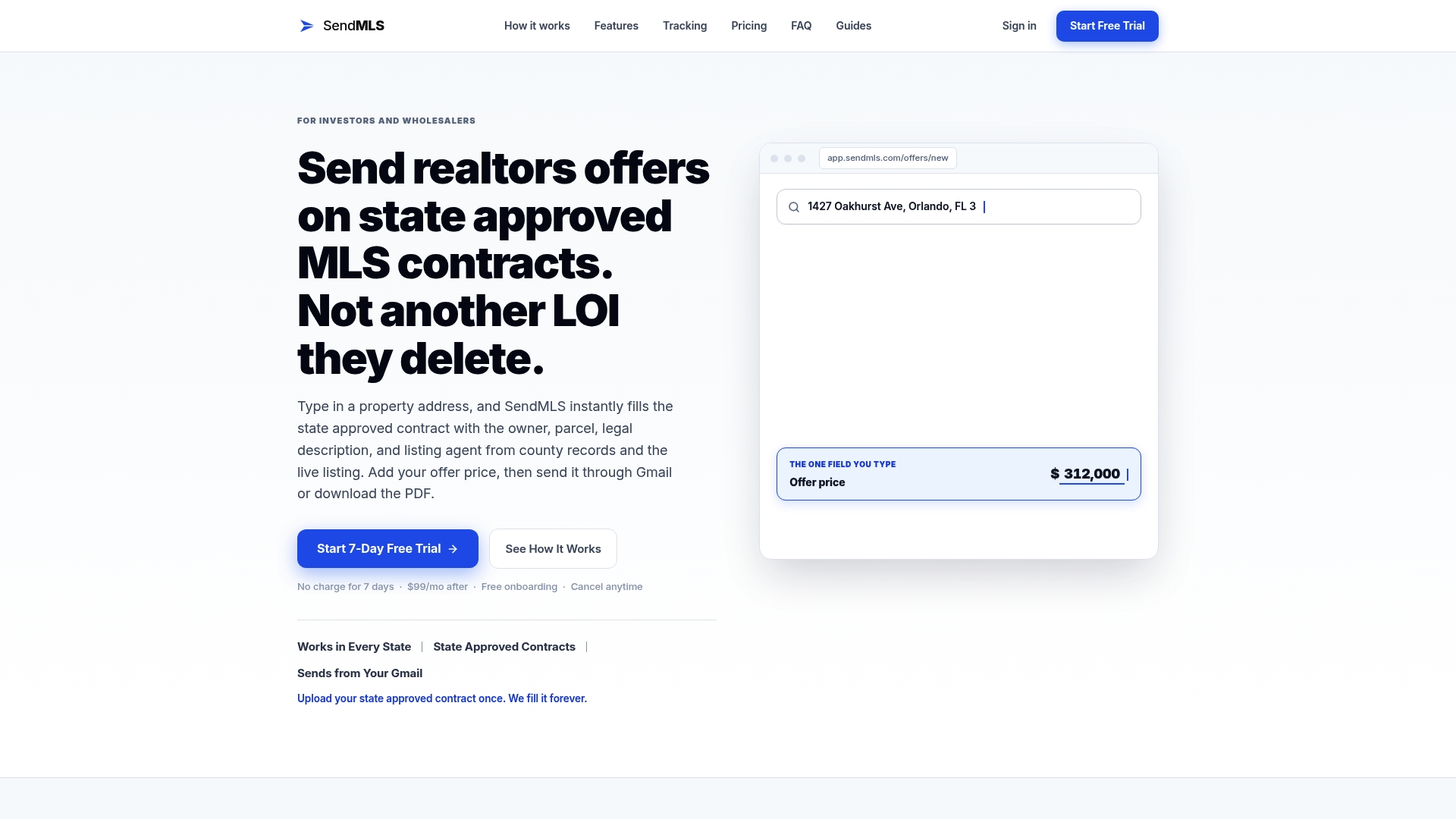
SendMLS solves exactly that. It pulls property details from MLS and county data, fills in a state-approved purchase contract automatically, and sends the offer straight from your Gmail so it lands as real paperwork from a real person, not a form email a VA typed. Open tracking tells you the moment an agent views your offer, so you follow up at the right time instead of guessing. Solo wholesalers replace a $900/month VA with a $99/month subscription and stop rechecking contracts for wrong counties or wrong closing dates. Land investors blast 100 offers on stale county listings before lunch. Acquisition teams give every rep their own sending identity while the manager sees every open in one dashboard.
Start with a 7-day free trial — no setup required, no contract, and no offer volume limits during the trial.
Sources
Use these during your evaluation to go straight to primary materials.
- Privy in 2026: Scrappy Email Tool or Underrated Growth Platform? – Ecommerce Times
- Stripe-Owned Privy Sees a Third of New Developers Building AI Agents
- 9 Best Privy Alternatives I’ve Found in 2026
- Privy competitors and alternatives (TrustRadius)
- Embedded Wallets: Compare Fireblocks vs. Privy vs. Turnkey
- Best Privy - Email, SMS & Pop Ups Alternatives for Shopify (StackDex)