Agents: Stop Losing Deposits on Pennsylvania Agreement of Sale
Checklist for agents and investors: confirm the current PAR Form ASR, satisfy 49 Pa. Code §35.333, run the six pre-sign checks, and avoid earnest money...
Agents: Stop Losing Deposits on Pennsylvania Agreement of Sale

The Pennsylvania Association of Realtors’ Form ASR is the commonly used standard Agreement of Sale for residential transactions involving licensees. Before signing, confirm you have the current form revision and the statutory clauses required under state regulation, and talk to a real estate attorney if anything about the property or the terms feels unusual.
TL;DR:
- Using the current PAR Form ASR and matching all statutory requirements, including zoning classification and escrow instructions, is essential for enforceability.
- All addenda must reference the correct paragraphs and be coordinated with the base agreement to avoid ambiguity and contractual gaps.
- Buyers need to verify they received and documented a signed seller disclosure before signing the contract, as late disclosures do not automatically give cancellation rights.
- Contingencies such as inspection, financing, appraisal, and title must be properly drafted within deadlines; missing them can waive protected rights.
- Automated contract tools like SendMLS can save time for high-volume investors but do not replace the need for legal review of form updates and unusual deal terms.
Table of Contents
- Overview of the PAR standard Agreement of Sale and when to use it
- Statutory required contents under 49 Pa. Code § 35.333
- Seller disclosures and timing under Pennsylvania law
- Common contingencies, cancellation rights, and remedies
- Earnest money handling, escrow rules, and dispute scenarios
- Drafting guidance: addenda, coordinating changes, and when to involve counsel
- Where to find official forms and a pre-signing checklist
- How automated state-approved contracts help high-volume offer workflows
- What sloppy paperwork actually costs a deal
- SendMLS: automated, state-approved offers for high-volume investors
- Sources
- FAQ
Overview of the PAR standard Agreement of Sale and when to use it
Form ASR is the residential sale contract published through the Pennsylvania Association of Realtors’ standard forms library. It is built for transactions where a licensee, a listing agent or a buyer’s agent, is involved in structuring the deal, and it bundles the clauses Pennsylvania real estate practice expects to see: identification of the parties, the property, the price, the contingencies, and the closing logistics.
Practitioners default to the standard form for a simple reason: consistency lowers risk. When both sides work from language that has already been tested across thousands of transactions, there is less room for a stray sentence to create an ambiguity that only shows up during closing. Casual edits to the core clauses, typed directly into the body of the agreement, are where most of that risk creeps back in. A buyer who strikes a paragraph about financing contingencies without understanding how it interacts with the deposit clause two pages later can unintentionally waive a protection they meant to keep.
That is why PAR designs the form to work with addenda rather than freehand changes. Transaction-specific terms, a seller rent-back, a special financing arrangement, an unusual conveyance, belong in a coordinated addendum that references the base agreement, not inserted into the main text. Our guide to purchase agreement addenda walks through how that coordination works in practice.
Before either party signs, run through a few basics:
- Confirm the form carries the current PAR revision date rather than an older cached copy pulled from a personal file or a third party site.
- Check that any addenda reference the correct paragraph numbers in the base agreement.
- Verify that the brokerage or agent preparing the form is using the PAR-hosted version, not a locally modified template.
A form that looks right at a glance can still be an outdated version with clauses that no longer match current regulation. That gap is exactly where the next section becomes relevant.
Statutory required contents under 49 Pa. Code § 35.333
Pennsylvania does not leave the content of a licensee-prepared agreement of sale to custom or convenience. 49 Pa. Code § 35.333 spells out what has to appear in the document, and missing an item is not a paperwork technicality. It can affect whether the agreement holds up the way either party expects.
The regulation requires the agreement to include, at minimum:
- The date of the agreement and the full legal names of the parties.
- A description of the property sufficient to identify it, typically including the address and a reference to the deed or tax parcel.
- The sale price, the amount and timing of any deposit, and the anticipated settlement or conveyance date.
- The zoning classification of the property at the time of the agreement.
- Language addressing how the broker will hold funds in escrow and in what capacity the broker is acting.
- Any mortgage contingency terms, stated clearly enough that both parties know what happens if financing falls through.
- Certain terms set off in boldface type, a formatting requirement meant to draw attention to provisions the regulation treats as material.
The zoning classification requirement is one of the more distinctive protections in Pennsylvania real estate practice. Under 49 Pa. Code § 35.333, if the agreement omits the zoning classification, the buyer can void the contract, and in some circumstances the deposit is returned without needing a court order to force it. That single missing line, easy to overlook when a form has been hand-modified, can unwind an entire transaction.
The regulation also touches on highway occupancy notice requirements for certain properties and reinforces that a broker preparing the agreement is acting in a defined capacity, not as a free agent improvising terms. None of this replaces legal advice for an unusual property or an out-of-state seller, but it gives buyers, sellers, and the agents representing them a checklist to measure a draft against before anyone signs. A licensee who skips one of these items is not just risking an awkward conversation later. They are risking the enforceability of the very document the deal depends on.
Seller disclosures and timing under Pennsylvania law
Pennsylvania’s Seller Disclosure Law, codified in Title 68, Chapter 73, requires a seller to complete, sign, and date a property disclosure statement and deliver it to the buyer before the buyer and seller sign the agreement of transfer. The order matters. Disclosure is supposed to inform the offer and the negotiation, not arrive as an afterthought once the contract is already signed.
The disclosure statement covers known material defects, meaning conditions the seller actually knows about, such as a roof leak, a failing septic system, or a boundary dispute. It is not an inspection report and it does not certify that the property is free of problems the seller genuinely does not know about.
A few practical points matter here:
- If a seller learns new information after delivering the disclosure but before closing, an amended disclosure should be delivered promptly, since the statute expects sellers to update known material defects as they become known.
- Documenting the buyer’s receipt, either inside the agreement itself or as a signed attachment, is a simple habit that prevents a later dispute over whether disclosure happened in time.
- A defect in the disclosure process does not automatically hand the buyer a broad right to cancel the agreement; remedies depend on what the contract itself says and on the specific facts.
That last point trips people up. Buyers sometimes assume that any disclosure problem, a late delivery, an omission, gives them an automatic exit. It does not work that way under Pennsylvania’s statute. The disclosure law creates obligations and potential liability for the seller, but it is not the same mechanism as a contract contingency, which is the tool that actually gives a buyer a contractual right to walk away under defined conditions. For readers who want a plain-language walkthrough of what these statements typically cover, a general explanation of property disclosure statements is a useful starting point, though state requirements vary and Pennsylvania’s own statute governs transactions here.
The Pennsylvania State Real Estate Commission, which oversees licensee conduct and publishes consumer-facing materials related to these disclosures, is a good reference point if a question comes up about what a licensee is required to provide during this stage of the transaction.
Common contingencies, cancellation rights, and remedies
A signed Pennsylvania agreement of sale is a binding contract. Once both parties have signed, walking away without a valid contingency or a recognized legal defense puts the departing party at risk of losing the deposit or facing a damages claim, a point attorney analysis of Pennsylvania agreement of sale disputes makes clear. That is exactly why contingencies matter: they are the built-in exit ramps, and they only work if they are drafted and triggered correctly.
- Inspection contingency. Gives the buyer a defined window, often a matter of days after acceptance, to have the property inspected and to request repairs, a credit, or in some cases to cancel if issues surface that the parties cannot resolve.
- Financing contingency. Protects the buyer if a mortgage cannot be secured on the terms specified in the agreement, provided the buyer has made a genuine, timely effort to obtain financing.
- Appraisal contingency. Addresses what happens if the lender’s appraised value comes in below the agreed purchase price, often giving the buyer room to renegotiate or exit.
- Title contingency. Lets the buyer back out or demand resolution if a title search turns up a lien, an easement dispute, or another defect that clouds ownership.
Each contingency has its own deadline, and missing that deadline typically waives the protection. A buyer who wants to cancel for a financing reason after the financing deadline has passed is no longer standing on a contractual right; they are just breaching.
When a deal collapses outside of a valid contingency, the available remedies tend to fall into a few categories: the seller may be entitled to retain the earnest money deposit, either party may pursue specific performance to force the sale through where that remedy is appropriate, or the non-breaching party may pursue damages. Legal analysis of these disputes notes that earnest money disputes are among the most frequent triggers of litigation in Pennsylvania real estate. Anyone facing a contested cancellation should move quickly, since delays in asserting a contingency right or disputing a breach can weaken the claim later.
Earnest money handling, escrow rules, and dispute scenarios
The broker handling the transaction has specific escrow duties under 49 Pa. Code § 35.333, including holding deposit funds in a proper escrow account and acting within the capacity the agreement describes. The regulation is specific about this because earnest money disputes are one of the most common sources of friction once a deal goes sideways.
A few scenarios come up repeatedly:
- A buyer cancels under a valid contingency, but the seller disputes whether the contingency was actually triggered in time, leaving the deposit in limbo.
- Both parties instruct the broker differently on where the deposit should go, and the broker is caught holding funds neither side will agree to release.
- A deal falls apart with no clear contingency in play, and one side simply refuses to sign a release.
Law firm guidance on these disputes points to documentation as the best protection available before a disagreement ever starts. An express escrow instruction clause, naming a neutral disbursement method or an interpleader path if the parties cannot agree, tends to resolve deposit disputes faster than leaving the broker to sort it out informally. Our earnest money strategies guide covers clause language buyers and investors can request when drafting these terms.
Pro Tip: Ask for an escrow instruction clause that names a specific release mechanism, such as mutual written release or court order, before you sign, so a future dispute has a clear path instead of an open-ended standoff.

Drafting guidance: addenda, coordinating changes, and when to involve counsel
The safest way to customize a Pennsylvania agreement of sale is to add a PAR addendum rather than editing the core clauses directly. Addenda are built to reference and coordinate with the base agreement, which keeps the contract internally consistent even when the deal has unusual terms, a rent-back period, a right of first refusal, or a non-standard conveyance structure.
Common mistakes to watch for:
- Inconsistent dates between the main agreement and an attached addendum, which creates ambiguity about which deadline actually controls.
- Exhibits referenced in the text but never actually attached, leaving a gap in what was supposedly agreed to.
- Boldface warnings stripped out during copying or reformatting, even though the regulation expects certain terms to stand out visually.
- Free-text edits to a financing or zoning clause that conflict with language elsewhere in the same document.
Some situations call for an attorney before anyone signs, not after a dispute starts: complicated title issues, zoning questions that go beyond a simple classification statement, unusual conveyance structures like a right of first refusal, or any transaction involving a trust, an estate, or multiple owners with competing interests. None of that is a sign the standard form has failed. It is simply outside what a template, however well drafted, is meant to handle alone.
Pro Tip: If a deal involves anything beyond a straightforward owner-occupied sale, get the addendum language reviewed before signatures go on, not after the inspection period has already started running.
Where to find official forms and a pre-signing checklist
Start with the source. The PAR Form ASR is hosted directly by the Pennsylvania Association of Realtors, and the regulatory text itself lives at 49 Pa. Code § 35.333, with disclosure obligations spelled out in Title 68, Chapter 73. A copy circulating through email or a personal file folder is not proof of the current revision.
Before signing, run through this list:
- Confirm the names of all parties match the deed and any prior correspondence exactly.
- Check that the sale price, deposit amount, and conveyance date are all stated and consistent across the agreement and any addenda.
- Verify the zoning classification is filled in, not left blank.
- Confirm escrow instructions name who holds the deposit and under what conditions it is released.
- Confirm the buyer received a signed, dated seller disclosure statement before signing the agreement.
- Note every contingency deadline on a calendar the moment the agreement is signed.
If the form was downloaded from anywhere other than the PAR site or a licensed agent’s current template library, confirm the revision date before relying on it.
How automated state-approved contracts help high-volume offer workflows
Investors making dozens of offers a month run into a version of the same problem this guide has been describing: getting the right form, filled in correctly, in front of a listing agent without errors creeping in. Manually retyping parcel numbers, owner names, and agent details into a contract is slow, and it is exactly where mistakes like a wrong county or a mismatched closing date show up.
SendMLS maps a state approved contract once, then autofills owner, parcel, legal description, and agent details from public records for offers sent at volume. Offers go out from the sender’s real Gmail account rather than a generic portal, and open tracking shows when an agent has actually viewed the offer. None of this replaces the checklist above. Verifying contract language and the current form version, and getting legal advice for anything unusual, is still the user’s responsibility. Our MLS offer software overview explains how the automation fits into a typical acquisition workflow.
What sloppy paperwork actually costs a deal
The errors that sink deals are rarely dramatic. They are a stale form revision nobody checked, a zoning line left blank, an addendum that references the wrong paragraph number. Each one looks small until it becomes the reason a closing gets delayed or a deposit gets contested.
The fix is not more caution, it is a habit: check the PAR revision date every time, and call a real estate attorney the moment a transaction stops looking routine.
— Shane
SendMLS: automated, state-approved offers for high-volume investors
Investors running the aged-listing play or submitting offers across a large buyers list do not have time to retype the same contract fields dozens of times a week. SendMLS handles that repetition: state approved contract templates, automated population from county and MLS data, delivery straight from your Gmail, and open tracking so you know when an agent actually looked at the offer.
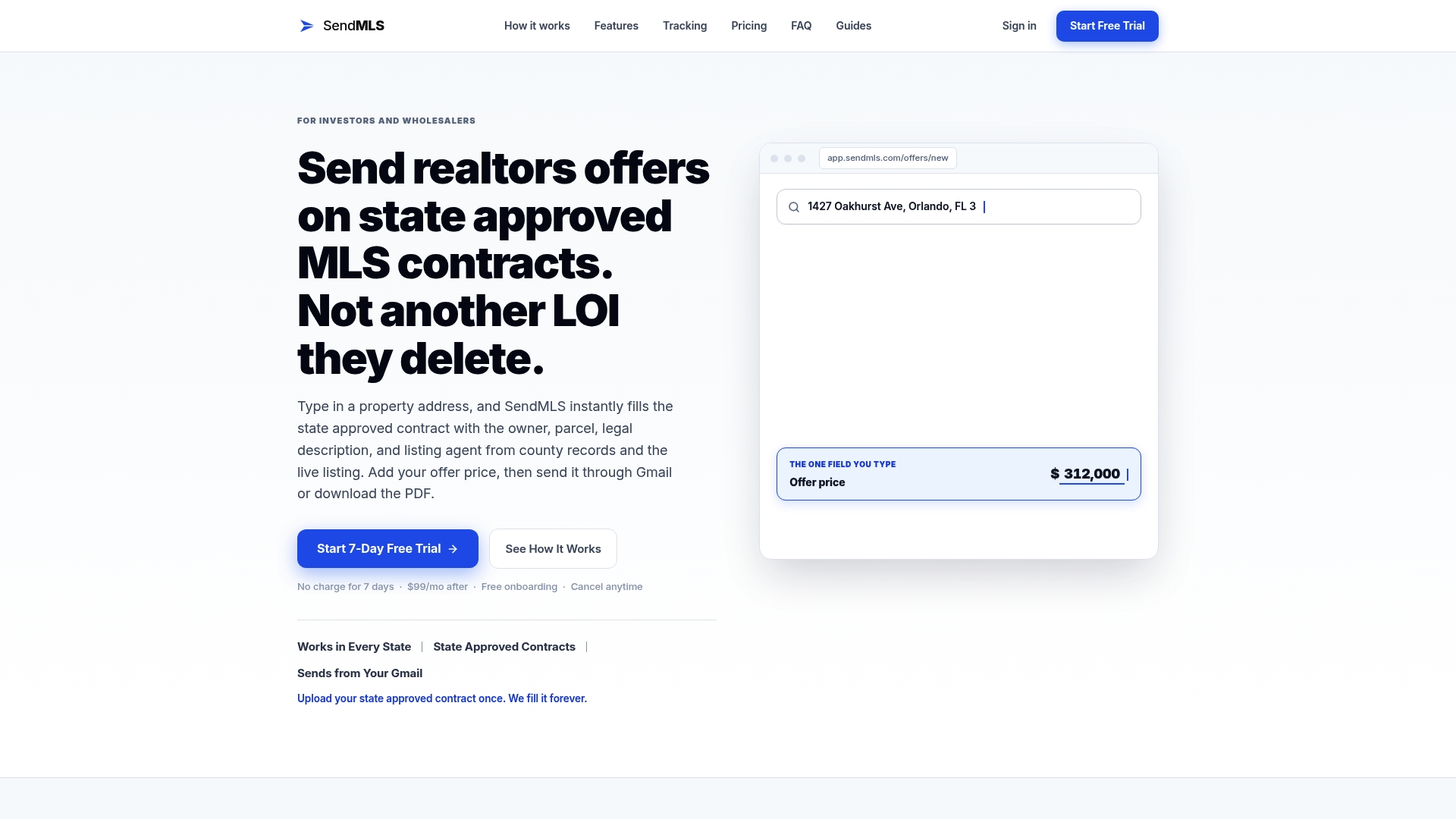
Legal review and confirming you are using the current form version stay on you or your attorney, SendMLS fills in the paperwork, it does not replace legal judgment. The plan is one flat subscription at $99 per month after a 7 day free trial, no setup required. If your bottleneck is throughput rather than deal flow, start a free trial and start sending offers at the volume your pipeline actually needs.
Sources
For anyone verifying a Pennsylvania agreement of sale against the primary legal text:
- Standard Agreement for the Sale of Real Estate - Pennsylvania Association of Realtors®
- 49 Pa. Code § 35.333. Agreements of sale.
- Chapter 73. - Title 68 - REAL AND PERSONAL PROPERTY (Seller Disclosure Law)
- Pennsylvania Agreement of Sale Disputes - Lebovitz & Lebovitz, P.A.
This article is general information, not a substitute for advice from a qualified lawyer. Consult a qualified legal professional about your own circumstances before acting on anything here.
FAQ
What is the standard agreement of sale in Pennsylvania?
The standard agreement of sale in Pennsylvania is commonly the PAR Form ASR, published by the Pennsylvania Association of Realtors for residential transactions involving licensees. It bundles the clauses required under state regulation, including price, parties, property description, and escrow terms, and is meant to be used with coordinated addenda rather than free-text edits.
What states have reciprocity with Pennsylvania real estate licenses?
License reciprocity rules change and are set by each state’s own real estate commission, so the current list is best confirmed directly with the Pennsylvania Real Estate Commission rather than relying on a general guide. This question concerns licensing, not the agreement of sale itself, so it falls outside what the contract form or the disclosure statute addresses.
How long are you liable after selling a house in PA?
Pennsylvania’s Seller Disclosure Law creates liability tied to known material defects that were not properly disclosed before the agreement of transfer was signed, under Title 68, Chapter 73. Because liability depends on what the seller actually knew and when, and can involve separate legal claims beyond the statute, sellers with specific concerns should consult a real estate attorney rather than assume a fixed time limit.
Where can I find a free Pennsylvania real estate sales agreement form?
The Pennsylvania Association of Realtors hosts Form ASR as its standard sales agreement, though access to member forms libraries can depend on realtor membership or working with a licensed agent. Always confirm the revision date on any copy before using it, since the regulation’s required content and formatting can change between versions.