7 Steps to Send Compliant Out of State Offers for U.S. Investors
7 steps for U.S. investors to scale out of state offers: autofill state contracts, reconcile public records, and use open tracking to convert listing agents.
7 Steps to Send Compliant Out of State Offers for U.S. Investors

Send a state-approved, prefilled purchase contract from a monitored business email, with open tracking and a logged pipeline, instead of a casual letter of intent or an email nobody reads. That combination beats a generic template because it gives listing agents real paperwork, gives you a timestamped record of what went out and when, and tells you the moment an agent opens the file so you know exactly when to follow up. Skip it and you’re guessing. Before scaling into a new state, confirm its disclosure and licensing rules and get title or escrow on the phone early.
TL;DR:
- Ensuring the property address, legal description, and MLS listing match is essential to avoid offer rejection based on paperwork errors.
- Using state-specific, approved purchase forms and including all required disclosures, contingencies, and proof of funds prevents common pitfalls.
- Automating data collection and contract generation saves time, but human verification remains crucial before sending offers at scale.
- Confirming local title and escrow procedures, remote closing support, and recording timelines avoids delays during settlement.
- Tracking offer opens and following up promptly increases the likelihood of engagement and successful transaction progression.
Table of Contents
- What Belongs on Every Out-of-State Offer
- How to Run a High-Volume Offer Workflow Without Losing Control
- State Rules Are Not the Same From Iowa to Oregon to Texas
- Title, Escrow, and Remote Closing: What to Confirm Before You Assume Anything
- Working With Listing Agents Without Burning Bridges
- Scale With Verification Gates, Not Around Them
- Where SendMLS Fits Into This Workflow
- Where to Verify These Standards Yourself
- Sources
- FAQ
What Belongs on Every Out-of-State Offer
Most rejected offers don’t die on price. They die on a mismatched address, a missing signature block, or a form the state doesn’t actually recognize. Before a single offer leaves your outbox, run it through a fixed set of checks.
Start with the property itself. The MLS listing, the county parcel record, and the legal description need to agree with each other, and any mismatch has to get flagged before the contract goes out, not after. Fannie Mae’s residential contract guidance specifically separates street address from legal description for this reason. Treat that separation as a checkpoint, not paperwork trivia.
From there, confirm you’re using the right form. Every state has its own approved purchase contract, and many counties layer on their own addenda for things like well and septic disclosures or HOA transfer requirements. A purchase agreement addenda guide is worth keeping handy if you’re not sure which riders apply where you’re buying.
The financial terms need to be airtight and specific, including a fully underwritten pre-approval, not a basic pre-qualification letter:
- Offer price, earnest money amount, and who holds it in escrow
- Cash or financing terms, spelled out, not implied
- Every contingency you’re actually keeping (inspection, financing, appraisal)
- Offer expiration date and proposed closing date
- Attached proof of funds, or a fully underwritten pre-approval, not a basic pre-qualification letter
Pro Tip: Keep a redacted proof-of-funds letter ready to attach to every offer. Realtor that most banks can issue one within 24 to 48 hours, and having it ready means you’re never the reason an offer stalls.
Realtor.com’s own breakdown of what sellers expect confirms all of this: address and legal description, price, terms, earnest money, contingencies, and dates. Skip any one of those and you’ve handed the listing agent a reason to move on to the next offer in the stack. Finally, log the metadata on your end: sent timestamp, recipient name and email, the exact attachment filename and version, and the response deadline you’re holding the seller to.
How to Run a High-Volume Offer Workflow Without Losing Control
Volume and accuracy usually fight each other. The fix isn’t working faster by hand. It’s building a sequence where the repetitive parts are automated and the risky parts still get a human set of eyes.
- Prebuild your infrastructure first. Map one state-approved contract per state you operate in, and build out property records ahead of time rather than starting from scratch on each listing.
- Automate the data pull. Owner name, parcel number, legal description, and listing-agent contact should populate from public records and MLS data automatically, with mismatches auto-flagged for a human to check rather than silently pushed through.
- Batch-generate, then verify once. Generate contracts in a batch, run a single verification pass across the group, then sign and send individually or in controlled small batches, never as one unchecked blast.
- Send from a real, monitored address. A Gmail-based send or a PDF attachment from an actual business email reads as real paperwork. A cold email body or a text message routinely gets ignored.
- Track opens and route them into a pipeline. Every offer needs a home in a central pipeline with its status, not a scattered folder of sent items.
- Follow up on a schedule tied to behavior, not guesswork. An opened offer gets a phone call within 30 to 60 minutes. An unopened offer gets exactly one polite check-in after 24 hours.
- Keep every version. Signed counters and ratifications attach to the original offer record, with their own timestamps, so nobody at your shop works off a stale document.
Pro Tip: Resist the urge to send the moment a contract is generated. The single verification step in the middle of this sequence is what catches the wrong county, the wrong closing date, or a legal description that doesn’t match the MLS listing, before an agent ever sees it.
State Rules Are Not the Same From Iowa to Oregon to Texas
A nationwide template is a liability, not a shortcut. Assignment rules, disclosure requirements, and the threshold for needing a brokerage license all shift from state to state, sometimes county to county.
Three examples make the point. Iowa’s administrative code imposes a written disclosure requirement for wholesaling that took effect June 18, 2025. Oregon has its own required disclosures that took effect July 1, 2025. Texas sets specific conditions under which someone can assign an equitable interest in a contract without holding a real estate license. None of these overlap cleanly, and none of them are optional research if you’re actually transacting in those states.
Build a compliance matrix before you scale into a new market, not after. That matrix should track:
- Disclosure language required by the property’s state, not your home state
- Assignment restrictions and any licensing triggers
- Counsel sign-off required before your first offer goes out in that state
The operational rule underneath all of this: disclosures get selected based on where the property sits, never where you’re sitting when you send the offer. Log that the disclosure was actually delivered with the offer, the same way you’d log a sent timestamp. If a regulator or a buyer ever asks whether you disclosed properly, “it’s our standard practice” is a weaker answer than a dated record showing you did.
Title, Escrow, and Remote Closing: What to Confirm Before You Assume Anything
An accepted offer that can’t close on schedule is barely better than a rejected one. Get local title or escrow on the phone before you’re deep into a deal, not after inspection contingencies expire.
Recording rules, remote-notarization approval, and title-curative timelines vary enough by jurisdiction that a one-day clearance assumption is a good way to blow a closing date. ALTA’s best-practices framework recommends written procedures covering exactly this, because settlement has to comply with the law of the state the property sits in, not the state you’re calling from.
Before you build your contingency dates, confirm:
- Whether the title company supports remote closing and which remote-notarization platform they’ll accept
- Licensing and credential requirements for the signing professional handling your closing
- Recording turnaround times, including whether e-recording is available in that county
- Fees and contracts with any recording vendor the title company uses
Set your closing date around the slowest realistic answer to those questions, not the fastest one.
Working With Listing Agents Without Burning Bridges
The listing agent controls the channel. Whatever their submission instructions say, follow them exactly, and confirm compensation and presentment expectations before you hit send, not after.
Open tracking earns its place here. Knowing the moment an agent opens your file means your follow-up references the exact offer and timestamp instead of a vague “did you get my email.” A guide to sending offers without an agent covers the etiquette side of this in more detail.
- Opened within an hour: call, don’t just email again.
- Unopened after 24 hours: one polite follow-up email, then wait.
- Countered: pause other offers to that same listing agent until it resolves.
Pro Tip: A documented rejection is worth saving to the offer record. Silence isn’t a “no,” and treating it like one means you stop following up on deals that are still alive.
Scale With Verification Gates, Not Around Them
The pattern behind most blown offers isn’t a lowball number. It’s an address that didn’t match the county record, or a disclosure that didn’t exist for that state yet. Speed exposes those mistakes faster, it doesn’t cause them. That’s the part investors moving into high-volume workflows tend to underestimate: automation makes a bad process fail faster, and a good process scale further, but it doesn’t fix a bad process on its own.
The right mental model is speed plus verification, not speed instead of it. Keep a human checkpoint on new property identities and a counsel review on any new state before your first offer goes out there. and.
Automation should take the repetitive fifteen minutes off each offer. It should never take the judgment off the table.
— Shane
Where SendMLS Fits Into This Workflow
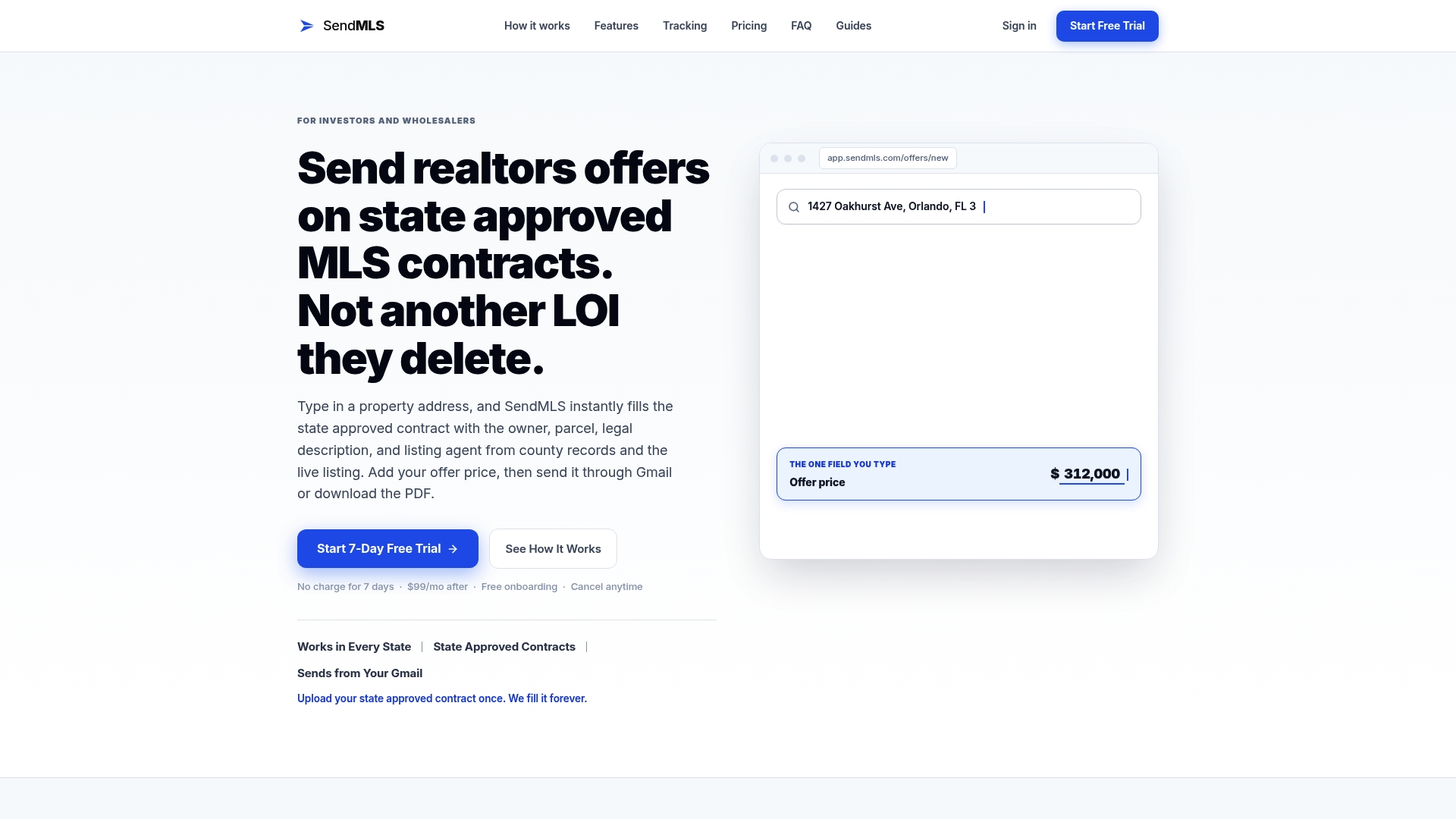
SendMLS is built around the exact sequence this article just walked through, not a simplified version of it. You map your own state-approved contract once, and SendMLS autofills it with owner, parcel, legal description, and listing-agent data pulled from public sources for any property in the country. Offers send straight from your real Gmail account, so agents see actual paperwork from an actual person, not a bulk blast. Open tracking tells you the second an agent views the file, and every offer lands in a pipeline you can actually manage instead of a scattered inbox.
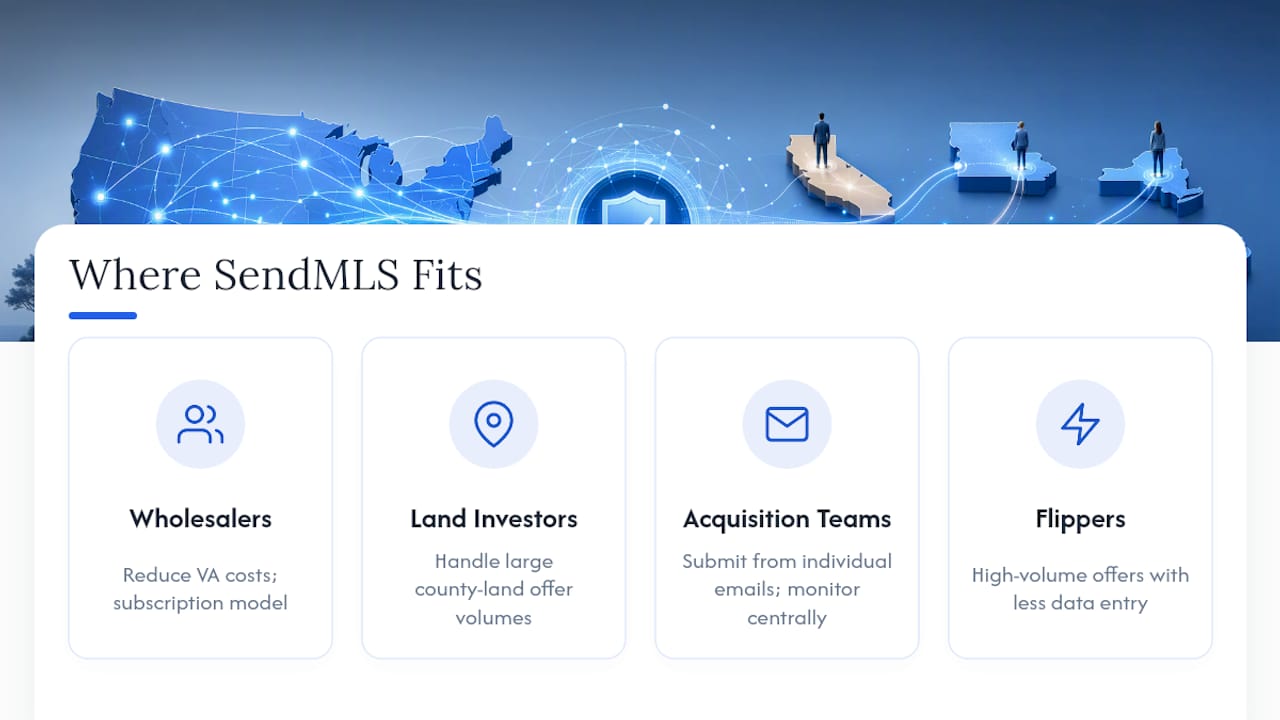
Solo wholesalers running the aged-listing play use it to reduce VA costs and switch to a subscription model while maintaining accuracy. Land investors use it to handle large volumes of county land offers efficiently. Acquisition teams manage offer submissions from individual email accounts while monitoring activity centrally. High-volume flippers use it to make numerous offers efficiently without spending excessive time on data entry.
Start with the 7-day free trial, no setup required, and see how many offers you can get in front of listing agents this week.
Where to Verify These Standards Yourself
For deeper reading beyond this article: ALTA’s title curative work study covers settlement and recording best practices in detail. Realtor.com’s offer guidance breaks down what sellers actually expect on paper. State administrative codes, like Iowa’s wholesaling disclosure rule, show how quickly the rules shift once you cross a state line.
Sources
- ALTA Title Insurance Curative Work Study / Best Practices (ALTA)
- Iowa administrative rule example for wholesaling (Cornell Law)
FAQ
What Makes an Out-of-State Offer Legally Sufficient?
It needs the property’s correct legal description matching county records, price, earnest money terms, contingencies, and clear expiration and closing dates, all on the contract form approved for that specific state. Realtor.com’s offer guidance lists these as the core terms sellers and their agents expect to see.
Do I Need a Local Real Estate License to Submit Offers in Another State?
It depends entirely on the state and on how you plan to assign or wholesale the contract. Iowa, Oregon, and Texas each set different disclosure and licensing conditions, which is why a single nationwide approach is risky, and counsel review before entering a new state matters more than speed.
How Fast Can I Get Proof of Funds for an Out-of-State Offer?
Most banks issue a proof-of-funds letter within 24 to 48 hours, according to Realtor.com, so keeping a redacted copy on hand lets you attach it to every offer without delay. A fully underwritten pre-approval, when financing is involved, tends to carry more weight with sellers than a basic pre-qualification letter.
How Much Does SendMLS Cost?
SendMLS runs one plan with everything included for $99 per month, after a 7-day free trial with no setup required.
How Do I Know When a Listing Agent Has Seen My Offer?
Open tracking on your sent offer shows the exact moment the agent views the file, which is when a phone call within the next hour tends to land best. If it stays unopened for 24 hours, one polite follow-up email is usually enough before moving on.