Land Purchase Contract: Complete Buyer and Seller Guide
Discover the essential steps for both buyers and sellers in a land purchase contract. Ensure a smooth transaction with our complete guide!
Land Purchase Contract: Complete Buyer and Seller Guide

A land purchase contract is a written, signed agreement that legally binds a buyer and seller to transfer a specific parcel of land at an agreed price, creating equitable title in the buyer at signing while legal title passes only when the deed is delivered and recorded at closing. Under the Statute of Frauds, every real estate contract must be in writing and signed by all parties to be enforceable — a verbal acceptance means nothing until ink hits paper.
Buyers: three things to do before you sign
- Confirm your full legal name (as it will appear on the deed) and gather the parcel’s APN or recorded legal description from the county assessor.
- Identify your escrow agent or title company and confirm they handle vacant land closings in that county.
- Order a preliminary title report before the due diligence period expires.
Sellers: three things to do before you sign
- Pull a current title report to confirm you hold clear, marketable title and identify any liens.
- Prepare any required state disclosures (condition, access, utilities, mineral rights).
- Decide your closing timeline and build it into the contract before negotiation starts.
Two warnings worth repeating: a verbal agreement is unenforceable — a seller can verbally accept your offer and still sign with a higher bidder the next morning. And signing a contract without recording the deed leaves you with a contractual claim, not recorded ownership.
Table of Contents
- What a land purchase contract actually is — and which type fits your deal
- Essential clauses every land purchase contract must include
- How the process works from offer to recorded deed
- Installment land contracts and seller financing: what both sides need to know
- Why state-compliant forms matter more than most buyers realize
- Annotated sample land purchase contract: what each section should say
- Common pitfalls and a pre-signing checklist
- Why volume investors automate state-approved contract generation
- Your action plan: draft, review, and close
- Key Takeaways
- The part most buyers skip until it costs them
- SendMLS cuts the manual work out of land offer volume
- Useful sources and official references
What a land purchase contract actually is — and which type fits your deal
The phrase “land purchase contract” covers two meaningfully different documents. Knowing which one you need before you draft anything saves real headaches later.
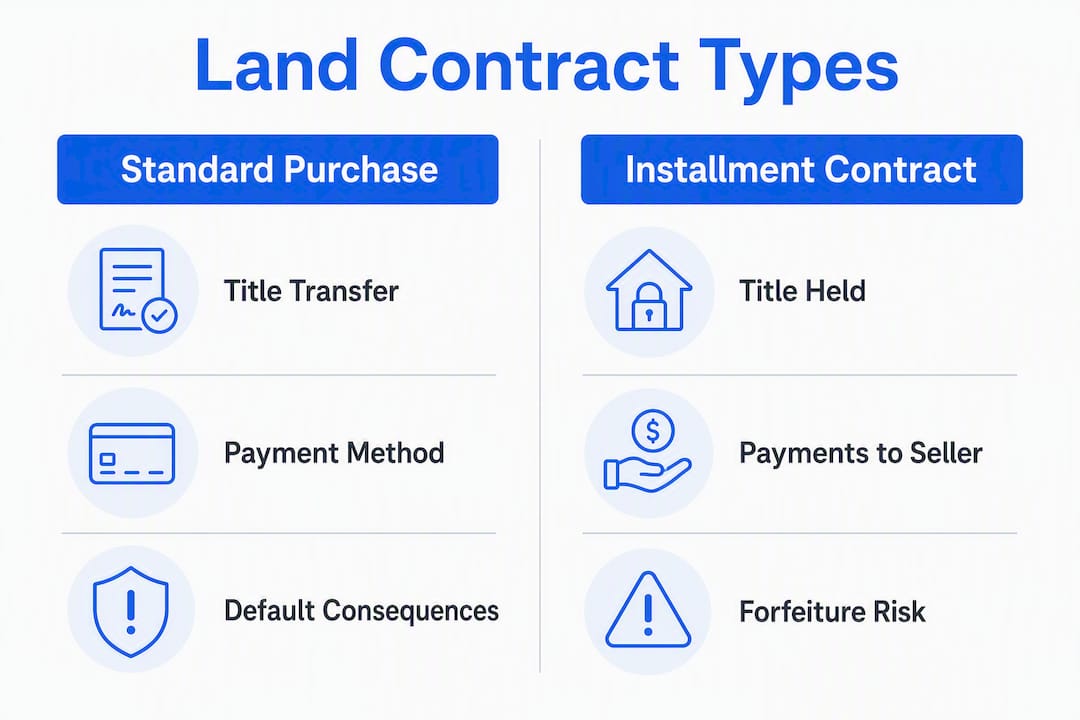
Standard purchase agreement. The buyer pays (cash or financed), the seller delivers a deed at closing, and legal title transfers immediately upon recording. This is the right form for cash purchases, bank-financed deals, and most investor acquisitions. The Colorado Division of Real Estate publishes a Contract to Buy and Sell Real Estate (Land) that illustrates the standard structure well.
Installment land contract (contract for deed). The buyer makes payments directly to the seller over time. The seller retains legal title until the final payment is made, then conveys the deed. This structure is common when a buyer cannot qualify for traditional bank financing. The Ohio State University Farm Office has a useful breakdown of how land contracts work in agricultural contexts, which applies broadly to rural parcels.
| Feature | Standard purchase agreement | Installment land contract |
|---|---|---|
| Who holds legal title during the deal | Seller (until closing) | Seller (until final payment) |
| When deed transfers | At closing | After all payments made |
| Financing source | Cash or third-party lender | Seller |
| Default remedy for seller | Earnest money forfeiture / suit | Forfeiture of payments (varies by state) |
| Buyer risk on default | Lose earnest money | Lose all equity paid |
| Best use case | Cash, bank-financed, investor buys | Seller financing, credit-challenged buyers |
The clauses that shift most between types are title transfer timing, default and forfeiture language, and interest/amortization terms. A standard purchase agreement has none of the last two; an installment contract lives or dies on how clearly those are written.
Essential clauses every land purchase contract must include
A land sale agreement that omits any of these is either unenforceable or a lawsuit waiting to happen.
Statute of Frauds requirements (non-negotiable)
- Full legal names of buyer and seller, exactly as they appear on government ID and as they will appear on the deed.
- Precise legal description — APN alone is not sufficient in most states. Include the metes-and-bounds description or the recorded plat reference (lot, block, subdivision, county, state).
- Purchase price, stated as a specific dollar figure.
- Signatures of all parties. An unsigned contract is not a contract.
Core transactional clauses
- Earnest money and escrow instructions. Specify the deposit amount (typically 1–5% of purchase price), the escrow holder, and the conditions under which it is refundable or forfeited.
- Due diligence period. State the number of days, what the buyer is permitted to inspect, and the exact termination right if inspections are unsatisfactory.
- Title contingency. Requires the seller to deliver clear, marketable title. Title insurance on land is relatively inexpensive and protects against liens, easements, or ownership disputes surfaced in the search.
- Survey contingency. Buyer’s right to obtain a boundary survey and object to encroachments or discrepancies.
- Financing contingency (if applicable). Specify lender, loan amount, and deadline for loan commitment.
- Closing date and mechanics. Who delivers what, where, and by when.
- Deed type. General warranty, special warranty, or quitclaim — each carries a different level of seller guarantee.
- Prorations and closing costs. Property taxes, HOA dues (if any), and which party pays recording fees, transfer taxes, and title insurance premiums.
- Risk of loss. Who bears the risk if the property is damaged (e.g., by fire or flood) between signing and closing.
- Remedies for breach. Specify whether the buyer’s remedy is return of earnest money only, specific performance, or damages — and the same for the seller.
Land-specific contingencies
- Access verification. Confirm legal access to a public road. Landlocked parcels are a real problem in rural markets.
- Utilities. Confirm availability of water, sewer or septic, electricity, and gas — or the cost to bring them in.
- Percolation (perc) test. Required if the buyer plans to install a septic system.
- Mineral rights. Clarify whether mineral rights are included in the sale or severed.
- Zoning and use restrictions. Confirm the parcel’s zoning classification and any overlay restrictions before removing contingencies.
- Environmental and soil testing. Especially on former agricultural or industrial land.
- Easements. Review recorded easements for utilities, drainage, or neighboring access that could affect use.
Pro Tip: Draft the due diligence contingency to give the buyer a clear termination right “for any reason or no reason” during the inspection period, with written notice required by a specific date and time. Vague language like “subject to satisfactory inspection” has been litigated repeatedly — a clean termination right is far harder to dispute.
| Clause | Standard purchase | Installment contract |
|---|---|---|
| Due diligence period | Yes | Often abbreviated |
| Title contingency | Yes | Buyer should still require |
| Financing contingency | Yes (if financed) | No (seller is the lender) |
| Interest/amortization schedule | No | Yes — required |
| Default/forfeiture language | Earnest money | Equity forfeiture (state-specific) |
| Reconveyance/deed-at-payment clause | N/A | Required |
How the process works from offer to recorded deed
Step 1: Submit the offer
Your offer should include buyer and seller names, the APN and legal description, purchase price, earnest money amount, financing method, contingencies, closing date, who pays closing costs, and an expiration date. Offers on rural land often start 10–20% below asking price, sometimes 20–30% on listings that have sat for months. The expiration clause matters: without one, a seller can sit on your offer indefinitely while shopping for better terms.

The offer becomes binding only when all parties have signed and copies have been delivered. Until that moment, the seller is free to accept a competing offer.
Step 2: Due diligence period
Once the contract is executed, the clock starts. Due diligence windows on land typically run 14–60 days depending on the parcel’s complexity and whether financing is involved. During this window, order:
- Title search and preliminary title report
- Boundary survey (if not recently surveyed)
- Perc test (if septic is planned)
- Zoning verification with the county planning department
- Access and utility confirmation
- Environmental or soil testing (if warranted)
The buyer pays for most inspections; survey costs are sometimes split or negotiated. If anything comes back unsatisfactory and the contract has a proper termination right, the buyer delivers written notice and recovers the earnest money.
Step 3: Remove contingencies and schedule closing
Once inspections are complete and satisfactory, the buyer removes contingencies in writing. If financing is involved, the lender issues a commitment letter and the closing date is confirmed with the title company or escrow agent.
Step 4: Closing and recording
At closing, the seller delivers the deed, the buyer delivers the remaining funds, and the escrow agent disburses proceeds. The deed is then submitted to the county recorder’s office. Signing the contract creates equitable title — the right to compel the sale — but legal title does not transfer until the deed is recorded. A buyer who skips recording has only a contractual claim against the seller, not recorded ownership.

| Cost item | Typical range | Who pays |
|---|---|---|
| Earnest money deposit | 1–5% of purchase price | Buyer (credited at closing) |
| Title search and insurance | Varies by state and parcel value | Negotiated; often buyer |
| Survey | Varies by parcel size and terrain | Often buyer; sometimes split |
| Perc test | Varies by county | Buyer |
| County recording fee | Varies by state and county | Often buyer |
| Transfer tax | Varies by state | Negotiated |
Installment land contracts and seller financing: what both sides need to know
In an installment land contract, the seller acts as the lender. The buyer makes monthly payments — principal plus interest — directly to the seller, who holds legal title until the final payment clears. Only then does the seller convey the deed.
For buyers, the appeal is access to a parcel without bank qualification. The risk is significant: default can trigger forfeiture of all payments made, depending on state law, leaving the buyer with nothing. Some states require a judicial process before forfeiture; others allow the seller to reclaim the property quickly.
For sellers, the upside is a higher effective yield (interest income) and strong security (retained title). The downside is ongoing title responsibility — if the seller dies, divorces, or faces creditors during the contract term, the buyer’s position can be complicated.
Risk mitigation for both sides
- Escrow payments. Route payments through a neutral escrow agent rather than directly to the seller. This creates a payment record and reduces dispute risk.
- Notice and cure period. Give the buyer written notice of default and a defined cure window (30 days is common) before any forfeiture remedy kicks in.
- Reconveyance clause. Explicitly state that the seller will deliver a deed within a set number of days after the final payment is received.
- Recording the contract. In many states, recording the installment contract protects the buyer against the seller’s creditors and subsequent purchasers. Check your state’s rules — some states have specific recording requirements for contracts for deed.
- Insurance and tax obligations. Spell out who carries property insurance and who pays property taxes during the contract term. Leaving this ambiguous is a common and expensive mistake.
Pro Tip: Include an acceleration clause that allows the buyer to pay off the balance early without penalty, and a late-fee provision that is specific (e.g., 5% of the overdue payment after a 10-day grace period). Vague late-fee language gets challenged; a precise figure does not.
Why state-compliant forms matter more than most buyers realize
A generic land purchase contract downloaded from a random website may be missing clauses your state requires — or may include language that conflicts with your state’s statutes. That gap can make a contract unenforceable or create recording problems at the county level.
Common state-specific variations
- Required disclosures. States vary widely on what sellers must disclose about land condition, access, water rights, and environmental hazards. California, Texas, and Florida each have distinct disclosure frameworks.
- Due diligence fee constructs. North Carolina’s standard Offer to Purchase and Contract for Vacant Lot/Land includes a defined due diligence fee paid directly to the seller at signing — a concept that does not exist in most other state forms and can confuse buyers using out-of-state templates.
- Installment contract recording rules. Some states require installment contracts to be recorded to be enforceable against third parties; others treat them as private agreements. Oklahoma’s Uniform Contract of Sale of Real Estate illustrates how state-specific forms handle land with or without a dwelling.
- Deed recording timing. County recorders set their own fee schedules and submission requirements. Some counties accept e-recording; others require original documents.
- Transfer taxes and exemptions. These vary by state and sometimes by county within a state.
The approximately 500+ regional MLS systems operating across the U.S. each serve distinct geographic markets, and the contracts used in those markets reflect local statutory requirements. A form that works in Colorado will not necessarily work in Georgia.
Practical rule: always start with the form published or approved by your state’s real estate commission or bar association. For county recording details, go directly to the county recorder’s or registrar’s website — not a third-party aggregator.
Annotated sample land purchase contract: what each section should say
No full legal text here — what follows is a clause-by-clause walkthrough of what a well-drafted vacant land purchase agreement looks like and where customization is safe.
1. Header and date
State the document title (“Vacant Land Purchase Agreement”), the effective date, and the state and county where the property is located. The county matters because recording fees and transfer taxes are county-specific.
2. Parties
Use the exact legal name that will appear on the deed. If the buyer is an LLC, include the state of formation.
3. Property description
Include the full legal description from the county assessor’s records — not just the street address or APN. The APN is a useful reference, but the metes-and-bounds or plat description is what satisfies the Statute of Frauds in most states.
4. Purchase price and earnest money
State the total price, the earnest money amount (typically 1–5% of purchase price), the escrow holder’s name and address, and the deadline for depositing earnest money (usually 3 business days after execution).
5. Due diligence clause
This is the most important clause in any land deal. A clean version reads something like:
Customize the number of days (14–60 is typical) based on the complexity of the parcel and your financing timeline.
6. Title contingency
Require the seller to deliver a title commitment within a set number of days. Specify that the buyer may object to any title exceptions that materially affect use, and that the seller has a cure period before the buyer can terminate.
7. Survey
State whether a new survey is required, who orders it, who pays, and what happens if the survey reveals encroachments or acreage discrepancies.
8. Closing mechanics
Name the closing agent, state the closing date, and list what each party must deliver at closing (deed, funds, transfer tax forms, etc.).
9. Deed type
Specify general warranty, special warranty, or quitclaim. For most buyer-protective transactions, a general warranty deed is standard. Investors buying distressed or tax-sale parcels often accept a quitclaim.
10. Signatures
All parties must sign. Date each signature. In many states, a notarized signature is required for recording.
Pro Tip: When customizing a template, change only the bracketed fields and the due diligence period length. Rewriting substantive clauses — especially default remedies and title contingency language — without legal review creates gaps that are hard to spot until a deal falls apart.
If you are sending multiple offers on MLS-listed land parcels, manually filling in each of these fields per offer is where errors accumulate. Automation that pulls parcel data and populates a state-approved form eliminates the wrong-county, wrong-APN mistakes that kill deals before they start.
Common pitfalls and a pre-signing checklist
Red flags to catch before you sign
- Omitted mineral rights language — In states where mineral rights are commonly severed (Texas, Oklahoma, Colorado, West Virginia), silence on this point is a real problem.
Pre-signing checklist
- Confirm full legal names of all parties match government ID and intended deed vesting.
- Verify the APN and attach the full legal description from county records.
- Name the escrow agent and confirm the deposit deadline and pathway.
- Confirm the due diligence scope covers title, survey, access, utilities, and any land-specific tests.
- Confirm which party pays each closing cost and record the agreement in writing.
- Set the recording date and confirm the county recorder’s submission requirements.
- If the contract is an installment agreement, confirm the reconveyance clause and payment escrow arrangement.
Handling missing information after signing
If a material detail is missing or incorrect after execution, use a written amendment signed by all parties. Never rely on email or verbal corrections — they will not hold up. For minor clerical errors (misspelled name, wrong APN digit), an agreed correction affidavit filed with the county recorder may be sufficient. For substantive changes (price, closing date, contingency terms), a formal addendum is required.
Why volume investors automate state-approved contract generation
Land investors who send offers at scale already know the math: acceptance rates on high-volume land offers typically run 2–5%, which means you need to send a lot of offers to close a meaningful number of deals. The bottleneck is not strategy — it is throughput.
The 500+ regional MLS systems in the U.S. give investors access to a large pool of listed land parcels, including aged inventory that has been sitting for months. Blasting low offers on stale listings is the core land investor model. The problem is that each offer needs to be a real, state-approved contract with the correct legal description, APN, county, and closing date — not a letter of intent or an email that agents ignore.
What the workflow looks like with automation
- Screen parcels by county, days on market, and price range.
- Pull parcel data (APN, legal description, listing agent contact) from MLS or county records.
- Auto-populate a state-approved contract template with the parcel details.
- Send the completed contract directly to the listing agent’s email from a real Gmail account.
- Track when the agent opens the offer so you know exactly when to follow up.
The time savings are real. Manually typing each contract into a signing platform takes 10–15 minutes per offer. At 50 offers a month, that is 8–12 hours of labor — or a VA bill that runs several hundred dollars monthly for work that is error-prone by nature. Wrong county, wrong closing date, wrong APN: these are the mistakes that make agents dismiss offers before they reach the seller.
Pro Tip: For sending offers on MLS listings at volume, the single biggest error-reduction step is locking the state-approved template and only allowing the parcel-specific fields to be edited. Every field that can be auto-populated from county data should be. Human entry should be limited to price and terms.
Solo wholesalers gain the most from automation on a per-offer basis. Small acquisition teams gain the most in aggregate — multiple reps sending from their own accounts, all tracked in one place.
Your action plan: draft, review, and close
For buyers
- Choose a state-compliant template from your state’s real estate commission or bar association. Do not start with a generic form.
- Complete due diligence before removing contingencies. Title search, survey, access confirmation, and any land-specific tests (perc, environmental) should all be done within the due diligence window.
- Record the deed immediately at closing. Do not leave the closing table without confirming the deed has been submitted to the county recorder.
For sellers
- Pull a title report before listing or accepting offers. Surprises in the title search after contract execution delay closings and kill deals.
- Prepare disclosures upfront. State-required disclosures delivered before contract execution reduce renegotiation risk.
- Set a realistic closing timeline in the contract. Sellers who leave the closing date vague often find buyers extending indefinitely.
When to involve a real estate attorney or title company: any transaction involving an installment contract, severed mineral rights, access disputes, or a parcel with a complicated title history warrants professional review before signing.
If you are sending multiple offers on listed land parcels, use a state-approved template and automate the population of parcel-specific fields to reduce errors and increase throughput.
Key Takeaways
A valid land purchase contract requires a written, signed agreement with a precise legal description, purchase price, and all parties named — equitable title passes at signing, but legal title only transfers when the deed is recorded.
| Point | Details |
|---|---|
| Written contract is mandatory | Verbal agreements are unenforceable under the Statute of Frauds; always get signatures from all parties. |
| Equitable vs. legal title | Signing creates equitable title; recording the deed at the county recorder’s office creates legal title. |
| Due diligence clause is critical | A clean termination right during the due diligence period is the single most protective clause for land buyers. |
| State-specific forms matter | Generic templates can miss required disclosures or recording language; always start with your state’s approved form. |
| SendMLS for volume offers | SendMLS auto-populates state-approved contracts from MLS and county data, sends via Gmail, and tracks agent opens for timely follow-up. |
The part most buyers skip until it costs them
The due diligence contingency is the most negotiated clause in a land purchase contract, and it is also the most frequently botched. Buyers either make it too vague (“subject to satisfactory inspection”) or too narrow (listing only specific tests and forgetting access or mineral rights). Sellers push back on long due diligence windows without understanding that a clean termination right actually protects them too — a buyer who discovers a problem and can exit cleanly is better than one who discovers it at closing and demands a price reduction.
The other thing worth saying plainly: the gap between equitable title and legal title is not academic. Investors who sign contracts and then delay recording — sometimes because they plan to assign the deal — are exposed. A seller in financial distress, a lien filed between signing and recording, a competing buyer: any of these can complicate a deal that felt done. Record promptly. The county recording fee is the cheapest insurance in real estate.
SendMLS cuts the manual work out of land offer volume
If you are running the land investor model — screening parcels, sending low offers on aged MLS listings, and accepting that most will not respond — the contract generation step is where most of your time and errors live.
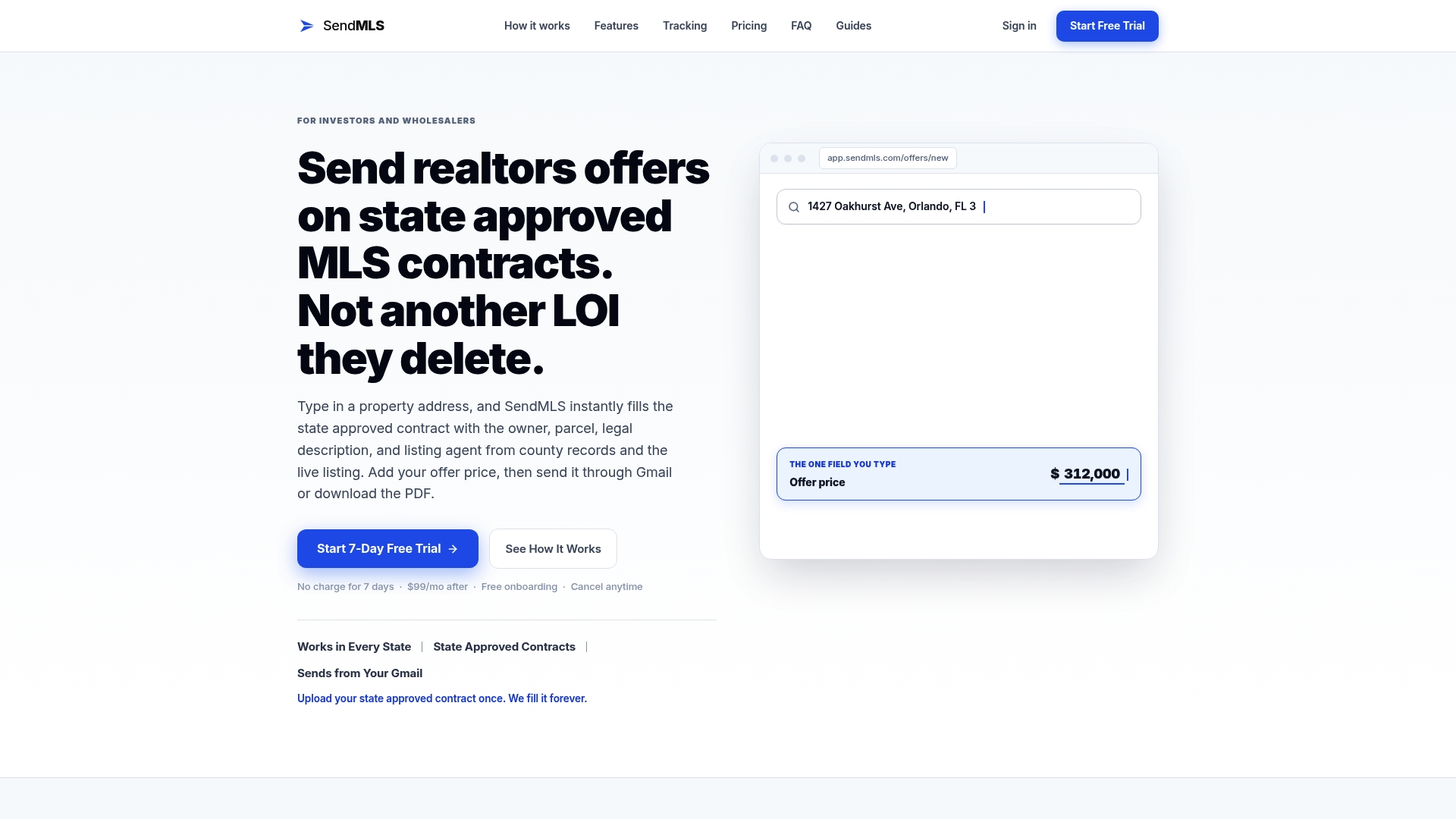
SendMLS auto-fills state-approved real estate contracts with the property details pulled from MLS and county data, then sends the completed offer straight from your Gmail so it lands as real paperwork, not a forwarded template. Open tracking tells you the moment a listing agent views your offer, so your follow-up call lands when the deal is top of mind rather than a week after the agent has moved on.
Solo land investors, wholesalers, and small acquisition teams all use it the same way: screen parcels, set your price, send. No VA rechecking fields, no wrong county on the contract, no guessing whether the offer was even opened. Start with a 7-day free trial at SendMLS — no setup required — and verify that your state’s approved template is loaded before your first send.
Useful sources and official references
The sources below are worth bookmarking for templates, recording guidance, and further reading on land purchase contracts.
| Source | Best used for |
|---|---|
| Colorado Division of Real Estate — Contract to Buy and Sell Real Estate (Land) | State-approved template example; illustrates standard clause structure for land-only transactions |
| Oklahoma Real Estate Commission — Land Contract Form | State-approved Oklahoma form; useful for understanding how state commissions structure land contracts |
| NC REALTORS / NC Bar Association — Offer to Purchase and Contract (Vacant Lot/Land) | North Carolina’s state-specific form; shows due diligence fee construct and escrow provisions unique to NC |
| Ohio State University Farm Office — What is a Land Contract? | Plain-language explanation of installment land contracts, particularly useful for agricultural parcels |
| NAR Consumer Guide: Multiple Listing Services | Background on MLS systems and how they function; useful for investors building MLS-based acquisition pipelines |
| Landmodo — How to Make an Offer on Land | Practical offer checklist, earnest money norms, and due diligence timelines for land buyers |
| Land Resellers — How to Make an Offer on Vacant Rural Land | Covers Statute of Frauds requirements and the enforceability of verbal vs. written offers |
Finding your state’s forms and county recorder: go to your state real estate commission’s website (search “[state name] real estate commission contract forms”) and your county recorder’s or registrar of deeds website for recording fee schedules and submission requirements. Both are primary sources; third-party aggregators often carry outdated versions.