Indiana Residential Purchase Agreement: 3 Checks Before You Send
Use an Indiana purchase agreement and run the three checks before sending: seller disclosure receipt, earnest money holder, and closing date to avoid...
Indiana Residential Purchase Agreement: 3 Checks Before You Send

Every enforceable Indiana residential purchase agreement needs the same backbone: a legal property description, purchase price, earnest money terms, financing details, closing date, and the seller’s disclosures attached before you sign. Download a template built on those fields, then check three things before you send anything: the Seller’s Disclosure, the earnest money instructions, and the closing date. Read on for the sample and the checklist that keeps you from missing a required piece.
TL;DR:
- Accurate legal descriptions from county records are crucial, as street addresses alone have caused deal cancellations and delays.
- Buyers have only two days after receiving Form 46234 to rescind the contract based on seller disclosures, making timing essential.
- Clear, specific clauses on earnest money, contingencies, and remedies significantly reduce disputes and legal risks in case of disagreements.
- Verifying all property, disclosure, and financial details before sending the offer prevents mechanical errors that can invalidate contracts.
- Automating contract generation with MLS data minimizes mistakes and speeds up sending offers, especially for high-volume or team-based real estate transactions.
Table of Contents
- What Goes Into An Indiana Residential Purchase Agreement
- When Must Indiana Sellers Disclose Property Condition?
- Contract Terms That Actually Decide Who Wins A Dispute
- How To Fill Out, Sign, And Deliver A Purchase Agreement
- Sample Contingency Language For Inspection, Financing, And Title
- Terminating Or Rescinding An Indiana Purchase Agreement
- Sample Agreement And A Pre-Send Checklist
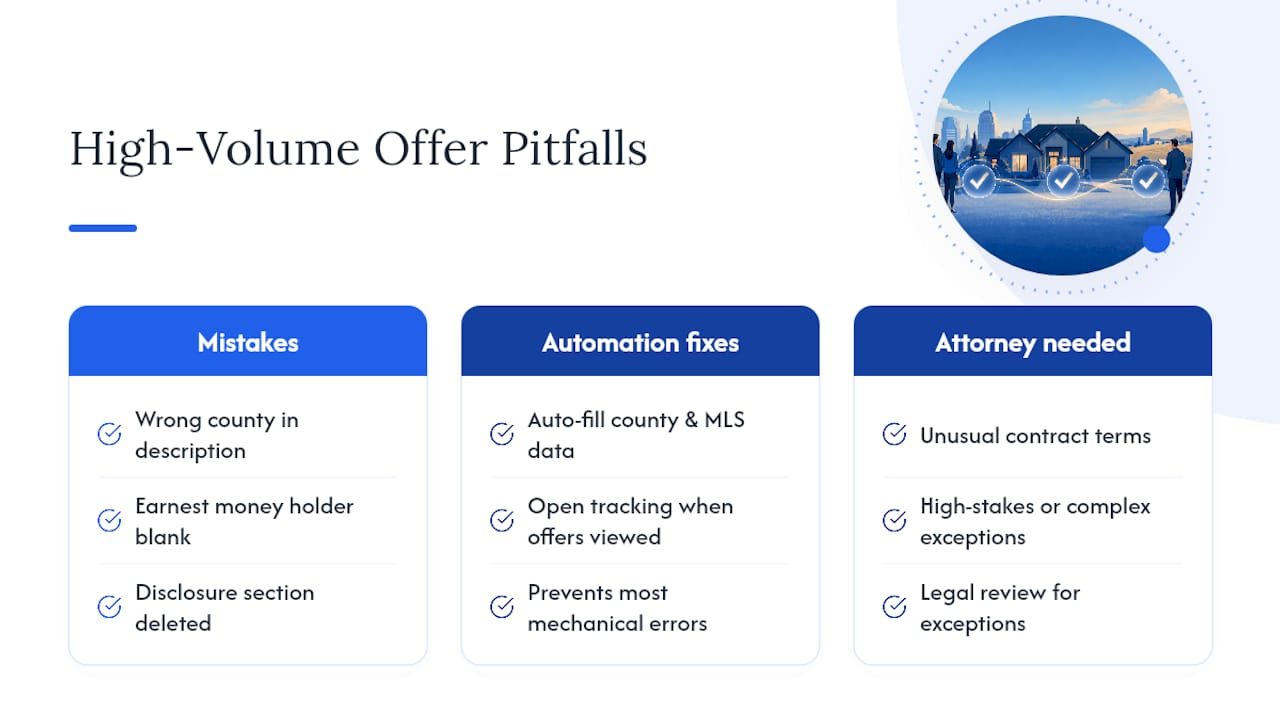
- [The mistakes that cost high-volume offer senders the most time aren’t legal, they’re mechanical: wrong county in the legal description, an earnest money holder left blank, a disclosure section deleted to save space. Automation that pulls county and MLS data directly into the contract fields removes most of that risk, and The complete guide to selling an investment property that helps investors understand and avoid these costly pitfalls effectively.](#the-mistakes-that-cost-high-volume-offer-senders-the-most-time-arent-legal-theyre-mechanical-wrong-county-in-the-legal-description-an-earnest-money-holder-left-blank-a-disclosure-section-deleted-to-save-space-automation-that-pulls-county-and-mls-data-directly-into-the-contract-fields-removes-most-of-that-risk-and-the-complete-guide-to-selling-an-investment-propertyhttpsmortgagesfastcablogselling-an-investment-property-that-helps-investors-understand-and-avoid-these-costly-pitfalls-effectively)
- What The Template Won’t Tell You
- Send More Indiana Offers Without Retyping Every Contract
- Sources
What Goes Into An Indiana Residential Purchase Agreement
A residential real estate agreement in Indiana lives or dies on a handful of fields. Get these wrong and you either delay closing or hand a judge a reason to void the deal.
Start with the parties: full legal names for every buyer and seller, matched exactly to how they’ll take or convey title. Then the legal property description, not just the street address. Pull it from the deed or the county assessor’s parcel record; “123 Maple St.” alone has voided more than one closing.
- Purchase price and earnest money: state the dollar amount, who holds the deposit (usually a title company or closing agent), and how it applies at closing.
- Financing method: check the box for cash, conventional, FHA, or VA, and note the lender’s approval deadline.
- Closing date and possession: name the date and specify whether the seller vacates at closing or under a short post-closing occupancy agreement.
- Inclusions and exclusions: list fixtures, appliances, and smart-home devices by name, e.g., “refrigerator, washer, dryer, and Ring doorbell included; workshop tools excluded.”
A sample Indiana residential purchase agreement lays these fields out in the order title companies expect to see them.
When Must Indiana Sellers Disclose Property Condition?
Indiana law requires sellers to complete the Seller’s Residential Real Estate Sales Disclosure, Form 46234, and deliver it to the buyer before an offer is accepted. It covers the roof, foundation, systems, and known defects, and the seller signs it under penalty of misrepresentation claims later.
Two other disclosures ride alongside it:
- Lead-based paint: federal law under 42 U.S.C. § 4852d requires a separate disclosure and pamphlet for any home built before 1978.
- HOA documents: if the property sits inside a homeowners association, attach the governing documents, current dues, and any pending special assessments as an addendum.
One detail catches almost everyone off guard: receiving the seller’s disclosure late gives buyers a narrow right to walk. Once the buyer actually receives Form 46234, Indiana gives them two days to rescind the agreement based on new information in it. It’s not a general cooling-off period. Indiana has no broad buyer’s remorse statute for real estate, so outside that two-day window tied specifically to disclosure receipt, you’re bound by the contract you signed.
Contract Terms That Actually Decide Who Wins A Dispute
Most disputes trace back to five clauses. Read these slowly, because vague language here is where deals fall apart.
- Earnest money: name the exact holder (title company, closing attorney, or brokerage escrow account) and the deposit deadline, typically 48 to 72 hours after acceptance.
- Financing and appraisal contingencies: state the lender approval deadline and what happens if the appraisal comes in low, credit adjustment, price renegotiation, or termination.
- Inspection clause: define what “inspection” covers, structural, mechanical, pest, and whether the buyer can demand repairs, request a credit, or terminate outright.
- Closing mechanics: who pays which closing fees, how property taxes prorate to the closing date, and exact possession language.
- Default and remedies: spell out what happens if either side backs out and how a mutual release gets signed and delivered.
The Indiana Real Estate Purchase & Sale Agreement guide shows how these clauses are typically worded in practice, and it’s worth comparing your draft against it before you send.
How To Fill Out, Sign, And Deliver A Purchase Agreement
Getting the paperwork right matters more than getting it fast. Here’s the order that avoids the most common mistakes.
- Verify names and the legal description. Pull the legal description from the county recorder, not the listing sheet, and confirm every buyer and seller name matches their ID.
- Enter price, deposit, and financing. Fill in the purchase price, name the earnest money holder, and check the correct financing box. Attach a preapproval letter or proof of funds if the listing agent will expect it.
- Set contingency timelines. Give yourself realistic windows, typically 7 to 10 days for inspection and 21 to 30 days for loan approval, and write them into the contract, not a side email.
- Sign and deliver. Email, fax, or hand delivery all work in Indiana as long as you can document receipt. Keep a timestamped copy of when the offer went out and when the agent confirmed it landed.
Pro Tip: Attach the addendum for any nonstandard term instead of hand-editing the printed form. Listing agents flag altered boilerplate faster than they read a clean addendum.
Sample Contingency Language For Inspection, Financing, And Title
Vague contingencies get argued over. Specific ones resolve themselves.
- Inspection: “Buyer may terminate, request repairs, or accept a credit in lieu of repairs within 10 days of the inspection report.” That gives both sides a clear menu instead of a standoff.
- Financing: “This agreement is contingent on buyer obtaining loan approval within 25 days. If the appraisal is below the purchase price, buyer may terminate or renegotiate.” Name the exact fallback, don’t leave it implied.
- Title and HOA: watch for unresolved liens, easements the seller didn’t disclose, or an HOA with pending litigation or unbudgeted special assessments.
Document every contingency resolution in writing, an email confirmation or signed addendum works, and keep it with the file. A verbal “we’re good” is worthless if the deal falls apart at closing.
Terminating Or Rescinding An Indiana Purchase Agreement
The two-day rescission tied to the Seller’s Disclosure only applies after you’ve actually received Form 46234, and the notice to cancel needs to go in writing to the seller or their agent, not a phone call.
Outside that window, contracts typically terminate for one of three reasons:
- Financing falls through inside the contingency deadline, triggering a documented termination and earnest money return.
- Inspection turns up a dealbreaker the seller won’t credit or repair.
- Both sides sign a mutual release, the cleanest exit when neither party is at fault.
Whatever the trigger, keep signed copies of every notice. Verbal cancellations create disputes that written ones avoid entirely.
Sample Agreement And A Pre-Send Checklist
A complete Indiana residential sales agreement template includes every field covered above, party names, legal description, price, earnest money terms, financing box, contingencies, closing date, possession, and inclusions/exclusions. Never strip out the disclosure attachment section just to shorten the document; it’s the piece that protects both sides later.
Before you send any offer, run this check:
| Field | Verify before sending |
|---|---|
| Party names | Match legal ID, not just the listing |
| Legal description | Pulled from county record, not street address |
| Earnest money | Amount, holder, and deposit deadline named |
| Disclosures | Form 46234, lead paint (if pre-1978), HOA docs attached |
| Closing date | Matches lender and title company availability |
If the deal involves an unusual structure, a trust, an LLC buyer, or a contingency outside the norm, get an attorney to review it before you sign. Templates cover the standard case well; they don’t replace judgment on the exception.
The mistakes that cost high-volume offer senders the most time aren’t legal, they’re mechanical: wrong county in the legal description, an earnest money holder left blank, a disclosure section deleted to save space. Automation that pulls county and MLS data directly into the contract fields removes most of that risk, and The complete guide to selling an investment property that helps investors understand and avoid these costly pitfalls effectively.
The mistakes that cost high-volume offer senders the most time aren’t legal, they’re mechanical: wrong county in the legal description, an earnest money holder left blank, a disclosure section deleted to save space. Automation that pulls county and MLS data directly into the contract fields removes most of that risk, and open tracking tells you the moment an agent actually views the offer instead of guessing whether to follow up. A platform earns its keep on repeat volume; unusual terms or high-stakes exceptions still belong with an attorney.
What The Template Won’t Tell You
Where most guides go wrong is treating the Seller’s Disclosure like a formality to skim past instead of the document that actually starts your rescission clock. If you don’t know the exact date you received Form 46234, you don’t know when your two-day window closes, and that’s a fact worth writing down the moment the disclosure lands in your inbox.
The other blind spot: buyers assume Indiana gives them a general cooling-off period like some states do. It doesn’t. Outside that narrow disclosure-triggered window, you’re bound the moment both sides sign. That’s not a technicality, it’s the whole reason earnest money exists.
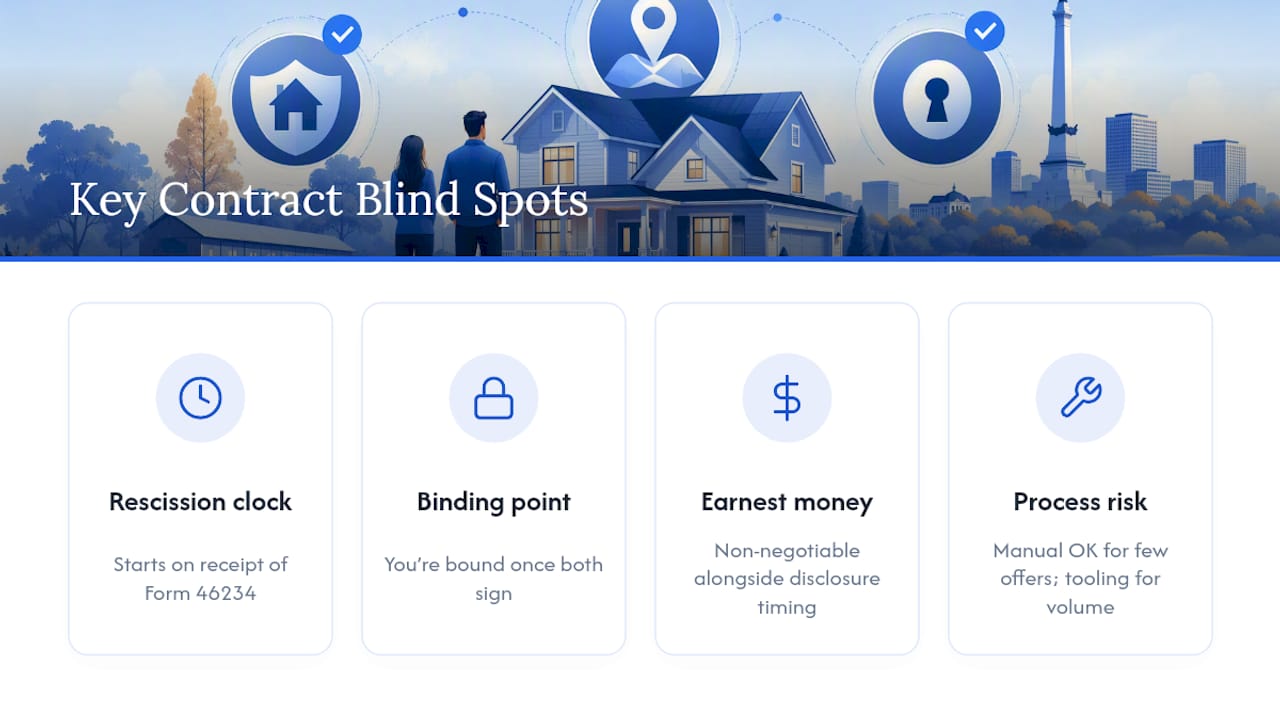
If you’re only sending a handful of offers a month, get comfortable with the manual process; it teaches you where the real risk sits. But if you’re sending offers at volume, on aged listings, on land parcels, across a team, the field-by-field mistakes multiply with every additional offer. That’s a mechanical problem, and mechanical problems get solved with better tooling, not more caffeine.
Prioritize the disclosure timing and the earnest money instructions first. Everything else in the contract is negotiable. Those two aren’t.
— Shane
Send More Indiana Offers Without Retyping Every Contract
If you’re preparing Indiana residential purchase agreements by hand, or paying a VA to do it, you already know where the errors creep in: wrong county, wrong closing date, a deposit instruction left blank because the form got copied from last week’s deal. SendMLS auto-fills state-approved contracts directly from county and MLS data, then sends them from your own Gmail so they land in the listing agent’s inbox as real paperwork, not a text they’ll ignore.
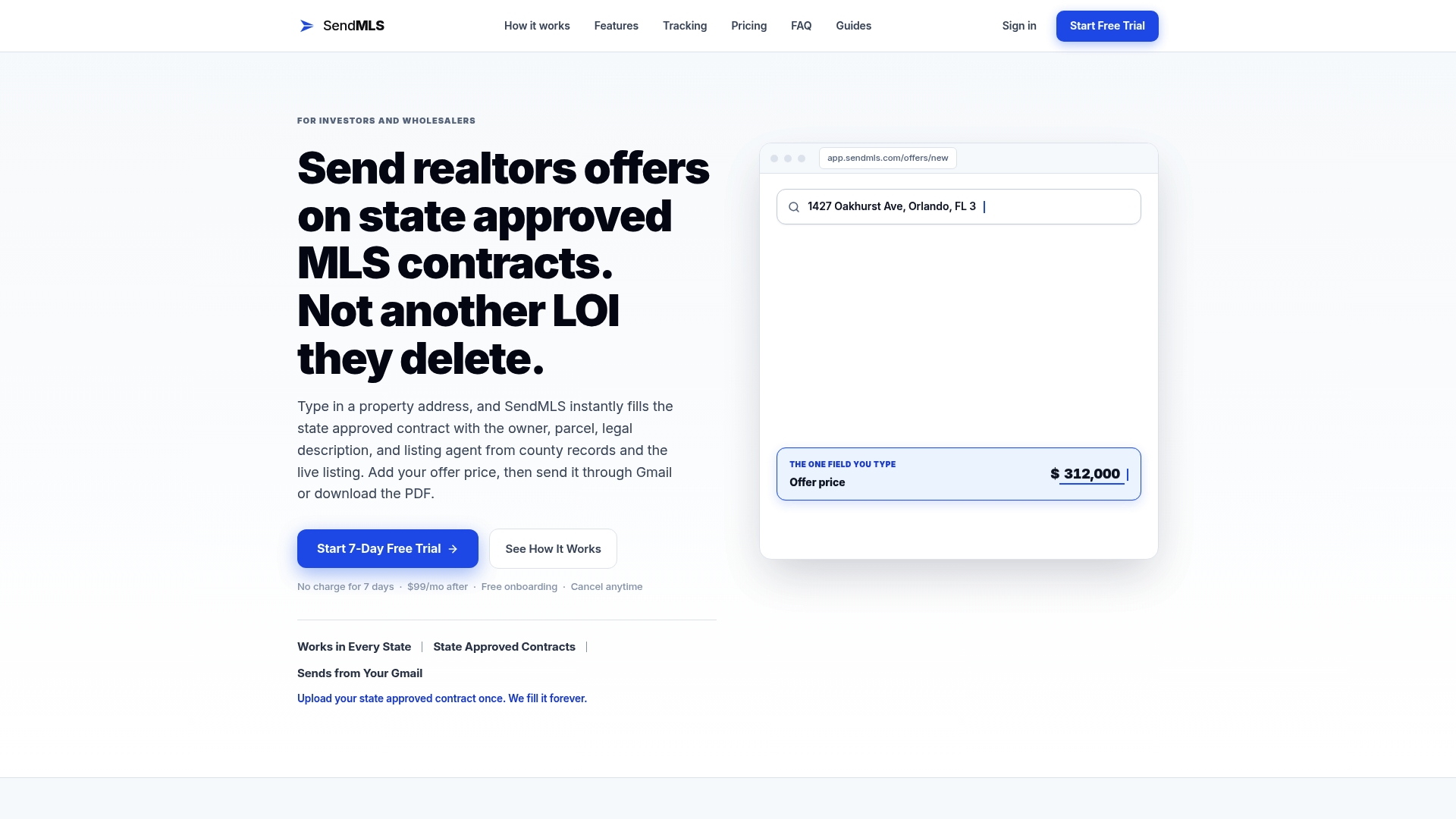
Solo wholesalers running the aged-listing play, land investors blasting county parcels before lunch, and acquisition teams juggling multiple reps all use it the same way: fill in the property details once, send, and watch open tracking tell you the moment the agent views the offer instead of guessing when to follow up. Start the 7 day free trial, no setup required, and populate one contract on a listing you’re already tracking to see how much faster it moves.
Sources
- 42 U.S. Code § 4852d - Lead-based paint disclosure
- Indiana Residential Purchase Agreement - eForms
- Indiana Residential Purchase Agreement (sample PDF)
- Indiana Real Estate Purchase & Sale Agreement (explainer + template)