Highest and Best Offer: Win More MLS Bids as an Investor
Boost your chances of winning MLS bids with a highest and best offer. Learn the key elements to submit an unbeatable package today!
Highest and Best Offer: Win More MLS Bids as an Investor

A highest and best offer is a seller’s request for every buyer’s single strongest price-and-terms package, submitted by a firm deadline. Unlike a “best and final” request, which signals no further negotiation, a highest-and-best round can still lead to a counter or a backup conversation. Your job is to submit a complete, verifiable package before the clock runs out.
Here’s what that package must include:
- A signed, state-approved purchase agreement (not a letter of intent or an email)
- Proof of funds or a verified preapproval letter
- All required addenda, completed and accurate
- Earnest money terms clearly stated, typically 1%–3% of the purchase price
- A cover letter or agent note that addresses the seller’s known priorities
According to Houzeo, homes often receive multiple offers, and a sizable portion sell above asking price. Multiple-offer situations are not the exception anymore. They’re the baseline.
Table of Contents
- When do sellers call for highest and best offers?
- What sellers actually care about when reviewing offers
- The complete checklist for a competitive offer package
- Risk versus reward: when to waive contingencies
- Step-by-step workflow for submitting a tracked offer
- Copy-ready templates for subject lines, cover letters, and escalation clauses
- Key Takeaways
- Why the software-first approach changes the outcome
- Sendmls gives you the workflow to compete at every deadline
- Useful sources
When do sellers call for highest and best offers?
A highest-and-best request usually surfaces within the first week of listing, often after an open house or a burst of showing activity. Low inventory, a well-priced home, or a listing that went viral on social media can all trigger it. The listing agent typically sets a deadline, often 24–48 hours out, sometimes less.
What happens after that deadline is less predictable than most buyers expect. The seller reviews all submissions with their agent, then accepts, counters, or asks for backup offers. There’s no obligation to pick the highest price. Sellers can choose any non-discriminatory offer that best meets their goals.
Deadlines are enforced to the hour. A submission that arrives 20 minutes late can be excluded without explanation. Confirm receipt immediately after sending, then follow up with a call to the listing agent.
Pro Tip: Ask the listing agent directly: “Has the seller set a firm deadline, and is there a preferred delivery format?” That one question can tell you whether to send a PDF, use a portal, or call in the offer.
What sellers actually care about when reviewing offers

Price matters, but it’s rarely the only thing. Sellers weigh net proceeds, certainty of closing, timeline flexibility, deposit size, and possession terms. A cash buyer offering $10,000 less than a financed buyer with a shaky preapproval often wins.
Primary seller priorities, roughly in order:
- Net proceeds after commissions, concessions, and closing costs
- Certainty of closing (cash, verified financing, waived contingencies)
- Closing timeline (faster is usually better, but some sellers need more time)
- Earnest money deposit size as a signal of commitment
- Possession and rent-back terms when the seller hasn’t found their next home
Buyers should ask their agents to find out what the seller values most so the offer can be tailored to closing speed, rent-back needs, or inspection tolerance. Public signals help too: listing remarks that mention “as-is” or “quick close preferred” tell you a lot before you ever pick up the phone.
Pro Tip: Check days on market. A listing sitting for 30+ days is a different negotiation than one that went to highest and best on day three. Sellers in the first scenario are often more flexible on terms.
The complete checklist for a competitive offer package
Every field matters. An incomplete offer is easy to deprioritize when a listing agent has five other submissions in their inbox.
Contract and documentation:
- Signed state-approved purchase agreement with accurate legal description and MLS number
- All required addenda (lead paint, HOA, as-is, etc.) completed in full
- Earnest money amount stated clearly, typically 1%–3% of purchase price
- Closing date that reflects the seller’s preferred timeline
Financial strength documentation:
- Preapproval letter or Verified Approval from a lender, dated within 30 days
- Proof of funds (POF) for cash offers or down payment verification
- POF language should state: “Buyer has verified liquid funds of $[amount] available for the purchase of [property address], available upon request.”
Offer terms to sharpen:
- Appraisal gap language with a defined cap (e.g., buyer covers up to EX above appraised value)
- Escalation clause with a verification requirement (more on that below)
- Contingency choices documented clearly, with any waivers explicitly stated
- Flexibility note on closing date if the seller’s timeline is unknown
Delivery:
- Single PDF package, not multiple attachments
- Sent via tracked email so you know when it’s opened
- Follow-up call to the listing agent within 10–30 minutes of sending
Risk versus reward: when to waive contingencies
Waiving contingencies is the fastest way to move up the stack. It’s also the fastest way to lose your earnest money if something goes wrong.
| Contingency | Benefit of Waiving | Financial Exposure |
|---|---|---|
| Inspection | Signals speed and confidence | Unknown repair costs, structural defects |
| Financing | Removes lender uncertainty | Lose earnest money if loan falls through |
| Appraisal | Eliminates low-appraisal risk for seller | Buyer covers gap between price and appraised value |
Waiving contingencies makes an offer stand out but creates significant financial risk if problems surface later. The practical middle ground: waive inspection for cosmetic issues only, keep a financing contingency unless you’re paying cash, and cap your appraisal gap in writing rather than waiving it entirely.
Inspection issues and appraisal shortfalls are two of the most common reasons deals collapse. There’s a real difference between flagging a cracked foundation (worth negotiating) and nitpicking a loose doorknob (which signals you’re looking for an exit).
Escalation clauses add a layer of complexity. They’re useful in competitive markets, but only when written correctly. A well-drafted escalation clause must require the seller to provide proof of the competing offer that triggered the escalation. Without that clause, you can be forced to overpay based on an unverified claim.
Pro Tip: Set a hard ceiling on your escalation clause and stick to it. If the property escalates past your number, let it go. Overpaying in a competitive moment is how investors end up underwater.
Step-by-step workflow for submitting a tracked offer
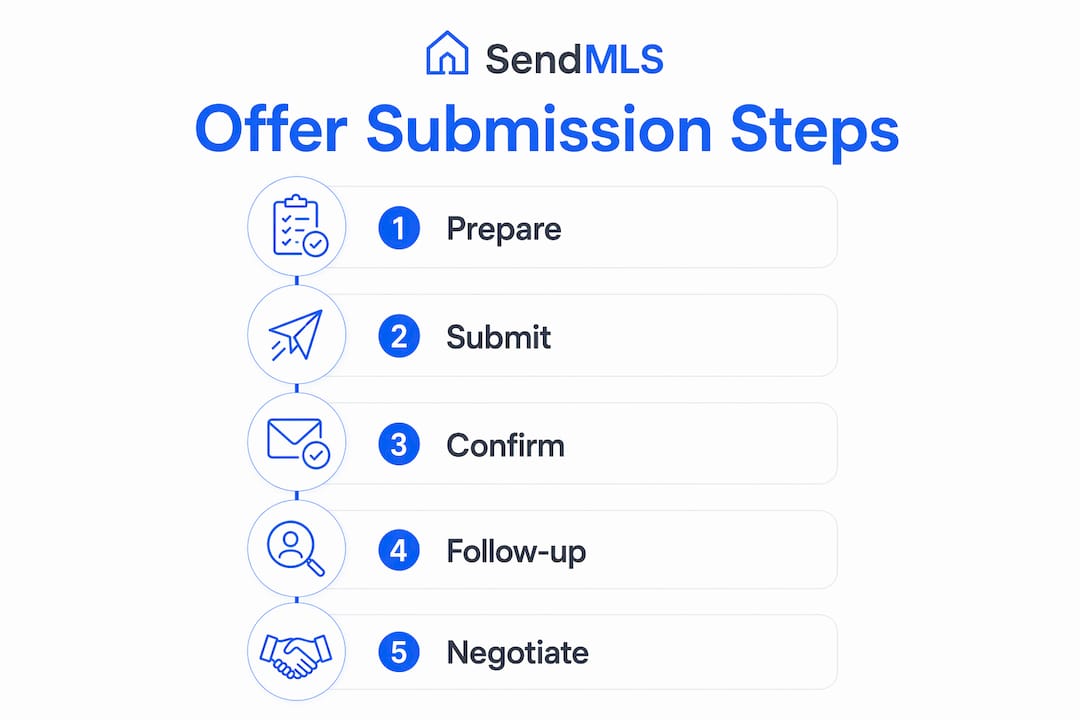
This is where software pays for itself. Manual offer submission via email attachments and phone calls works, but it’s slow and leaves no audit trail.
- Pull the state-approved contract template for the property’s state and autopopulate it with MLS and county data.
- Complete all addenda and attach the POF or preapproval letter.
- Generate a single PDF with all documents in one file.
- Send via Gmail integration with open-tracking enabled so you know the exact moment the listing agent opens it.
- Call the listing agent within 10–30 minutes of sending to confirm receipt and ask one question about seller priorities.
- Log the outcome in your offer pipeline: accepted, countered, backup requested, or rejected.
Tools like Sendmls autopopulate state-approved contracts from MLS data, send directly from Gmail, and timestamp every open. That timestamp matters: if a listing agent claims they never received your offer, you have proof.
For investors submitting offers without an agent, the state-approved contract is non-negotiable. A letter of intent or a text message won’t be taken seriously in a multiple-offer situation.
Pro Tip: Use saved templates for your POF language and cover letter so you can respond to a highest-and-best request in under 15 minutes. Speed is a competitive advantage when deadlines are tight.
After sending, follow up twice: once by phone immediately, once by email the next morning if you haven’t heard back. If the seller requests backup offers, ask to be first in line. Many primary contracts fail, and a signed backup can convert without another bidding round.
Copy-ready templates for subject lines, cover letters, and escalation clauses
Email subject line:
Offer for [Property Address] — [Your Name/Company] — [Offer Price] — State-Approved Contract Attached
Short cover letter script:
We are pleased to submit our offer of $[amount] for [property address]. We have attached a fully executed state-approved purchase agreement, proof of funds, and all required addenda. Our earnest money deposit is $[amount], and we can close in [X] days. We are flexible on possession date if needed. Please confirm receipt at your earliest convenience.
Proof-of-funds wording:
Buyer confirms liquid funds of $[amount] are available for the purchase of [property address]. Documentation is available upon request and can be verified within 24 hours.
Escalation clause template (short form):
Buyer agrees to increase their offer by $[increment] above any bona fide competing offer, up to a maximum purchase price of $[ceiling]. Seller must provide written documentation of the competing offer before this escalation takes effect.
Customize these by market: in attorney-review states like New Jersey or Illinois, note that the offer is subject to attorney review. For as-is properties, remove any inspection-contingency language and replace it with an explicit as-is acknowledgment.
Key Takeaways
A winning highest-and-best offer combines a complete, state-approved contract with verified financial strength, smart contingency choices, and a tracked delivery that proves the listing agent received it.
| Point | Details |
|---|---|
| Complete the full package | Submit a signed state-approved contract, all addenda, and POF or preapproval in one PDF. |
| Deadlines are absolute | Submissions late by minutes can be excluded; confirm receipt immediately and follow up by phone. |
| Terms often beat price | Sellers weigh certainty, closing speed, and deposit size alongside the dollar amount. |
| Escalation clauses need verification | Require written proof of the competing offer before the escalator triggers to avoid overpaying. |
| Sendmls maps to every step | State-approved contracts, Gmail integration, open-tracking, and pipeline logging cover the full workflow. |
Pro Tip: If you don’t win the primary position, ask to be placed as the first backup offer. A surprising number of deals fall through, and a signed backup converts without another round of bidding.
Why the software-first approach changes the outcome
Most investors lose highest-and-best rounds not because their price was wrong, but because their package was incomplete, late, or invisible. A listing agent with five offers in their inbox will prioritize the one that arrived on time, looks professional, and uses the right contract form.
The shift to a tracked, state-approved submission process removes the three most common failure points: wrong contract form, no delivery confirmation, and slow follow-up. When you know the agent opened your offer at 2:14 PM, you call at 2:20 PM. That’s not luck. That’s a process.
Sendmls gives you the workflow to compete at every deadline
Winning a competitive bid comes down to speed, completeness, and proof of delivery. Sendmls is built specifically for investors and wholesalers who need to move fast without sacrificing contract quality.
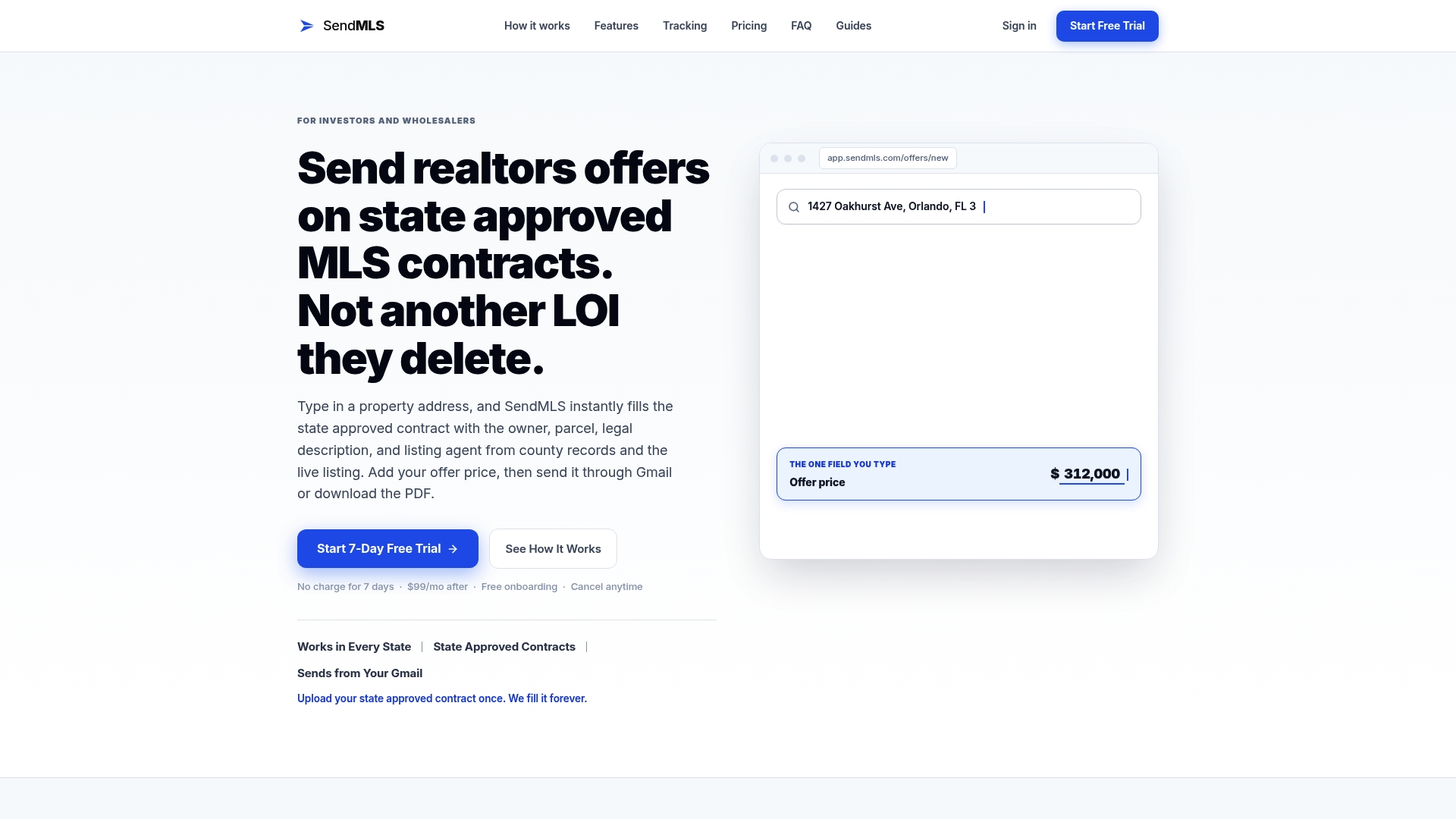
Sendmls autopopulates state-approved contracts from MLS and county data, sends offers directly from your Gmail account with open-tracking, and organizes every submission in a pipeline with reminders. You get the timestamp that proves delivery, the correct contract form that listing agents recognize, and the follow-up structure that keeps you from missing a response window. Bulk submission tools let you run multiple highest-and-best rounds simultaneously without losing track of any of them.
Start with the 7-day free trial and submit your first tracked, state-approved offer today. No long-term contract required.
Useful sources
- Houzeo: Multiple Offers and Highest and Best — market data on offer volume and above-asking sales; supports urgency framing.
- Redfin: Highest and Best Offer — explains the distinction between highest-and-best and best-and-final rounds.
- LegalClarity: What to Include and Win — escalation clause verification requirements, contingency risk, and deadline enforcement.
- Realtor.com: Highest and Best vs. Best and Final — broker guidance on tailoring offers to seller priorities and backup offer strategy.
- Rocket Mortgage: Highest and Best Offer — earnest money ranges and financial strength documentation.
- Inman: Highest and Best, Price, and Contingencies — industry coach perspective on inspection behavior and appraisal failure patterns.