Earnest Money Strategies for Buyers and Investors
Unlock effective earnest money strategies to protect your investment. Discover how to make competitive offers while safeguarding your funds.
Earnest Money Strategies for Buyers and Investors

The single most effective approach is pairing a market-calibrated deposit with staged terms that keep your money refundable until the biggest risks clear. Industry norms place typical deposits between 1%–3% of purchase price. In competitive markets, sellers routinely expect 5%–10% as a credibility signal. Three tactics get you most of the way there immediately:
- Match local norms first. For a typical home in a balanced market, an earnest money deposit aligned with local expectations is standard. In hotter seller’s markets, larger deposits are commonly seen as necessary to be competitive.
- Stage your deposit. Start with a smaller refundable amount, then escalate to a larger hard deposit only after inspection and financing clear. You protect capital without looking weak.
- Prove funds and use neutral escrow. Attach a bank statement or proof-of-funds letter with the offer. Wire to a licensed title company or escrow holder, never directly to the seller.
Avoid aggressive hard money when your cash reserves are thin, financing is unconfirmed, or you cannot realistically meet contingency deadlines. The deposit you can’t afford to lose is the one you shouldn’t put at risk.
Pro Tip: If you need to be competitive but cautious, offer a small refundable initial deposit in the contract, then add a clause committing to a larger second deposit within three business days after inspections clear. You signal seriousness without going hard on day one.
Key Takeaways
Sizing your deposit to local market norms, staging when money goes hard, and documenting every contingency notice are the three practices that most consistently protect buyers and win deals.
| Point | Details |
|---|---|
| Size to market norms | Use 1%–3% as a baseline; expect 5%–10% in hot seller’s markets to be competitive. |
| Stage deposits to control risk | Start with a refundable initial deposit; escalate to hard money only after inspection and financing clear. |
| Always use neutral escrow | Pay to a licensed title company or escrow agent named in the contract; never wire directly to the seller. |
| Document every contingency notice | Send written termination or removal notices before each deadline; the timestamp is your legal protection. |
| SendMLS for volume workflows | SendMLS auto-fills state-approved contracts, attaches proof of funds, and tracks offer opens to time deposit follow-up. |
Table of Contents
- What is earnest money and how does it move through a deal?
- How much earnest money should you offer?
- How to structure earnest-money terms in your offer
- What earnest-money signals actually move sellers
- How to protect your earnest money deposit
- What happens when earnest money disputes arise?
- Investor and wholesaler workflows for high-volume offers
- Contract language and documents that protect your deposit
- The tradeoff most buyers get wrong
- SendMLS makes high-volume earnest-money workflows faster
- Sources
What is earnest money and how does it move through a deal?
Earnest money is a good-faith deposit a buyer submits with or shortly after an accepted offer. It sits in a neutral account held by a title company, escrow agent, or real estate attorney depending on the state, and it is credited toward the buyer’s down payment or closing costs at closing. It is not an extra fee. The money moves from your account into escrow and then straight to your closing settlement statement.
The neutral holder matters more than most buyers realize. Escrow or title companies protect both parties and simplify dispute resolution; when funds sit with a licensed third party, neither the buyer nor the seller can unilaterally access them. That structure is what gives the deposit its legal weight.
Key transaction trigger points:
- Offer accepted / mutual acceptance (effective date established)
- Earnest money due: typically 1–3 business days after effective date
- Escrow confirmation receipt received
- Inspection window opens and closes (written notice required to cancel)
- Financing and appraisal contingency deadlines
- Hard date: deposit becomes non-refundable if contingencies are waived or deadlines pass
- Closing: deposit credited to buyer’s settlement
The phrase “time is of the essence” in a purchase contract is not boilerplate. It means missing a deadline by even one day can cost you the deposit. Calendar every trigger point the moment the contract is signed.
How much earnest money should you offer?
The right amount depends on three variables: local market temperature, purchase price, and how much of that deposit you could absorb as a loss. NAR notes that buyers in hot seller’s markets sometimes offer deposits of 5%–10% to strengthen offers, while 1%–3% is the practical baseline in most markets.
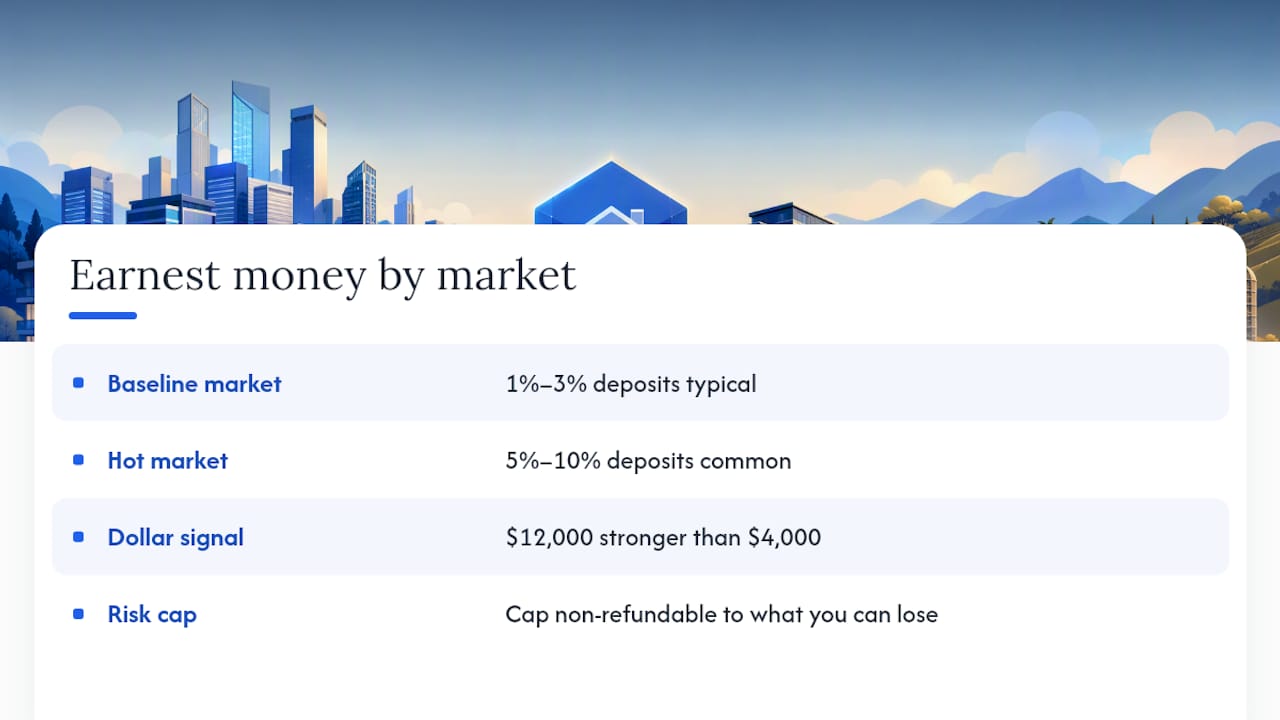
Price matters too. Sellers read the dollar figure, not just the percentage.
In a multiple-offer situation, $12,000 reads meaningfully stronger than $4,000, and if your financing is solid and inspections are clean, you’ll get it back at closing anyway.
Pro Tip: Cap the hard (non-refundable) portion at the maximum dollar amount you could genuinely afford to lose. Use the percentage as a competitive signal, but set your personal risk ceiling in dollars before you write the offer.
How to structure earnest-money terms in your offer
The structure of your deposit terms often matters more than the raw dollar amount. A well-structured offer tells the seller exactly when money becomes real, which is what they actually care about.
Staged deposit structure
The most flexible approach splits the deposit into two tranches. The first is a smaller refundable amount due within 1–3 business days of acceptance. The second is a larger amount that becomes non-refundable after a defined milestone, typically inspection clearance, financing approval, or both. Commercial and investor-focused purchase agreements commonly use this pattern: a soft period during due diligence, then a hard date when the bigger deposit locks in.

Hard money and when it makes sense
Offering a fully non-refundable deposit from day one is a powerful signal in a bidding war, but it transfers nearly all risk to the buyer. Reserve this for deals where you have already done significant pre-offer diligence, your financing is essentially certain, and the upside justifies the exposure. Investors who flip or wholesale should almost never go hard on day one without a clear exit.
Sample offer structures
- Balanced buyer-friendly: $8,000 refundable deposit (3 business days), full contingency package (inspection, financing, appraisal), 10-day inspection window, 21-day financing contingency. Money stays refundable through due diligence.
- Aggressive investor offer: $5,000 refundable initial deposit, second deposit of $15,000 going hard 5 days after inspection period ends, shortened 7-day inspection window, pre-approval attached. Signals speed and commitment without full early exposure.
- Wholesale-style structure: $1,000–$2,500 initial deposit, option/assignment language where permitted by state law, longer due-diligence window to allow for buyer identification, second deposit contingent on assignment execution.
Risk tradeoffs at a glance:
- Balanced structure: lowest risk, moderate competitiveness, best for first-time buyers or uncertain financing
- Aggressive structure: moderate risk, high competitiveness, best for investors with clear exit and solid financing
- Wholesale structure: minimal early capital, lower seller confidence, best for motivated sellers on aged listings
What earnest-money signals actually move sellers
Sellers are not reading your deposit amount in isolation. They are reading certainty. A higher deposit says “I won’t walk away over something minor.” A faster deposit timeline says “I’m organized and ready.” A non-refundable component says “I’ve already decided.” Each of those signals addresses a different seller fear.
High-impact tactics that actually shift seller decisions:
- Show proof of funds with the offer. A bank statement or lender letter attached to the offer email removes the seller’s first doubt before they even ask.
- Offer faster deposit timing. Committing to deposit within 24 hours instead of 3 business days is a concrete signal that costs you nothing if you’re ready.
- Shorten the inspection window. Dropping from 10 days to 7 days tells the seller you’re not going to drag out due diligence looking for an exit.
- Propose partial early release. Offering to release a portion of the deposit to the seller after inspection clears (with both parties’ consent) is rare and memorable.
- Combine tactics strategically. A larger deposit paired with a shorter inspection period beats a large deposit alone. A smaller deposit paired with an escalation clause and a proof-of-funds letter can beat a larger bare deposit.
When you’re presenting these terms in a cover letter or through your agent, keep the language short and specific. “Buyer will deposit $12,000 within 24 hours of acceptance; $8,000 becomes non-refundable upon inspection removal” is clearer and more credible than a paragraph of reassurances.
Pro Tip: A seller who lost a previous buyer to cold feet values faster deposit timing and a non-refundable component far more than a seller who has never had a deal fall through. Ask your agent about the seller’s history before you structure the offer.
Listing agents also influence how your offer lands — a well-packaged offer with clear deposit terms is harder to dismiss than a vague one.
How to protect your earnest money deposit
The most common way buyers lose legitimate deposits is not fraud. It’s missed deadlines and poor documentation. The second most common is wire fraud. Both are preventable.
Core protection checklist:
- Pay only to a neutral third-party escrow holder named in the contract. Never wire to the seller, the seller’s agent, or any account not explicitly listed in the signed agreement.
- Use a wire transfer to a licensed title company or escrow agent, or a cashier’s check. Personal checks are generally not accepted and create proof-of-delivery problems.
- Get a written escrow deposit receipt. This is your proof the money arrived on time.
- Keep timestamped copies of every email and written notice related to contingencies.
- Send inspection termination or financing denial notices in writing, before the deadline, to both the escrow holder and the listing agent.
- Store your signed contract, escrow receipt, inspection report, and any lender denial letters in one folder. If a dispute arises, you’ll need all of them.
On escrow instructions specifically: well-drafted escrow instructions should require dual-signature release, meaning both buyer and seller must authorize any disbursement. This significantly reduces interpleader risk and makes dispute outcomes cleaner. If your escrow instructions don’t include that language, ask your agent or attorney to add it before you sign.
Submitting offers without an agent puts more of this documentation responsibility on you directly, so the checklist above becomes even more critical.
What happens when earnest money disputes arise?
Most disputes follow a predictable pattern: the buyer believes they are entitled to a refund, the seller disagrees, and escrow is stuck in the middle holding the funds. NAR notes that escrow release typically requires both listing and buyer agent sign-off, or an interpleader action filed by the escrow company. That means neither party gets the money until someone blinks or a court decides.
Scenarios where earnest money is refunded:
- Buyer terminates during a valid inspection contingency window with written notice
- Lender issues a formal denial and buyer provides written notice before the financing deadline
- Appraisal comes in low and buyer exercises the appraisal contingency in writing
- Seller breaches the contract (fails to disclose, can’t deliver clear title, backs out)
- Home-sale contingency is invoked and buyer’s property doesn’t sell in time
Scenarios where earnest money is forfeited:
- Buyer walks away without a contract-protected reason
- Buyer misses a contingency deadline and the protection lapses
- Buyer waived contingencies and then backs out anyway
- Buyer fails to deposit funds on time, giving seller grounds to cancel
If a dispute appears, act immediately:
- Pull the contract and locate the exact contingency language and deadlines
- Gather every timestamped notice, inspection report, lender denial letter, and escrow receipt
- Notify your agent and the escrow holder in writing the same day
- Do not agree to anything verbally without written confirmation
Dispute resolution paths run from cheapest to most expensive: mutual release (both parties sign), mediation, arbitration, interpleader (escrow files with a court), and litigation. In practice, many sellers prefer returning the deposit rather than spending months in arbitration over $10,000. A practical settlement offer — “release the deposit and we walk away cleanly” — often resolves disputes faster than any formal process.
Involve a real estate attorney the moment the other party refuses a mutual release. Timing matters: most arbitration clauses have notice deadlines, and missing them can affect your options.
Investor and wholesaler workflows for high-volume offers
The investor approach to earnest money is fundamentally different from a retail buyer’s. You’re not buying one home every few years. You’re running a pipeline, and every dollar tied up in a deposit is a dollar not available for the next deal.

The staged deposit blueprint
The cleanest investor workflow runs in three phases:
- Discovery and initial offer: Submit a conservative refundable deposit ($500–$2,500 for most wholesale deals; slightly higher for fix-and-flip). Wholesalers commonly use initial deposits in the $500–$5,000 range to limit early exposure while signaling enough seriousness to get a response.
- Active due diligence: Run inspections, confirm title, verify ARV or assignment viability. Keep the deposit fully refundable during this window.
- Escalation to hard money: Only after red flags clear, step up to the larger hard deposit. Cap that hard amount at a fraction of your expected profit — a common rule of thumb is keeping hard money below 25% of your expected assignment fee.
Operational controls for volume offers
When you’re making 20–100+ offers a month, manual tracking breaks down fast. The controls that matter most:
- Standardized contingency templates so every contract has the same deadline structure and you’re not re-reading each one to find the hard date
- Per-deal risk caps set before the offer goes out, not after you’re emotionally invested
- A single escrow partner who knows your workflow and can process deposits quickly
- Calendar automation for every contingency deadline tied to the effective date
How SendMLS fits the investor workflow
Automation is where volume investors recover the most time. SendMLS generates state-approved contracts pre-filled with property details from MLS data, attaches proof-of-funds documents, and sends offers directly from your Gmail so they arrive as real paperwork rather than a text or a generic email. Open tracking tells you the moment a listing agent views the offer, which is the right time to follow up on deposit terms or escalate to a second deposit conversation.
For investors running the aged-listing strategy, where you’re targeting properties that have been sitting 180+ days, the combination of a low initial deposit and a fast, professional offer package is exactly the right signal. The seller is tired of waiting. A clean contract with a small refundable deposit and a clear escalation path is often more persuasive than a higher offer with sloppy paperwork.
Sample three-deal pipeline:
Pro Tip: For wholesale deals, use low initial EMD plus option/assignment language where your state permits it. For off-market deals, a promissory-note structure is sometimes used, but only with documented seller consent and legal review. Never use promissory notes on MLS-listed properties without confirming it’s acceptable to the listing agent and compliant with your state’s contract requirements.
Contract language and documents that protect your deposit
The contract clause is where strategy becomes enforceable. Vague language about “reasonable time” or “as soon as possible” creates disputes. Specific language closes them before they start.
Clause examples to adapt with your agent or attorney:
- Deposit timing: “Buyer shall deliver earnest money of $[amount] to [Escrow Holder Name], [Address], within three (3) business days of the Effective Date of this Agreement.”
- Hard date: “The earnest money deposit shall become non-refundable upon Buyer’s written removal of the inspection contingency, or on [specific calendar date], whichever occurs first.”
- Business day definition: “Business days are defined as Monday through Friday, excluding federal holidays. The Effective Date is the date of last signature.”
- Dual-signature release: “Escrow Holder shall not disburse funds without written authorization signed by both Buyer and Seller, or pursuant to a court order.”
- Dispute path: “In the event of a dispute, Escrow Holder is authorized to file an interpleader action and shall be held harmless for costs incurred in doing so.”
Escrow instruction additions worth requesting:
- Interest handling: specify whether deposit earns interest and who receives it
- Interpleader authorization: confirm escrow can file without further instruction if parties disagree
- Release conditions: list every condition under which funds may be released to either party
Attachments to include with the offer:
- Proof of funds (bank statement, brokerage account, or lender letter)
- Pre-approval or lender commitment letter
- Inspection scheduling confirmation (shows you’re ready to move)
- Brief cover letter stating deposit timing and any non-refundable commitments
Delivery and confirmation checklist:
- Send the signed offer and escrow instructions to the listing agent and escrow holder simultaneously
- Request written acknowledgment from escrow that funds were received and the effective date is confirmed
- Set calendar reminders for every contingency deadline the day the contract is signed
- Save all agent acknowledgment emails with timestamps
- Confirm contingency removal or termination notices are sent in writing before each deadline, not on the deadline day
How listing agents handle and present offers affects whether your deposit terms even reach the seller’s attention, which is another reason clean paperwork and clear language matter from the first submission.
The tradeoff most buyers get wrong
The conventional wisdom on earnest money is to offer as much as you can afford to look competitive. That’s not wrong, but it misses the more important variable: the structure of when money becomes hard matters more than the total amount.
A buyer who offers $20,000 fully refundable is taking less real risk than a buyer who offers $10,000 non-refundable from day one. Sellers and their agents often don’t distinguish between these clearly, which means a well-structured staged deposit can signal more commitment than a larger flat deposit, while actually protecting the buyer better.
The other thing most buyers underestimate is documentation. Winning a refund dispute almost always comes down to whether you sent written notice before the deadline, not whether you had a good reason to cancel. The inspection report, the lender denial letter, the timestamped email — those are your actual protection, not the contingency language alone. The contingency is the right; the written notice is the exercise of it.
For investors running volume, the operational discipline around deadlines and deposit tracking is where deals are won and lost. One missed contingency notice on a $15,000 hard deposit is a $15,000 lesson. Automation and standardized templates exist precisely to prevent that.
SendMLS makes high-volume earnest-money workflows faster
Volume investors spend 10–15 minutes per offer when they do it manually. Multiply that by 50 offers a month and you’ve spent a full workweek just filling in contracts. SendMLS cuts that to minutes per offer by auto-filling state-approved purchase contracts with MLS property data, so the county, closing date, and property details are already in the contract before you review it.
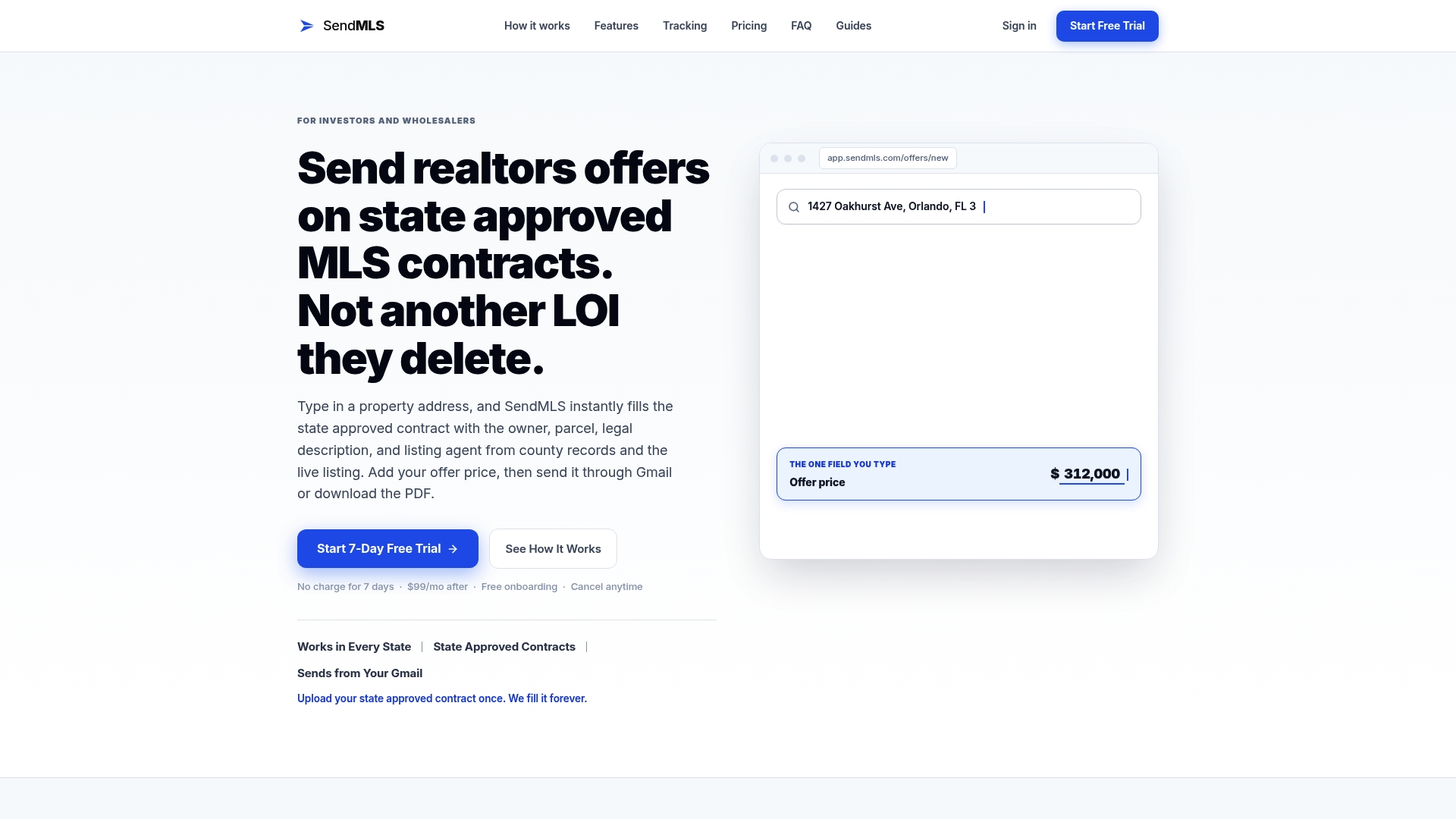
Proof-of-funds attachments go out with every offer. Escrow contact details drop into the contract automatically. Offers send from your Gmail, so listing agents receive real paperwork from a real person rather than a forwarded PDF or a text message. Open tracking shows you the exact moment an agent views your offer, which is when to follow up on deposit terms or push for a response. For teams, every rep sends from their own Gmail and all opens appear in one shared pipeline.
The 7-day free trial requires no setup. Start submitting offers at volume on SendMLS and see how many more deals move to the deposit stage when your paperwork arrives looking like it came from a serious buyer.
Sources
The sources below back the guidance in this guide. For jurisdictional rules, always confirm current requirements with a local real estate attorney or your title/escrow company, since state-specific practices on deposit timing, escrow holders, and contingency language vary materially.
- Earnest money in real estate: refunds, returns and regulations | NAR
- When do you pay earnest money? Deadlines and refunds | LegalClarity
- When is earnest money due? | Redfin
- Earnest money | Opendoor
- Earnest Money Strategies for Wholesalers | Deal Run
- How to Negotiate Earnest Money Terms — The Fractional Analyst
This article provides general educational information about earnest money practices in the United States. It is not legal advice. Consult a licensed real estate attorney in your state before relying on any contract language or deposit structure for a specific transaction.
This article is general information, not a substitute for advice from a qualified lawyer. Consult a qualified legal professional about your own circumstances before acting on anything here.