Avoid 35+ Deadline Traps: Colorado CBS1 (2026), DRE Form & Fast Offers
Download the mandatory 2026 CBS1 from the Colorado DRE. Protect 35+ deadlines, complete high risk fields correctly, attach required disclosures, and send...
Avoid 35+ Deadline Traps: Colorado CBS1 (2026), DRE Form & Fast Offers

The official Colorado residential purchase contract is the CBS1, formally the Contract to Buy and Sell Real Estate (Residential). You download it directly from the Colorado Division of Real Estate’s contracts and forms page, and the version now in play carries a Commission-mandated use date of on or after January 1, 2026. Any older version circulating in a broker’s file or a wholesaler’s template folder is out of compliance, and the form itself warns that signing it carries real legal consequences.
TL;DR:
- Only the Colorado Division of Real Estate’s current CBS1 form, adopted on or after January 1, 2026, is legally valid for residential transactions; using outdated versions can lead to legal penalties.
- Deadlines such as earnest money, inspections, and closing dates are strictly enforced, making careful deadline tracking essential to avoid default or loss of earnest money.
- Accurate completion of high-risk fields like legal descriptions, party names, and earnest money instructions prevents title issues, delays, or disputes at closing.
- Attach all relevant addenda and disclosures, including HOA documents and lead-based paint notices, as missing disclosures can create legal liabilities post-closing.
- Automating offer submissions through tools like SendMLS reduces errors, accelerates delivery, and improves follow-up on stale listings, especially when handling multiple offers monthly.
Table of Contents
- Where to Download the Colorado Contract to Buy and Sell Real Estate
- What the CBS1 Contract Covers: Key Sections and Deadlines
- How to Complete the High-Risk Fields Correctly
- Common Contingencies and Addenda Tied to CBS1
- Broker Rules, Mandatory Forms, and Recent Earnest Money Legislation
- Can You Write Your Own Purchase Contract in Colorado?
- Practical Checklist: Submitting an Offer Without Mistakes
- How Automation Cuts Errors When You’re Sending Volume Offers
- Statutory Disclosures Required With Colorado Contracts
- Default and Remedies Under Colorado Contract Law
- Escrow and Closing in Colorado Real Estate
- What Actually Trips People Up on This Contract
- A Faster Way to Get Colorado Offers in Front of Agents
- Sources
- FAQ
Where to Download the Colorado Contract to Buy and Sell Real Estate
Skip the generic template sites and go straight to the source. The Colorado Division of Real Estate hosts every Commission-approved form as a free PDF, in both clean and redline versions so you can see exactly what changed between revisions. That matters this year because the entire 2026 contract suite got an overhaul, not just the residential form.
Here’s what you’ll find on the DRE page and how to use each one:
- CBS1 (Residential) covers standard single-family, condo, and townhome purchases. It’s the form most buyers and sellers in Colorado will ever touch.
- CBS1 (Foreclosure Protection Act) applies when the property is in foreclosure and triggers extra statutory disclosures that a standard sale doesn’t require.
- Income-Residential version is built for properties with existing tenants or income-producing residential units, like a duplex with a lease in place.
- Commercial and Land versions swap out residential-specific clauses (HOA disclosures, lead paint language) for terms relevant to raw acreage or commercial buildings.
Before you fill anything in, check the header. Every current CBS form states its adoption date and the date it becomes mandatory for licensed use. The 2026 commercial variant, for example, shows an adoption date of August 5, 2025, with mandatory use starting January 1, 2026. That same pattern applies across the CBS3, CBS4, and CBSF1 forms. If your PDF’s header doesn’t match those dates, you’re looking at a superseded version.
A rule of thumb that saves confusion: match the form to the property, not the buyer’s intent. A land investor planning to eventually build a house still uses the Land contract, not CBS1, because the contract governs what’s being conveyed today. If a deal has unusual layers, like a residential property with a foreclosure notice already filed, you don’t draft new language into CBS1. You attach the correct addendum or switch to the Foreclosure Protection Act version entirely. The printed portions of these forms can’t be altered except under the narrow allowances in 4 CCR 725-1-7.2, so when in doubt, use an addendum rather than editing the base contract.
What the CBS1 Contract Covers: Key Sections and Deadlines
The CBS1 is organized less like a traditional legal document and more like a project timeline with legal teeth. Once you understand its skeleton, the whole thing gets a lot less intimidating.
The contract opens with party identification and property description, moves through price and financing terms, and then hits its most consequential section: Dates, Deadlines and Applicability. This section functions as the master clock for the entire transaction. Every other clause in the contract references back to a date set here, so an error in this table doesn’t stay contained. It ripples through inspection rights, financing contingencies, and your ability to walk away with earnest money intact.
The current CBS1 form identifies more than 35 distinct events and deadlines buyers and sellers need to track across a typical transaction.
The deadlines that actually decide whether a deal closes cleanly:
- Earnest money deadline. The date by which the buyer must deliver earnest money to the holder named in the contract, typically a title company or brokerage.
- Record title and off-record title deadlines. Windows for the buyer to review title commitment documents and raise objections.
- Survey deadline. If a survey is ordered, the date by which it must be delivered and reviewed.
- Inspection and due diligence deadline. The window for the buyer to inspect the property and negotiate repairs, credits, or termination.
- Appraisal deadline. Relevant when financing is contingent on the property appraising at or above the purchase price.
- Loan conditions and credit information deadlines. Dates tied to the buyer’s financing approval process.
- Closing date. The date title transfers and funds change hands.
That’s over 30 checkpoints in a single transaction, which is precisely why high-volume investors and wholesalers making dozens of offers a month find deadline tracking becomes the actual bottleneck, not deal sourcing.
Pro Tip: Build your own deadline calendar the moment a contract is signed. Don’t rely on remembering the contract’s language “days after acceptance” versus “days after Effective Date.” Those two phrases calculate differently, and mixing them up is one of the most common ways buyers accidentally waive an inspection contingency they meant to keep.
Missing a deadline in the CBS1 isn’t a soft failure. The contract treats most deadlines as strict cutoffs. Miss the inspection objection deadline, and you’ve typically accepted the property in its current condition, full stop. Miss the earnest money deadline, and depending on how the seller responds, you could be in default before the deal ever gets to closing. The form’s language around time limits is deliberately unambiguous because Colorado courts have consistently enforced these dates as written, not as intended.

How to Complete the High-Risk Fields Correctly
Most contract disputes in Colorado real estate don’t come from exotic legal issues. They come from someone rushing through a handful of fields that look simple but aren’t.
The fields that cause the most problems, and how to get them right:
- Party names and vesting. Write the exact legal name of every buyer and seller, and specify how title will be held (joint tenants, tenants in common, an LLC). A mismatch between the contract name and the deed name creates title company headaches at closing.
- Legal description vs. street address. The street address is convenience text. The legal description, pulled from the county assessor or a prior deed, is what actually gets recorded. Copy it character for character. A dropped lot number or wrong subdivision name can stall a closing by days.
- Purchase price and payment terms. State the total price in figures, not just words, and make sure the financing section (cash, conventional loan, seller financing) matches what you actually intend. Ambiguity here invites renegotiation later.
- Earnest money instructions. Name who holds the earnest money, exactly how much, and by what deadline it must be delivered. “Title company” isn’t specific enough if there are two title companies involved in the deal; name the actual entity.
- Date fields. Use actual calendar dates where the form allows it, not relative language you’ll have to calculate later. When the form requires a day count, double check whether it’s calendar days or business days, since Colorado contracts increasingly specify business days for closing-fund related events.
Signature mechanics matter more than most first-time buyers realize. A contract isn’t “accepted” until every required party has signed and that signed copy has been delivered back to the other side. A verbal “yes” from a listing agent, or a signed offer sitting unopened in someone’s inbox, is not acceptance under Colorado contract law. Delivery is part of the legal act, not a formality that happens afterward.
Common Contingencies and Addenda Tied to CBS1
The CBS1 contract’s contingencies are what give buyers room to walk away, negotiate, or adjust price without losing earnest money, but only if they’re exercised inside the deadlines set earlier in the form.
The inspection and due diligence contingency is the broadest of these. It lets the buyer inspect the property and then choose from a handful of paths: request the seller make repairs, request a price credit, or terminate the contract entirely and get earnest money back. Sellers aren’t obligated to agree to repair requests, which is why many Colorado deals end up as a negotiated middle ground rather than a full repair list getting honored.
Title and survey objections work on a similar logic but narrower grounds. If the title commitment reveals a lien, easement, or encumbrance the buyer didn’t expect, the buyer can object within the title deadline. The seller then has an opportunity to cure the issue, often by paying off a lien before closing, or the parties negotiate a credit. Unresolved title objections that go undocumented in writing tend to become the murkiest part of a dispute later, so put every objection and cure agreement in writing, even a short email exchange.
Addenda exist to handle situations the base CBS1 wasn’t written for:
- HOA addendum applies to any property inside a homeowners association, since Colorado law requires specific disclosures about HOA documents and fees.
- Manufactured home addendum covers properties where the structure is titled separately from the land, which changes how the sale is legally structured.
- Foreclosure-related addenda or the dedicated Foreclosure Protection Act contract apply when the seller is in default on their own mortgage.
Attaching the wrong addendum, or skipping one that should apply, doesn’t just create paperwork gaps. It can leave a buyer without disclosures state law requires, which becomes a liability problem for the broker involved, not just an inconvenience for the buyer.
Broker Rules, Mandatory Forms, and Recent Earnest Money Legislation
Licensed Colorado brokers don’t have discretion about which contract to use. The Commission requires Commission-approved forms for the transaction types they cover, and the DRE explicitly directs brokers to confirm they’re using the most current version and to flag discrepancies if a third party hands them an outdated or altered form.
That obligation extends beyond the purchase contract itself. Broker engagement contracts, the agreements that create the buyer or seller representation relationship, face their own restrictions. Colorado statute prohibits engagement contracts from including certain provisions, like language that would create a recordable lien or a covenant running with the land.
Statutory text restricts what a broker engagement contract can include, and the Commission enforces these limits directly, meaning brokers cannot draft around the rule by adding their own custom lien or covenant language to a listing agreement.
This isn’t a paperwork technicality. It’s a limit on how much leverage a broker’s own contract can hold over a seller’s property after the relationship ends.
Earnest money rules changed meaningfully with recent legislation. Under HB24-1094, developers can accept earnest money directly under specific conditions tied to accredited-investor disclosures, and closing procedures now require confirmation that funds are actually deposited before closing proceeds, generally at least one business day ahead.
What buyers and sellers should confirm with their title company or escrow agent before closing day:
- The earnest money was deposited with the correct holder, not just promised.
- Closing funds are confirmed as received, not just wired, with enough lead time to satisfy the one-business-day rule.
- Any developer-held earnest money arrangement includes the required investor disclosures.
Buyers who want a deeper walkthrough of how earnest money actually moves through a transaction can find more detail in SendMLS’s guide to earnest money strategies.
Can You Write Your Own Purchase Contract in Colorado?
Sometimes, yes. Homebuilders selling new construction, REO sellers offloading bank-owned property, and certain developers commonly use their own proprietary purchase agreements instead of the CBS1. These exceptions exist because those sellers aren’t operating through a standard resale transaction, and their forms typically address construction warranties or lender-owned property conditions that CBS1 was never built to cover.
That flexibility has limits, though. A licensed broker representing a client remains subject to Commission rules even when the other side hands over a non-standard form. The Commission’s broker responsibility guidance makes clear that using a proprietary form doesn’t excuse a broker from their duties to their own client.
Steps that reduce risk when a non-standard form shows up in a deal:
- Have the brokerage’s office policy specify when proprietary forms are acceptable and who has to review them first.
- Route any unfamiliar builder or developer contract through legal counsel before a client signs, not after.
- Document why a non-Commission form was used, especially if it replaces required disclosures rather than supplementing them.
For sale-by-owner sellers and buyers without an agent, the honest answer is that you technically can draft custom terms into a private sale agreement, but doing so without legal review is where most FSBO disputes originate. The CBS1’s protections exist because Colorado’s contract law has been tested against its exact language for years. A hand-drafted alternative hasn’t been. If you’re navigating a transaction without an agent involved, SendMLS’s guide on submitting offers without a listing-side agent walks through what still needs to happen correctly on the paperwork side.
Practical Checklist: Submitting an Offer Without Mistakes
Getting an offer accepted in Colorado’s competitive market often comes down to submitting a clean, complete package the first time. Listing agents are quick to set aside anything that looks sloppy.
- Confirm you’re using the current CBS1 form, dated for use on or after January 1, 2026. Check the header against the version on the DRE site.
- Fill in every critical field: exact legal names, correct legal description, clear purchase price, and complete financing terms.
- Spell out earnest money instructions naming the specific holder and the exact deadline for delivery.
- Attach every relevant addendum, whether that’s an HOA addendum, inspection resolution addendum, or a lead-based paint disclosure for pre-1978 construction.
- Get every required signature, including any counteroffer initials if the deal went through a round of negotiation.
- Include proof of funds or a preapproval letter so the listing agent isn’t left guessing whether the offer is credible.
- Double check every deadline field reads as an actual date, not a placeholder or a mismatched day count.
For delivery, a signed PDF sent as a real email attachment, from a real person’s account, still outperforms text messages or offer letters typed into an email body. Listing agents routinely skip anything that doesn’t look like an actual contract. Follow up within a day or two if you haven’t heard back, since silence on an aged listing usually means the offer got buried, not rejected.
The mistakes that get offers set aside fastest: using a superseded contract version, leaving the legal description blank or copying only the street address, writing vague earnest money language like “held by escrow,” and submitting a PDF missing a signature page. Every one of these is preventable with a five-minute review before you hit send.
How Automation Cuts Errors When You’re Sending Volume Offers
Filling out a CBS1 by hand for one offer is manageable. Filling it out correctly 40 times a month, with a different legal description, seller name, and county every time, is where manual entry starts producing exactly the mistakes covered in the checklist above.
This is the problem SendMLS was built around. You map the Commission-approved contract once, and the platform autofills owner, parcel, legal description, and agent details pulled from county and MLS data for whatever property you’re targeting next. That single mapping step is what prevents the recurring version-control and typo errors that come from a VA retyping the same form dozens of times a week.
Where the time and error savings actually show up:
- No more re-checking a VA’s work for wrong counties, wrong closing dates, or a mismatched legal description.
- Offers go out from your own Gmail account, so they land in a listing agent’s inbox as real signed paperwork rather than a template email.
- Open tracking tells you the moment an agent views the offer, so follow-up timing is based on data instead of a guess.
Pro Tip: If you’re running 20 or more offers a month on aged inventory, the deadline-tracking problem in the CBS1’s Dates and Deadlines section compounds fast. Automating the fill-in step frees up the time you actually need to track those 30-plus deadlines across every open deal.
Land investors blasting low offers across county listings and small acquisition teams running multiple reps both hit this same wall eventually: the contract itself doesn’t get faster to fill out just because you’re sending more of them. You can browse more workflow breakdowns on the SendMLS blog or see how the mapping process works on the SendMLS product page.
Statutory Disclosures Required With Colorado Contracts
Colorado law requires several disclosures to travel with the CBS1, and skipping one isn’t a minor oversight. It can expose the seller and the broker to liability after closing.
The Seller’s Property Disclosure form, while not always mandatory in every transaction, is the standard practice for informing buyers about known defects, and most brokerages require it as office policy even when it’s not strictly required by statute. Properties built before 1978 require a federal lead-based paint disclosure, since Colorado follows the same federal requirement every state does. Properties inside a homeowners association require HOA document disclosures, giving buyers a window to review governing documents, financials, and fee schedules before they’re locked in.
Sellers using the Foreclosure Protection Act version of the contract have additional disclosure obligations tied specifically to the property’s foreclosure status, since that statute was written to prevent buyers from being blindsided by a distressed sale’s unique risks.
None of these disclosures get folded into the CBS1’s printed text. They’re delivered as separate attachments or addenda, which is exactly why the checklist in the earlier section treats “attach every relevant addendum” as its own line item rather than an afterthought. A buyer who never received a required disclosure has grounds to raise it later, sometimes well after closing, which is part of why brokers treat disclosure delivery as seriously as the contract signature itself.
Default and Remedies Under Colorado Contract Law
The CBS1 spells out what happens when one side doesn’t perform, and the remedies differ depending on who’s in default.
If a buyer defaults, meaning they fail to close or perform without a valid contingency to fall back on, the contract typically gives the seller two paths: keep the earnest money as liquidated damages, or pursue actual damages through specific performance or a lawsuit. Most sellers choose the earnest money route because it’s faster and doesn’t require litigation, but the contract preserves the option to pursue more if the earnest money doesn’t cover the seller’s actual loss.
If a seller defaults, the buyer generally has the option to seek specific performance, forcing the sale to go through, or to terminate and recover the earnest money along with certain costs. Specific performance is a real remedy in Colorado, not just theoretical language, though pursuing it means committing to litigation timelines that can outlast the property’s original closing date by months.
The critical detail buyers and sellers both miss: these remedies only apply cleanly when the default is genuine, meaning a deadline was truly missed with no valid contingency in play. A buyer who terminates within their inspection deadline isn’t in default at all. That’s the entire reason the Dates and Deadlines section carries so much weight. Whether you’re even in a default scenario depends entirely on whether a deadline was met, waived, or missed, which is why documentation of every deadline event matters far more than it seems to during a smooth transaction.
Escrow and Closing in Colorado Real Estate
Colorado closings run through a title company acting as the escrow and closing agent in the overwhelming majority of residential transactions, rather than through attorney-conducted closings common in some other states.
The title company holds earnest money, orders the title commitment, coordinates with the buyer’s lender if financing is involved, and prepares the closing statement. Under the earnest money and closing legislation referenced earlier, funds now need to be confirmed as actually deposited before closing proceeds, generally at least one business day ahead, rather than simply wired and assumed to have landed.
Colorado closings typically happen at the title company’s office or, increasingly, through a remote e-closing process for out-of-state or investor buyers. Both buyer and seller sign closing documents, the title company disburses funds, and the deed gets recorded with the county, usually the same day or the next business day. Recording is what actually transfers legal title, not the signing itself, so a closing that happens Friday afternoon might not record until the following Monday, a detail that matters if you’re timing a resale or need proof of ownership immediately.
The confirmed-deposit requirement exists specifically because closing-day fund confusion, money that was “sent” but not yet “available,” used to create last-minute delays. Confirming funds ahead of time rather than on closing day itself has become standard practice for a reason.
What Actually Trips People Up on This Contract
Three things separate a clean Colorado transaction from a messy one, and none of them require a law degree to get right.
First, confirm the form version before anything else. The CBS1 changes periodically, and the 2026 mandatory-use date makes this the wrong year to be working off a form you downloaded three years ago. Second, protect your deadlines like they’re the actual contract, because legally, they are. The purchase price and party names get attention naturally. The Dates and Deadlines section is where deals quietly fall apart. Third, verify earnest money handling specifically, not generally. “It’s with the title company” isn’t verification. A confirmed deposit is.
The red flags worth pausing on: a contract with vague or missing deadline dates, a legal description that’s clearly copied from the wrong parcel, and earnest money language that doesn’t name a specific holder. Any one of those should stop you before you sign, not after.
None of this replaces professional judgment. If a deal involves a defaulting party, a foreclosure, an unusual title issue, or language you don’t fully understand, bring in a real estate attorney or lean on an experienced title company before you’re past the point of easy correction. The contract is standardized. The situations it gets used in are not.
— Shane
A Faster Way to Get Colorado Offers in Front of Agents
SendMLS is the alternative to the manual contract-filling grind this entire article just walked through. Instead of retyping the CBS1 for every listing, or paying a VA to do it and then rechecking their work for the wrong county or a stale legal description, you map the state-approved contract once and let it autofill from real county and MLS data for whatever property you’re targeting next.
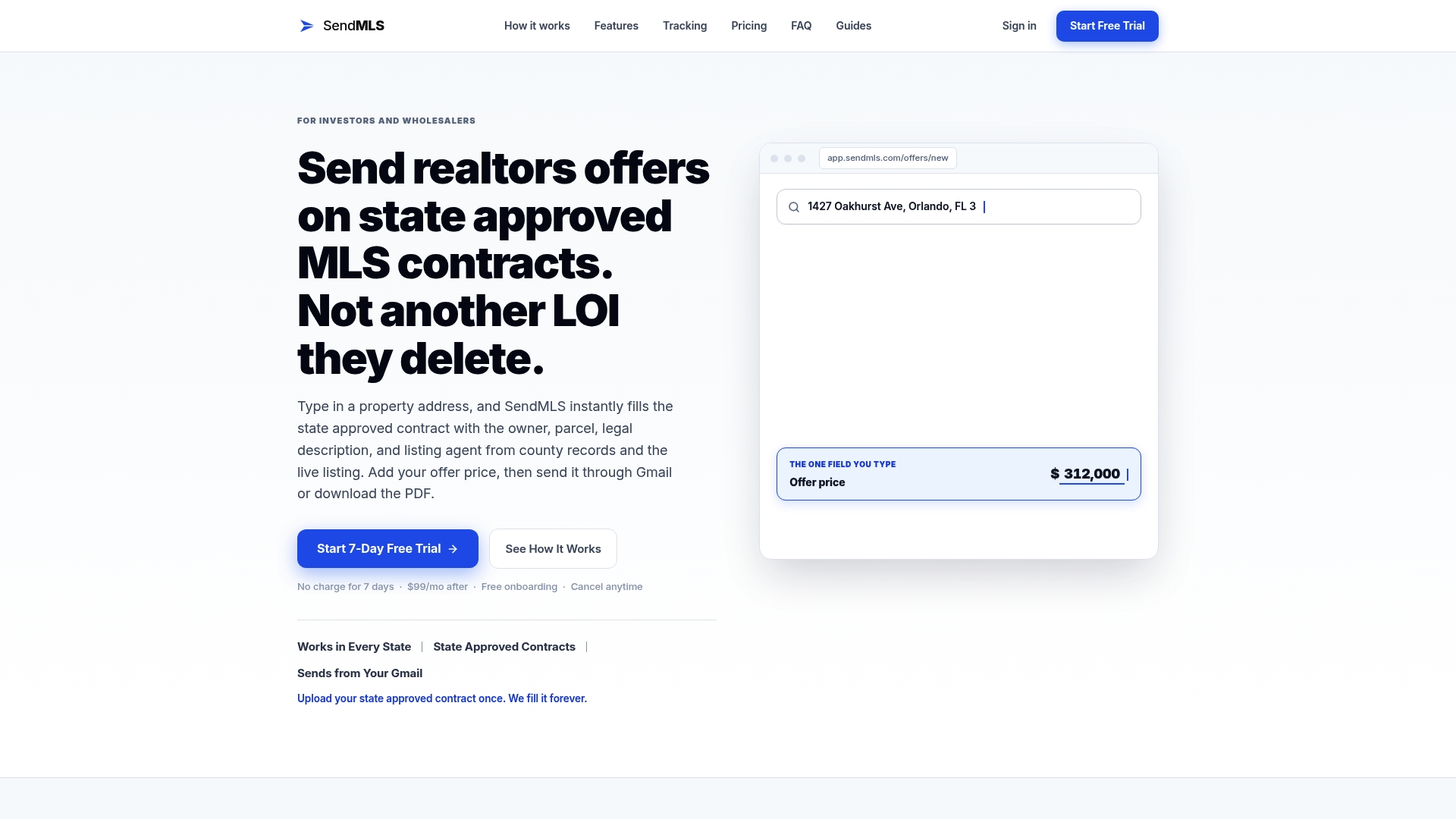
Offers send from your own Gmail account, so they arrive looking like what they are: real signed paperwork from a real buyer, not a template email an agent scrolls past. Open tracking shows you the exact moment an agent views the offer, which turns your follow-up timing into something based on data instead of a guess. That matters most on the aged, stale listings where most other investors have already stopped watching, and where a fast, clean, correctly-filled contract is often the only thing separating your offer from getting ignored.
SendMLS runs on one plan with everything included, priced at $99 per month, with a 7-day free trial and no setup required. If you’re already sending offers manually and hating every minute of the data entry, starting a trial may help you get more offers out the door faster.
This article is general information, not a substitute for advice from a qualified lawyer. Consult a qualified legal professional about your own circumstances before acting on anything here.
Sources
For anyone verifying details in this article firsthand, these are the primary sources worth bookmarking:
- Real Estate Broker Contracts and Forms
- HB24-1094 (earnest money / developer deposits) - Session law text
These are government and legislative sources, not secondary summaries, so they’re the right place to check anything before you sign.
FAQ
Can I Write My Own Purchase Agreement in Colorado?
You can in specific situations, like a FSBO sale or a homebuilder using a proprietary form, but licensed brokers are generally required to use Commission-approved forms such as CBS1 for standard residential sales. A hand-drafted agreement skips the protections built into the CBS1’s tested contract language, so legal review is strongly recommended before using custom terms.
What Is an Exclusive Right to Buy Contract in Colorado?
An exclusive right to buy contract is the broker engagement agreement a buyer signs with their agent, giving that agent the exclusive right to represent the buyer for a set period. It’s a separate document from the CBS1 purchase contract, and Colorado statute restricts certain terms these engagement contracts can include, such as language creating a lien on the buyer’s future purchase.
Is Colorado a Buyer’s or Seller’s Market Right Now?
Market balance shifts by county and price point, and conditions change throughout the year, so there’s no single statewide answer that holds everywhere at once. Aged listings, the ones sitting on the MLS the longest, tend to favor buyers regardless of the broader market label, which is exactly why volume-offer strategies target that inventory specifically.
What States Have Real Estate License Reciprocity With Colorado?
Colorado has cooperative reciprocity arrangements that let licensees from certain other states qualify for a Colorado license more easily, though the exact list and requirements change periodically. Anyone relocating a license into Colorado should verify current reciprocity terms directly with the Colorado Division of Real Estate rather than relying on older lists.
Where Do I Get the Current, Mandatory-Use CBS1 Form?
The current CBS1, mandatory for use on or after January 1, 2026, is available free as a fillable PDF on the Colorado Division of Real Estate’s contracts and forms page. Always check the form’s header for its adoption and mandatory-use dates before using it in a transaction.
How Does SendMLS Help With Colorado Offers Specifically?
SendMLS maps the Commission-approved Colorado contract once, then autofills property, owner, and legal description details for any listing you’re targeting, cutting out the manual re-entry that causes version and field errors. It costs $99 per month with a 7 day free trial and no setup required.