Real Estate Assignment Clauses for Wholesalers: Exact Language
See sample assignment language, what to attach, and how state disclosure rules affect wholesalers. Use contract checks to prevent failed assignments.
Real Estate Assignment Clauses for Wholesalers: Exact Language

An assignment clause lets a buyer transfer their rights under a purchase agreement to another party before closing, and under U.S. contract law that transfer is generally allowed by default unless the contract or a statute says otherwise. The catch for wholesalers: a growing number of states now require written disclosure and give sellers rescission rights when a contract gets assigned, so the default rule only tells half the story.
TL;DR:
- Ohio, Maryland, and Louisiana impose wholesaler disclosure requirements, and missing or defective notices can trigger seller cancellation rights; requirements include signed acknowledgments and placement rules.
- An assignment alone usually leaves the original buyer liable if the assignee defaults, so seek a seller’s written release or negotiate a novation.
- Put assignability language in the offer, verify the assignee’s funds, and document the fee, deposit treatment, obligations, and written seller notice before closing.
- Choose a double closing when taking title is preferable: it avoids assignment liability but requires two transactions, duplicated closing costs, and potentially difficult financing.
Table of Contents
- What an Assignment Clause Is and How Assignability Works
- How an Assignment Transaction Actually Proceeds
- Sample Clause Language and a Template Checklist
- State Rules on Wholesaler Disclosure and Assignment
- Drafting Checklist for Assignable Purchase Agreements
- Assignment vs. Novation vs. Double Close
- Reducing Assignment Errors With Contract Automation
- Why Procedure Is the Real Competitive Edge in 2026
- A Tool for Keeping Assignment Language Consistent
- FAQ
- Sources
What an Assignment Clause Is and How Assignability Works
An assignment clause is contract language that spells out whether, and how, a buyer can hand off their contractual position to someone else before closing. When a buyer assigns a purchase agreement, they are not selling real estate. They are transferring their equitable interest, the right to buy the property under the agreed terms, to a new party called the assignee.
Under U.S. contract law, rights and duties in a contract are generally assignable and delegable unless the agreement contains an express restriction, a statute prohibits the transfer, or the performance involves a substantial personal interest that only the original party can satisfy. That default presumption is why most residential purchase agreements are assignable unless a seller specifically negotiates a restriction into the contract.
Clause phrasing typically falls into a few recognizable patterns:
- “And/or assigns” language: the buyer is named as “Buyer and/or assigns,” which puts the seller on notice at signing that the buyer may transfer the contract.
- Express assignment grants: a standalone clause stating the buyer has the right to assign the agreement without needing further written consent.
- Conditional consent clauses: language requiring the seller’s written approval before any assignment takes effect, sometimes with a “not to be unreasonably withheld” qualifier.
- Outright prohibitions: a flat statement that the agreement is personal to the buyer and may not be assigned, which some listing agents insert specifically to block wholesaling.
Assignment, delegation, and novation are related but distinct. An assignment transfers the buyer’s rights (the benefit of the bargain) to the assignee. Delegation shifts performance obligations, such as paying the purchase price, to that same party, governed in commercial transactions by concepts like UCC § 2-210, which clarifies when an obligee’s substantial interest in personal performance blocks delegation. A novation goes further: it substitutes the assignee entirely for the original buyer and releases the original buyer from the contract altogether.
That distinction matters most when something goes wrong after closing. A simple assignment, without a seller’s written release, typically leaves the original buyer secondarily liable if the assignee fails to perform. The seller can still look to the original signer for damages unless the assignment agreement includes an explicit release or the parties execute a novation instead. Investors who assign contracts regularly should treat a signed release from the seller as a core deal term, not an afterthought, since it is the only mechanism that fully closes the loop on liability.
How an Assignment Transaction Actually Proceeds
Assigning a contract follows a predictable sequence once you understand the mechanics. Each step protects a specific point of failure in the deal.
- Write the purchase agreement as assignable from the start. Include “and/or assigns” after the buyer’s name or attach an express assignment clause at the offer stage, before the seller signs. Trying to add assignability after the contract is executed usually requires a formal amendment and fresh seller consent.
- Market the equitable interest to potential assignees. Share the contract terms, not the property listing itself, and require proof of funds or financing approval before releasing full contract details.
- Collect an assignment deposit from the assignee. This protects the assignor if the assignee backs out after other buyers have been turned away.
- Execute an assignment and assumption agreement. Spell out the assignment fee, when it is paid (often at closing through the settlement statement), and whether the original earnest money deposit transfers or gets reimbursed.
- Notify the seller, the title company, and escrow. Most purchase agreements and nearly all escrow instructions require written notice of an assignment before closing; lenders involved in the assignee’s financing will also need to confirm the change in buyer.
- Confirm closing logistics match the new buyer. Verify the title commitment, loan approval, and closing date all reflect the assignee, not the original signer.
- Request a written release from the seller when possible. This is the step most assignors skip, and the one that leaves them exposed if the deal later falls apart.
Pro Tip: Build your assignment deposit into the assignment and assumption agreement as non-refundable once the assignee’s financing or proof of funds is confirmed, so a late withdrawal does not leave you empty-handed days before closing.
The operational checkpoints matter as much as the paperwork. Escrow instructions should name the assignee explicitly and reference the assignment agreement by date. Indemnity language in the assignment should protect the assignor if the assignee fails to perform after the transfer. And wherever the seller is willing to sign a release alongside the assignment, treat that signature as the final step of the transaction, not an optional extra.
Sample Clause Language and a Template Checklist
Clause wording does most of the legal work in an assignment, so getting the phrasing right matters more than getting it elaborate. A few short, adaptable examples cover most situations investors encounter.
A buyer-line assignment grant often reads something like this:
That single sentence does two jobs: it discloses to the seller at signing that assignment is possible, and it removes any later argument that the seller never agreed to it.
An express assignment clause, placed as its own paragraph rather than folded into the buyer line, typically states:
For the assignment and assumption document itself, the operative language usually covers five elements in one or two sentences: the assignment, the assumption of obligations, the fee, the deposit treatment, and the effective date. A compact version reads:
A usable SEC-filed assignment example shows this same structure in a corporate context, which is a useful reference point when adapting institutional-style language for a private-party deal.
Every assignment package should travel with a consistent set of attachments:
- The underlying purchase agreement, fully executed, with the assignability language visible.
- Any amendments or addenda that changed price, timeline, or contingencies after the original offer.
- Proof of funds or a pre-approval letter from the assignee.
- The signed assignment and assumption agreement itself.
- A written consent or release from the seller, when one was negotiated.
Missing any of these documents is the most common reason title companies delay or reject an assignment at the closing table.
State Rules on Wholesaler Disclosure and Assignment
A handful of states have moved from treating assignment as a private contract matter to regulating it directly when the buyer is a wholesaler acting on owner-occupied residential property. The pattern across these statutes is similar: a conspicuous written disclosure before contract signing, and a rescission right for the seller if that disclosure is missing or defective.

Ohio Revised Code § 5301.95 requires wholesalers to give property owners a conspicuous written disclosure before entering into a binding contract. Failure to provide it can create a cause of action against the wholesaler and typically requires a signed acknowledgment from the seller as part of the file.
Maryland’s HB 0124, enacted as Chapter 508, requires written disclosure to sellers and grants rescission rights when wholesalers do not follow the prescribed notice and form requirements for residential property. The statute defines “wholesaler” explicitly and ties the disclosure obligation to that definition.
Louisiana’s enrolled legislation on wholesaling disclosure includes cancellation windows and mandatory disclosure language, with a specific requirement that the disclosure appear near the owner’s signature line in boldface type, a detail that trips up investors who treat disclosure as boilerplate buried in page three of a contract.
States are trending toward stricter disclosure and rescission protections for owner-occupied residential transactions involving wholesalers, which makes a standardized disclosure form part of a normal compliance checklist for anyone operating across more than one state.
Practical compliance steps that satisfy most versions of these statutes:
- Use a standalone disclosure form, separate from the purchase agreement, rather than burying disclosure language in a paragraph of the contract.
- Set the required language in bold type where the statute calls for it, matching Louisiana’s placement requirement near the signature line.
- Collect a dated, signed acknowledgment from the seller confirming they received and understood the disclosure.
- Track the applicable rescission window for each state where you operate, since cancellation periods differ by statute.
- Keep a copy of every disclosure form with the closing file, not just the purchase agreement, in case a seller later challenges the assignment.
These laws do not ban assignment. They add a documentation layer that protects the seller’s right to know who is really buying their property, and investors who build that layer into their standard paperwork rarely run into trouble.
Drafting Checklist for Assignable Purchase Agreements
A well-drafted assignment clause and assumption agreement should cover six items every time, regardless of deal size.
- Clear assignability language in the original purchase agreement, stated at signing, not added later.
- An assumption clause in the assignment agreement confirming the assignee takes on all obligations, not just the right to close.
- Indemnity language protecting the assignor if the assignee defaults or misrepresents their ability to close.
- Earnest money handling terms, specifying whether the deposit transfers, gets reimbursed, or is replaced by a new deposit from the assignee.
- A release from the seller, when negotiable, eliminating the assignor’s secondary liability after closing.
- Governing law and venue, matching the underlying purchase agreement so any dispute over the assignment lands in the same jurisdiction.
Requiring proof of funds from the assignee before signing the assignment agreement is a minimum bar, not a courtesy. Pairing that with an indemnity clause gives the assignor a contractual remedy if the assignee’s financing falls through after the deal has already been pulled off the market.
Seller consent language deserves particular attention during negotiation. A flat “no assignment” clause blocks the strategy outright, but a “consent not unreasonably withheld” standard gives both sides room: the seller retains some control over who ultimately closes, while the buyer keeps a workable path to assign if needed. That middle-ground phrasing shows up often in listing agent counteroffers and is usually the most realistic outcome to negotiate for, rather than pushing for unrestricted assignment rights outright.
Assignment vs. Novation vs. Double Close
These three exits solve the same underlying problem, getting out of a contract without performing the purchase yourself, but they differ sharply in liability, cost, and complexity.
- Assignment transfers the buyer’s equitable interest to a new party for a fee, but unless the seller signs a release, the original buyer can remain secondarily liable if the assignee fails to close.
- Novation substitutes the new party for the original buyer entirely, with the seller’s agreement, and fully releases the original buyer from the contract. A novation agreement process typically requires more seller cooperation upfront than an assignment does, since the seller is formally agreeing to a new counterparty rather than simply being notified.
- Double closing involves two separate transactions: the wholesaler buys the property, then immediately resells it to the end buyer, often on the same day. No assignment fee changes hands; instead, the wholesaler’s profit shows up as the spread between the two purchase prices.
The liability difference is the most important distinction. Assignment without a release leaves the assignor exposed. Novation removes that exposure by design, since the original buyer is no longer a party to the contract once the novation is executed. Double closing sidesteps the liability question entirely because the wholesaler actually takes and transfers title, but that comes with two sets of closing costs, two title searches, and sometimes financing hurdles if a lender is unwilling to fund a same-day resale.
Cost and timing trade-offs generally run in this order: assignment is fastest and cheapest, novation takes longer because it requires full seller buy-in, and double closing carries the highest transaction costs due to duplicated title and closing fees. A deeper comparison of assignment versus double closing covers the cost breakdown in more detail for deals where either exit is viable.
Reducing Assignment Errors With Contract Automation
Most failed assignments trace back to the same root cause: the underlying purchase agreement was missing assignability language, or the required state disclosure never made it into the file. Manual contract entry, especially at volume, is where those omissions happen.
We built our workflow around solving exactly that problem. Mapping a state-approved contract once and reusing it on every offer means the assignability clause and any required disclosure language are populated the same way every time, rather than depending on whoever typed the contract that day remembering to add them.
A few practical habits make that reliable in practice:
- Reuse one verified, state-approved contract template per state rather than editing a generic form by hand for every offer.
- Send offers from a real email address tied to a real sender, since agents routinely ignore offers that arrive as unsigned attachments from unfamiliar addresses.
- Track when an agent opens an offer so follow-up happens based on actual engagement instead of guesswork.
- Keep the underlying purchase agreement, any amendments, and the assignment attachments together in one record for escrow and title to reference later.
That last point matters more than it sounds. Title companies and escrow officers ask for the full paper trail when an assignment closes, and having the original agreement, the disclosure form, and the assignment and assumption agreement already organized saves the kind of last-minute scramble that delays closings.
Why Procedure Is the Real Competitive Edge in 2026
Wholesalers used to treat assignment clauses as a formality, a line in the contract that either existed or did not. That is no longer true. With Ohio, Maryland, and Louisiana already requiring written disclosure and rescission rights, and more states likely to follow, the operational discipline around documentation has become the actual skill that separates investors who scale from those who get stuck fighting a seller’s rescission claim months after closing.
The investors doing this well are not necessarily the ones making the most offers. They are the ones whose paperwork looks identical every time: the same disclosure form, the same assumption language, the same signed acknowledgment, regardless of which state the property sits in. Consistency is the compliance strategy.
If there is one habit worth adopting now, it is this: treat the disclosure and the assignment clause as part of the offer itself, not as paperwork you assemble after a buyer agrees to accept the contract.
— Shane
A Tool for Keeping Assignment Language Consistent
Everything above depends on the same contract going out the same way every time, and that is harder to guarantee by hand than it sounds once you are making more than a handful of offers a week. We built SendMLS to close that gap for investors who already have the deal flow and just need the paperwork to keep up.
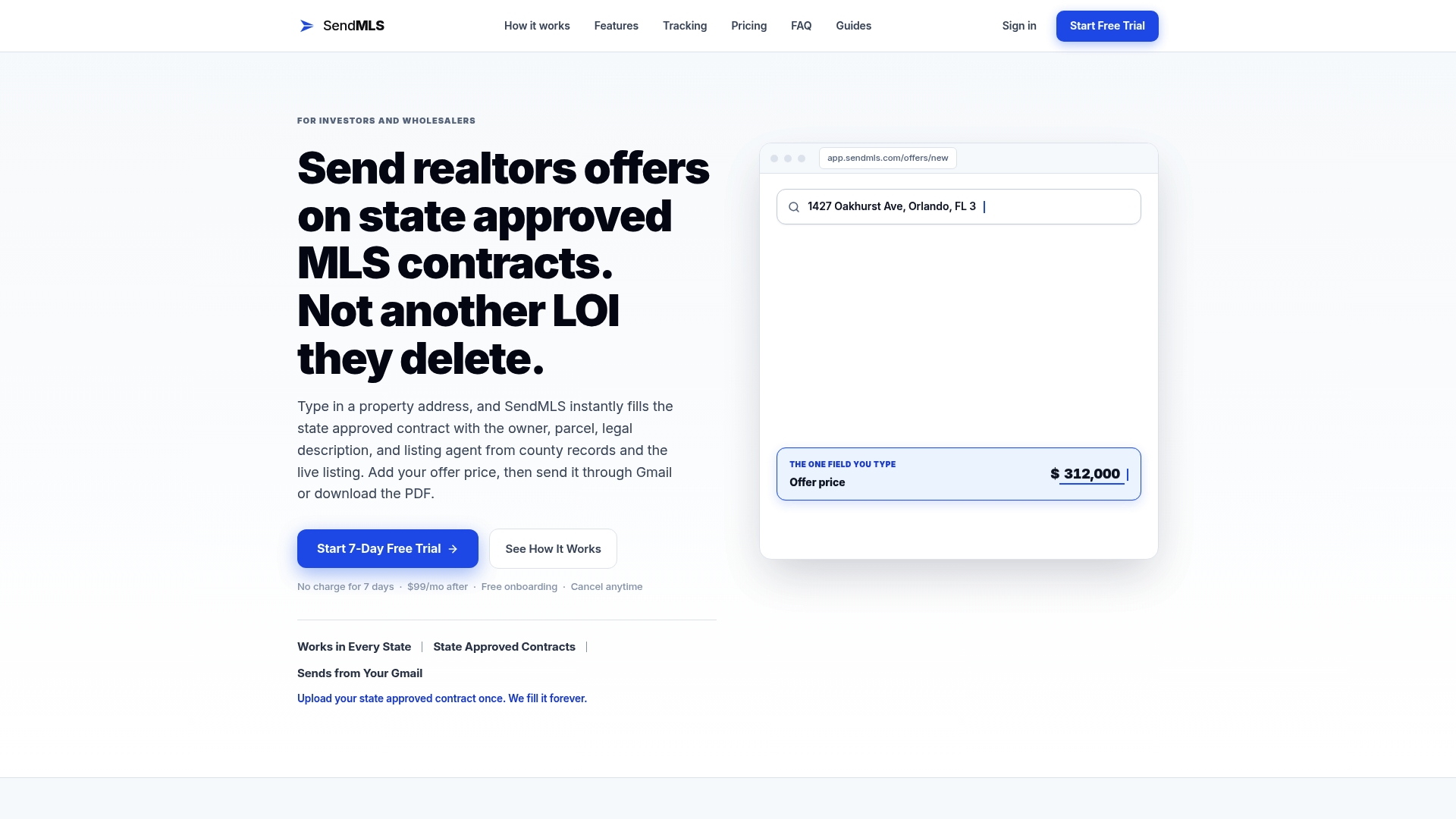
Map your state-approved contract once inside the software, and every offer after that autofills with the owner, parcel, and agent details pulled from public records, with your assignability language and any required disclosure text populated the same way on every submission. Offers send from your own Gmail, so they arrive as real paperwork from a real sender instead of a form letter agents learn to ignore, and open tracking tells you the moment an agent views the offer so you know exactly when to follow up.
- One plan with everything included, at $99 per month, with a 7 day free trial and no setup required.
- Every submitted offer keeps a record of the underlying contract and attachments in one place, ready for escrow or title if an assignment question comes up later.
This is an operational tool for sending and tracking offers, not a substitute for legal advice. For state-specific disclosure requirements or a release and assignment agreement tailored to a particular deal, talk to a real estate attorney licensed in that state. Start your free trial and see how many offers you can get in front of agents this week.
FAQ
Does the seller have to agree to assignment of contract?
Not under the general default rule: contracts are assignable unless the agreement itself restricts assignment, a statute prohibits it, or the deal requires the buyer’s personal performance, according to Cornell’s Wex legal dictionary. Many purchase agreements include “and/or assigns” language specifically so the seller’s consent is not required later.
What happens if there is no assignment clause in a contract?
Without an explicit prohibition, the default rule under U.S. contract law still generally allows assignment, since silence is not the same as a restriction. The safer practice is adding assignability language at the offer stage rather than relying on the default, since some sellers and title companies push back when a contract is silent on the issue.
Who pays the assignment fee in real estate?
The assignee, the new buyer taking over the contract, typically pays the assignment fee to the assignor, usually settled through the closing statement at the time the deal closes. The fee amount and payment timing should be spelled out explicitly in the assignment and assumption agreement to avoid disputes at the closing table.
What is an example of assignment in real estate?
A common example is a wholesaler signing a purchase agreement with “Buyer and/or assigns” named as the buyer, then assigning that contract to a cash buyer for a fee before the scheduled closing date. The assignee then steps into the original buyer’s position and completes the purchase directly with the seller.
Can you assign a lease the same way you assign a purchase agreement?
Lease assignment follows a similar default rule, generally allowed unless the lease restricts it, but most commercial and residential leases include landlord consent requirements that purchase agreements often skip. Reviewing the specific lease language for an assignment or subletting clause is necessary before assuming the same “and/or assigns” logic applies.
Sources
- assignment | Wex | US Law | LII / Legal Information Institute
- Ohio Revised Code § 5301.95
- Maryland HB 0124 (Chapter 508) — residential property wholesaling disclosure