Email Offers Can Bind U.S. Real Estate Senders: 5 Elements Courts Apply
U.S. courts assess five contract elements across an email chain, and a disclaimer may not prevent a deal. Learn when real estate offers can bind.
Email Offers Can Bind U.S. Real Estate Senders: 5 Elements Courts Apply

Yes, an email exchange can create an enforceable contract. U.S. courts look for five elements in the correspondence: offer, acceptance, consideration, intent to be bound, and certainty about material terms. Judges apply an objective test across the whole email chain, and federal and state law already treat electronic records as valid, so a “not binding” disclaimer in a signature block does not automatically save you.
TL;DR:
- For real estate, the Statute of Frauds still requires a written, signed agreement; an email thread must state material terms and identify a signature.
- Courts assess the entire email chain and later conduct, so a typed name, deposit, or inspection scheduling can support acceptance without a formal contract.
- A “subject to contract” disclaimer weighs against binding intent, but later actions contradicting it can overcome that protection, including beginning performance or paying a deposit.
- Real estate rules vary by state, and some jurisdictions expect approved purchase forms even when emails contain the required terms.
- You can generally revoke an offer before acceptance, but a paid option to keep it open may restrict withdrawal during the agreed period.
Table of Contents
- What makes an email chain legally binding: the five elements applied
- The governing rules: E-SIGN, UETA, and the Statute of Frauds
- How courts read email evidence: the objective test in action
- Practical checklist: is your email offer binding?
- Initial offer emails versus later negotiation emails
- State-specific variations in real estate email offers
- Timing and withdrawing an email offer
- Email tracking and read receipts as evidence
- What high-volume offer senders tend to get wrong
- Another option for consistent, trackable offers: SendMLS
- FAQ
- Sources
What makes an email chain legally binding: the five elements applied
Every enforceable contract, whether on paper or in a Gmail thread, needs the same five building blocks. Email just changes how they show up.
An offer is a statement specific enough that the other side could simply say yes and form a deal: “I’ll buy the property at 142 Elm Street for $185,000, closing in 30 days” is an offer. “Would you consider something in the $180,000s?” is an inquiry, not an offer, because it invites more negotiation rather than proposing fixed terms.
Acceptance can be as direct as “We accept your offer” or as indirect as conduct that signals agreement, like scheduling an inspection or wiring a deposit after receiving the terms. Consideration is the value each side gives up: money for property, a promise to perform for a promise to pay. Without it, you have a one-sided statement, not a contract.
Intent to be bound is where most disputes actually live. Courts infer intent from a typed name at the bottom of an email, from a reply that moves straight into logistics, or from a party who starts performing before any formal document is signed. The strongest signal of all is certainty: the price, the property or subject matter, and the parties involved need to be identifiable from the emails themselves. According to legal analysis from Juro, these five elements are standard across U.S. jurisdictions for evaluating whether electronic correspondence formed a contract.
- Offer: specific terms a reasonable person could accept outright, not an open question.
- Acceptance: explicit agreement or conduct that shows assent, such as paying a deposit.
- Consideration: a real exchange of value on both sides.
- Intent to be bound: a typed name, a direct reply, or early performance.
- Certainty: price, parties, and subject matter all identifiable in the thread.
Pro Tip: If you would not want a judge reading your email out loud as the contract, add “for discussion purposes only” before you hit send, not after.
The governing rules: E-SIGN, UETA, and the Statute of Frauds
Electronic correspondence does not get a pass just because it is “only an email.” Under 15 U.S. Code § 7001, known as E-SIGN, a contract or signature cannot be denied legal effect solely because it exists in electronic form. The Uniform Electronic Transactions Act, adopted in some version by most states, mirrors that rule at the state level.
That said, neither law erases the Statute of Frauds, which still requires certain agreements, most notably real estate sales, to be in writing and signed. An email chain can satisfy that writing requirement if it contains the material terms and something courts treat as a signature, such as a typed name or an “/s/” notation. Where it tends to fail is completeness: a model illustration in the Uniform Electronic Transactions Act commentary shows email contracts succeeding when all required terms are present and failing when something like quantity or price is missing.
- E-SIGN and UETA give electronic records and signatures the same legal weight as paper, with some consumer-consent exceptions.
- The Statute of Frauds still requires a writing and signature for real estate and certain other contracts.
- An email satisfies that requirement only if it captures the material terms and an identifiable signature.
- Consumer-facing transactions carry added disclosure rules about consent to electronic records that commercial deals generally do not.
How courts read email evidence: the objective test in action
Courts do not isolate one message. They read the entire exchange, plus what the parties actually did afterward, and ask whether a reasonable person would conclude an agreement existed. That approach, often called the objective test, is described in Practical Law’s analysis of emails as binding agreements, which notes that courts weigh the totality of correspondence and conduct rather than any single line.
In one pattern that tends to favor enforcement, a buyer emails specific price and closing terms, the seller replies “Agreed, let’s move forward,” and the buyer then wires a deposit. The combination of explicit acceptance and real-world performance is hard to argue away. In the opposite pattern, parties exchange friendly emails about a possible deal, never land on a price, and nothing changes hands. Courts routinely find no contract there because a material term never solidified.
- Explicit acceptance language (“I accept,” “agreed,” “let’s proceed”).
- A typed name or electronic signature attached to the key email.
- Deposit payment, scheduling, or other performance that assumes a deal exists.
- All material terms, price, property, and parties, stated somewhere in the thread.
A typed name can serve as a legally sufficient signature, and courts have found that conduct like beginning performance can establish assent even when a formal signed document was still being planned.
Practical checklist: is your email offer binding?
Run any thread you are worried about through this sequence before you assume you are safe, or assume you are stuck.
- Check whether price, property, and parties are all clearly stated somewhere in the thread.
- Look for explicit acceptance language, not just friendly agreement or enthusiasm.
- Note whether a typed name, “/s/,” or similar signature appears on the key messages.
- Check for consideration: did money, property, or a firm promise actually change hands.
- Look for performance, such as a deposit, inspection scheduling, or document signing.
If several of those boxes are checked, treat the thread as a live contract. Preserve the entire chain, stop sending any message that could read as a further admission or concession, and note any performance that already happened, like a wired deposit. When the exposure involves real money or real property, loop in an attorney before you send anything else.
Disclaimers like “subject to contract” create a presumption against being bound, but legal commentary on email contract disputes notes that presumption can be overcome if later conduct contradicts it. A disclaimer you never actually follow does not protect you.
Pro Tip: If you want to keep negotiating without risk, write “for discussion only, no binding offer until a signed purchase agreement” at the top of the email, and then actually behave that way in every reply that follows.
Initial offer emails versus later negotiation emails
The first email in a chain and the fifth one rarely carry the same legal weight. An opening offer email is often deliberately incomplete, a feeler to see if a seller is even interested, and courts are less likely to treat it as binding on its own. As the thread progresses and the parties narrow in on price, closing date, and other specifics, each reply adds more certainty, and with it more risk of forming a contract.

The danger zone is the middle of a negotiation, where one side believes they are still haggling and the other believes a deal has been reached. A seller who replies “That works, let’s do it” to a specific price and closing date has likely accepted an offer, even if a formal purchase agreement has not been signed yet. By contrast, a reply like “I’d need to run that by my partner” keeps the thread in negotiation territory because it withholds assent.
For anyone sending many offers a week, the practical lesson is to treat every reply as a potential acceptance point, not just the first and last messages. A single “sounds good” buried in message four of a long thread can be the moment a court decides the deal was made.
State-specific variations in real estate email offers
Every state has adopted some version of the Statute of Frauds requiring real estate contracts to be in writing and signed, and most have adopted UETA or an equivalent statute recognizing electronic signatures. The baseline rule, electronic records can satisfy a writing requirement, holds across the country.
Where states differ is in the details: what counts as a sufficient electronic signature, whether a real estate purchase contract must use a specific state-approved form, and how local courts weigh informal email language against a later, formal signed agreement. Some states lean on standardized association-approved contract forms as the norm, which makes an email-only exchange look incomplete by comparison even if it technically contains the required terms. Others are more willing to find a binding deal from correspondence alone when the material terms are clear.
Because the baseline writing and signature requirements come from state law, not a single national standard, the safest approach for real estate offers is to assume your state expects a recognizable purchase agreement form, not just an email summary of terms, and to treat early email exchanges as negotiation rather than a finished deal until that form exists.
Timing and withdrawing an email offer
An offer sent by email is generally revocable at any time before the other side accepts it, the same rule that applies to a paper offer. If you email a seller a price and terms on Monday and the seller has not responded by Wednesday, you can typically withdraw or revise that offer with another email, as long as your withdrawal reaches them before any acceptance does.
Timing gets complicated once a deposit or other consideration enters the picture. If you have offered to hold the deal open for a set period, in exchange for something of value, you may have created a separate option contract that limits your ability to withdraw during that window. Silence on the other end is not acceptance, so an unanswered offer does not bind anyone, but a reply that arrives after you have already sent a revocation can create a dispute about which message controls.
For high-volume offer senders, the practical risk is less about revoking one offer and more about losing track of which version of an offer is currently live after several rounds of email back-and-forth. Keeping a clear record of exactly what was sent, and when, matters as much as the legal rule itself.
Email tracking and read receipts as evidence
When a dispute over an email offer reaches court, metadata often becomes part of the record alongside the words themselves. Timestamps, delivery confirmations, and read receipts can help establish that a party actually saw an offer before replying, which matters for the objective test courts apply. Practical Law’s guidance on email agreements notes that such metadata is weighed alongside the substantive language and conduct in the thread, not as a standalone proof of agreement.
Practical attorney commentary on recent disputes points the same way: courts piece together the email content and whatever happened off-email, like deposits or assignments of rights, rather than relying on tracking data alone, according to reporting on casual emails becoming binding contracts. A read receipt showing an agent opened your offer at 9:14 a.m. does not prove they accepted it, but it can undercut a later claim that they never saw your terms.
For anyone sending offers at volume, that evidentiary role cuts both ways. Tracking gives you a factual record of what was sent and received, which helps you know when a thread went quiet versus when it was ignored, but it also means your own open and delivery data could surface in a dispute about timing or notice.

What high-volume offer senders tend to get wrong
Investors and wholesalers who send dozens of offers a week often treat each email as disposable small talk until a formal contract shows up later. That habit is exactly what creates exposure: a quick “sounds good, let’s lock it in” reply can read to a court as acceptance, regardless of what you meant by it.
The fix is not legal caution so much as operational discipline: consistent, state-approved contract language, clear subject lines, and a record of exactly what terms went out and when. Automation makes that consistency easier to maintain, but it does not replace deliberate wording or, when the stakes are high, a lawyer’s review.
— Shane
Another option for consistent, trackable offers: SendMLS
If you are sending offers at volume, the real fix is not writing more careful emails, it is sending fewer ambiguous ones. SendMLS autofills a state-approved real estate purchase contract with the property’s owner, parcel, and agent details, then sends it from your own Gmail account so it lands as real paperwork from a real person, not a typed note an agent can skim past.
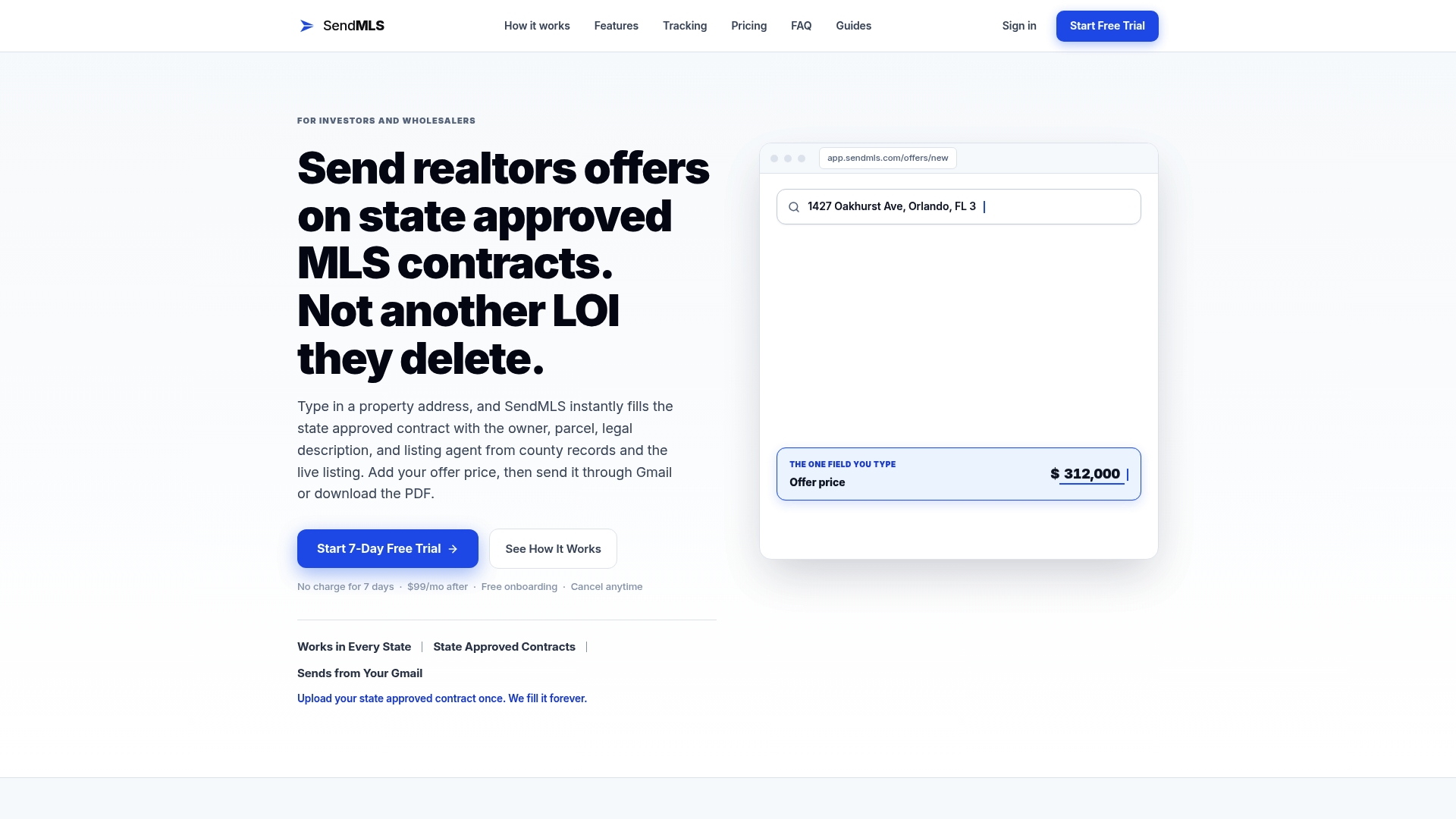
- Autofills a contract template with owner, parcel, and agent details for properties.
- Sends directly from your Gmail account.
- Tracks email opens.
- Organizes submitted offers in one pipeline instead of scattered email threads.
A consistent, auditable offer process removes the guesswork about what was actually proposed and when, which matters as much for your legal footing as it does for your response rate. Readers evaluating the other side of these deals may also want to review contract red flags before signing a cash offer. Start a 7 day free trial and see what a full pipeline of tracked, state-approved offers looks like.
This article is general information, not a substitute for advice from a qualified lawyer. Consult a qualified legal professional about your own circumstances before acting on anything here.
FAQ
Can an email hold up in court?
Yes, an email can hold up in court as evidence of a contract when it contains the material terms, shows acceptance, and reflects intent to be bound, as described in Practical Law’s analysis of email agreements. Courts review the whole chain and any related conduct, not just one isolated message.
Is accepting a job offer by email binding?
An email accepting a job offer can be binding if it contains the key terms, such as role, pay, and start date, and clearly signals acceptance rather than continued negotiation. The same five elements that apply to any contract, offer, acceptance, consideration, intent, and certainty, govern whether that email exchange counts as a final agreement.
What makes an agreement not legally binding?
An agreement typically fails to bind when a material term, like price or the identity of the property or parties, is still unresolved, or when the correspondence shows ongoing negotiation rather than final assent. Disclaimers such as “subject to contract” support a finding of no binding deal, though legal commentary notes that presumption can be overturned if later conduct contradicts it.
What kinds of mistakes can invalidate a contract?
Contracts can be invalidated by mutual mistake, where both parties are wrong about the same key fact, unilateral mistake known to the other side, mistakes about the identity of the other party, and mistakes about the subject matter itself, such as which property is actually being sold. Any of these can undercut the certainty and genuine agreement a valid contract requires.
Do E-SIGN and UETA make every email contract enforceable?
No, E-SIGN and UETA simply prevent a contract from being denied effect solely because it is electronic, as stated in 15 U.S. Code § 7001. The contract still needs the standard elements, offer, acceptance, consideration, intent, and certainty, and real estate deals still need to satisfy the Statute of Frauds writing requirement.
Sources
- Can an email be a legally binding contract? - Juro
- Emails as binding agreements - Practical Law / Westlaw
- 15 U.S. Code § 7001 - Electronic Signatures in Global and National Commerce Act
- Lexology: Can you be bound to a contract as a result of an email?